Showing posts with label teacher leader. Show all posts

Sunday, March 15, 2015

It's OUR Table

How many of us have heard (or said) some variation of the phrase, "We want a seat at the table." Often as educators, we feel excluded from the decisions being made that have a direct impact upon our ability to teach our students in the way that each learner needs. Policy and decisions are made almost daily about students learning by those who often have never been in a classroom or whose experience is a far distant memory. For educators, it's disempowering and frustrating, leaving us wondering about the direction that education is headed when often student learning is not the central focus of these policies. I think I'm like so many of you. I'm passionate about educating students; every student, regardless of the challenges they may face or the support they may need. That's why I became a teacher, not a politician. I wanted to empower students. So, I began asking for a seat at the decision making table in order to speak up for my students.

Then, my thinking shifted. A lightbulb turned on. I was at a professional learning event in panel discussion on Teacher Leadership. Laren Hammonds (@_clayr_) made the statement that as teacher leaders,  we need to have our own table and invite policy makers to join us. As I reflected up this idea, I realized that somewhere in the past, as teachers, we have been giving up our seats to policy makers. As a profession, we bought into the false idea that we are "just teachers" and that elected officials, and those appointed by them, had more importance than us. We gave up our seats (because we'd rather be in our classrooms), decisions were made without us, we grumbled among ourselves and moved on back to teaching our students. The process just continued to escalate, which drove many teachers away from classroom or education altogether. After all, what could we do? They were elected or appointed and we are "only teachers."

As teachers, there are several things that we need to do in order to claim our table and directly impact the policy that can dictate how we reach our students. We need to realize that we are the one in the trenches with students every day. Our voices, and our students' voices, are the ones that are the most relevant. The elected officials and their appointees are there because we put them there. Let's take the time to educate them about what student learning looks like in 2015. We can send them emails and letters [even in 2015 handwritten makes the most impact] with stories of student learning. Invite them to our classrooms and large learning events. Connect with them through social media by posting photos of the phenomenal learning taking place in our classrooms every day.  If they are not willing to listen to us, then we need to elect officials who will support student learning. The mentality that we are "just a teacher" or "only a teacher" must die within all of us.

We also must realize that while a one-time email, letter, or conversation may lay a foundation, we  need to develop a relationship with policy makers. The repeat contact and follow-up solidifies you as an expert in the education field. Inviting them to join in education conversations held in OUR classrooms and schools at OUR table reshapes their thinking and puts student learning at the forefront of their thinking. In the fours years that I have been advocating for student learning, I have never had a policy maker, committee, or council ever ask me to leave. They may not have joined OUR table, but that doesn't mean that we stop extending the invitation. After all, this is OUR dinner party. We want for them to join the conversation because all of OUR futures are at stake. Leaners are our future's most precious commodity. And without these conversations, we are doing a great disservice to ourselves and future generations.

So let's send out invitations, pull out a chair, and have a seat. It's time we start facilitating these conversation and decisions based on what's best for our learners. The students of today and tomorrow are depending up on us.

Saturday, February 28, 2015

Dear Conference Organizer

My name is Julie. I am a classroom teacher who teaches ELA to amazing sixth graders at Rock Quarry Middle School in Tuscaloosa, Alabama. In case you're wondering, yes, that's a pubic school with a very diverse population. I believe that growing professionally is a key component in sharpening my teaching practice and providing my students with the best possible learning opportunities. One of the strongest ways I have found to improve is by attending conferences both big and small. However, over the last couple of years, I have noticed a growing trend in major conferences which I (as a practicing classroom teacher) find disturbing.

The most powerful learning, and subsequent growth, I have had has come from two sources, my students and other classroom teachers. For years I have believed that there was a voice missing from these conferences...the voice of students. We are growing, learning, and connecting with one another at these professional learning events in order to become better for our students. Has anyone ever stopped and wondered why we aren't including students in the conversations at these events? I'm not talking about having a student group perform or do introductions of major speakers (which I do enjoy), but actually share their ideas, ask questions, and answer our questions. At these conferences, all of our professional learning should focused on them as we reshape our thinking and evolve our practice. Yet I believe that when we exclude them from the actual conversation, we are unintentionally forcing our beliefs on them instead of using their feedback, coupled with our knowledge of sound education practice as the perfect marriage to facilitate the best learning opportunities for them.

Over the years, I have heard many claim that students aren't savvy or educated enough to join these conversations. I strongly disagree with this premise. For over twelve years, my students have presented at conferences and (recently) at Edcamps. They have conducted webinars, Skyped, and created resources for faculties all over the world. They WANT to have a voice. They NEED to have a voice. Education isn't something that should be done to them. I hear many educators talking about how we as educators want a seat at the table. What I believe so many of us are missing is that the table actually belongs to our students....and we are relegating them to "kids table" away from the "adult' conversation. If we truly want to stay relevant in today's fast -paced world, we must learn along side our students and to acknowledge that their voice has value to our learning.

Another crucial component of my professional growth is learning from my colleagues. As a classroom teacher, I want to learn from other classroom teachers. I want to gain the benefit of their experience, both formally in sessions and informally through conversations. I know there is something to be said for providing conference participants inspiration from celebrities. Henry Winkler's story of his struggle with learning disabilities helped me to re-evaluate how I was providing support and encouragement to my struggling readers and writers. However, as a veteran teacher who is a lifelong learner, I find it a bit insulting to have a celebrity (who is not an educator) tell classroom teachers how we should be teaching our students. Conference Organizers, I don't know if you believe that those big names bring status to your organization or there is a reason that I am missing, but as an avid conference participant, I rarely leave those sessions (no matter how entertaining) with anything of value that I can take back to my students. [An example done right: AMLE did a fantastic job of having keynotes who were practicing educators who not only inspired and entertained but delivered fantastic practical applications we could take back to our schools.]

Also, in these conference communities you usually see session spotlights on consultants, non-profit groups, and one-time educational events that are not replicable in other places. There is a place for these at conferences, but not to the detriment of teachers. When it's hard to find sessions on your schedule led by classroom practitioners, your opinion of classroom teachers is broadcast load and clear. I can't help but wonder if this is part of the reason why teachers tend to put the word "just" in front of teacher when describing themselves. When classroom teachers aren't spotlighted, showcased, or promoted, it may inadvertently be sending the message that classroom teachers who (often on their own dime) travel far distances to share their students' stories. They have direct contact with students every single day. They know what works, what doesn't, and how to overcome obstacles. For those of us in the trenches with them, that is the true reason why we are taking precious time away from our own students and spending our own money to travel to your event.

I have to lead my students by example. I know that someone needs to speak up or nothing will ever change...and today is my day to speak up. I realize that I am opening myself up for debate and criticism, but I hope that it prompts some introspection and thought for the future. If anyone would like to discuss this further, I am open to new ideas, dialogues, and perspectives.

Yours truly,
Julie
A classroom teacher

P.S. I am not writing about one specific conference, but trends that I have seen emerging. As someone who has organized many professional learning events, I truly value the hard work it takes to plan and implement these huge events that provide teachers a place to meet, connect, and build relationships. Thanks for all that you do.

Wednesday, June 25, 2014

"I Have Nothing to Say"

Have you ever thought, "I have nothing to say in the world of education?" I often hear educators make claims that they have nothing to share with their colleagues, locally or globally. They point to their perceived weaknesses, shrug their shoulders and move on. They turn down opportunities to fulfill leadership responsibilities, let opportunities to share their experience formally or informally pass by, or they remain quiet in online discussions lurking and learning rather than joining and participating.

In the interest of transparency, I must admit that I have had moments where I felt like I had nothing left to share with others. In my mind, I made very similar excuses. I've sat in front of a blank screen wondering what I could impart that would have any impact or relevance to others. I've had requests to do all day workshops and I was at a loss as to what I could present that would enrich the lives of the students of the educators that would spend a day with me. What if I have nothing to say?

We all have moments of self-doubt. I have come to the conclusion that is absolutely okay. What is not okay is giving in to those doubts, remaining silent, denying other educators of your unique perspective and experience. So I thought I would address some of the most common excuses we may give ourselves that prevents us from sharing and connecting with others.

1- "Others know more than me." While that may be true, they are not YOU. As we all recognize that our students are unique, so are each of us. Although there may be a world-renowned author/speaker/educator out there who has a massive following, that has no bearing on what you have to share. You have different perspectives and experiences. He/she is not in your classroom every day with your students. Chances are they haven't read many of the same articles, Twitter chats, research, or books that you have. And even if they have, you are looking at it with a different lens; one that frames into within the context of what you do each and every day.

This is the same as saying, "I don't know enough." Would any of us accept this excuse from one of our students? I hope not. My students become adept at adding "yet" to the end of statements like this. It sets the lack of proficiency as a goal to strive to learn more, reach higher, and grow personally. One thing that I learned quickly was that not every teacher is teaching at the same level. Like our students, teachers are each at different places on their learning continuum.  I've been in sessions at conferences where one group of teachers walked out completely overwhelmed and confused, while others claimed that they were bored because there wasn't anything new shared. This was in the same presentation. No matter where you are in your journey, whether you are talking about differentiation, questioning techniques, reading strategies, writing practices, assessment, or digital literacy, there are individuals who need to benefit from your expertise. They may have been overwhelmed or underwhelmed with someone else because they weren't being fed what they needed. Continue to learn so that you can fulfill that need in others.

2- "I could never be as good as ______." Here's something to think about: Education is NOT a competition. We are all striving to provide our students with the best education possible. It's okay if you are presenting at a conference and the room across from yours is packed while you only have a handful of people. That does not mean that what you are sharing isn't worthwhile. Our responsibility is to share our experiences with others in a hope that  they can not only benefit in their own practice, but also their students can reap the reward.

Personally, I've had educators compare me to others who are more of a "rock star." Without a doubt I came up lacking. How did I handle it? After much reflecting, I realized that I am full-time teacher who shares my experiences with others. What I'm sharing is what really works with students...it's not some theory by someone who has only read/heard about it from another party. I know it's relevant and meaningful because my students are the evidence. When I speak, I share their stories. For me, that speak volumes that a disconnected researcher can never touch. Our intention should never be to become a "rock star." Our intention should be to give back to the educational community that has given us so much over the years. As educators it is our obligation to share what we know...whatever that may be.

3- "No one will listen." Would we permit our students to enter something with a defeatists attitude? Then why do we allow it to get in our way of sharing with others? If we blog, tweet, post, or pin things that are value to us, I guarantee that there is someone out there looking for what you are sharing. If one person benefits, isn't it worthwhile? Sometimes it about having the right frame of mind when we share. If we are looking for the number of reads, likes, or retweets, we might be disappointed. However, is that why we write or share? I know that I write to reflect on my own experiences: what goes well, what doesn't, and how to improve. That transparency is what connects others to you. I share because I know that others have done so before me and I want to pay it forward.

We need to remember that someone out there is counting on each of us. They are searching for answers, support, and encouragement that only you may be able to provide. Speak up. Share your voice. Inspire others. It can make all the difference in the world.

Saturday, April 5, 2014

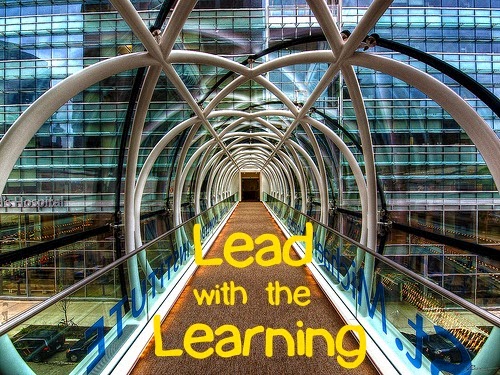
Lead with the Learning

In the last month, I have met with legislators and policy makers in both D.C. and Montgomery, Alabama. I have spent much time in reflection on what we as educators can do to make a difference for our students (See Can One Person Make a Difference?) In all the (mostly) ups and (rather few) downs, I have emerged with one thought that was shared by State Superintendent, Dr. Tommy Bice: Always lead with the learning. He shared this in the context of speaking with non-educators, policy makers, and legislators, but I believe that this phrase has much greater ramifications on the mission and vision of an educator.

As educators, all decisions that we make must always be focused on positively impacting student learning whether we are discussing instructional practice, professional development, or logistical planning within a school or district. Everything needs to be focused on student learning.

It is human nature to become creatures of habit. We find a lesson, strategy, or management technique that works and we tend to stick with it for years even when it proves unproductive. Many times we want to make a square peg into an ever-shrinking round whole. What we really need to do is pause and evaluate if that practice is not only effective, but also supports students in their academic and personal goals. Are we leading with the learning?

My intern (who has been doing a fantastic job) often asked me how to adjust her management techniques to support certain students. I asked her to explain her rationale behind the choices she had been making. Once she reflected on it, she realized that she was simply imitating something she had observed rather than thinking about how her choices would impact student learning. I recommended she speak with the students to see what they suggested. What she discovered was that students knew what would help hold them accountable for making good choices and getting the most learning out of each of the opportunities that she provided. She began leading with the learning.

In our PLG meetings, are we making choices about our practice based on what's easiest for us or best for student learning? Taking the time to plan hands-on, cross-curricular activities or experiential learning experiences off campus or supporting student-created and driven learning activities all take time, planning, and resources. But, are we making decisions based on the learning or some less important factors. We must always lead with the learning at the forefront of all decision making processes.

In my aforementioned post, I wondered if I was accurately teaching my students that one voice can make a difference. To the best of my abilities, I try to lead by example. Following Dr. Bice's advice, I try to always lead with the learning when speaking with our policy makers and legislators. This week, I was fortunate to see a how leading with the learning intrigued legislators we spoke with last year. Several of these legislators had spent time seeking out the National Board Certified Teachers in their districts. They spoke with these teachers and visited their classrooms. They were able to see how accomplished teachers lead with the learning and the positive impact it truly has on each individual student's learning. These legislators have embraced the powerful learning that is possible and they have been actively seeking new ways to support it within their districts.

Lead with the learning is a mantra that educators can embrace in all aspects of their professions; one that can greatly impact not only the students directly in one's classroom, but have far reaching ramifications. So next time we each have a choice to make, whether big or small, let's take a moment to ask ourselves, are we leading with learning? If not, maybe it's time to stop forcing that square peg to fit that round hole and step out of our comfort zones and try something new.


photo credit: paul bica via photopin cc

Wednesday, June 19, 2013

Living Out Loud

I recently had the opportunity to hear Kevin Honeycutt deliver the Opening Keynote for AETC2013. If you have never heard him speak, I highly recommend that you look him up on YouTube. He tells heartwarming, poignant stories which leave you laughing until your sides hurt or tearing up because they hit so close to home. While he spoke, I sent out this tweet:


This idea of sharing our stories has really stuck with me over the last several days. Stories...we all have them. How many times have we reminisced about how we should write all of these stories down? Teachers have stories of student successes, challenges, heartbreak, and triumph. With our lives in the classroon, we are walking anthologies of the lives we have have touched or been touched by. But, how many of us are sharing these stories? Are we taking the time to show the impact that our teaching brings to the lives of our students every day? Or, are we allowing someone else to author our lives...someone who is not living our life; someone who is so far detached they could not cipher all of the clues upon which we pick up from our students every single day; someone who is creating a work of fiction instead of a collection of memoirs.

The idea of "living out loud" came to mind when a couple of news stories were released this week and (per usual) "experts" weighed in on the ills of today's schools. How many teachers were asked their perspective? How many of our stories were being shared? None! I've heard many teachers bemoan that they don't have something important to offer to an already inundated information age. I strongly disagree. If we don't start sharing our students' stories, who will? Those "experts?" If that is the case, who will become the victims of these fictional tales? Our students.

So as we take some time this summer to reflect and begin making plans for the upcoming school year, devote some time to document and share some of these stories. We live in a time where there is a host of media where we can amplify these unforgettable stories. Tweet about them. Photograph them. Write a blog about them. Video them. Curate them into one easily "shareable" location. These collections become a living testimony of what our students are accomplishing, many against great odds. Reach out and connect with other educators and spend some time swapping stories.  We are teachers and it's time for us to share our stories and live out loud.

Tuesday, April 2, 2013

Top Seven "Forget-Me-Not" Presentation Practices

The busy spring time is upon us and for some of us, it will carry us into an even busier summer. One thing that I love is the opportunity to travel to speak and facilitate training all over the U.S. I thoroughly love the opportunity to meet and learn from other passionate and dedicated educators. Even though I do present, I try to take the time to continue by professional growth as well. I attend a lot of sessions. Every one of the presenters is knowledgeable on their topic, but sometimes it does not translate well to an audience. In Pay It Forward: 5.1 Ways to Share Your Expertise, I mentioned ways that we can guide our colleagues into sharing their teaching successes and experiences. Not one of us can claim to be where we are as educators without the assistance of others; it is important to give back to the educational community. Once teachers begin to feel comfortable sharing their best practices, the next progression is to present at a conference. The teacher who had asked for my advice in the previous post asked for some tips in creating an engaging presentation. Here are my top seven "forget-me-not" presentation practices.
  1. Set the tone of your presentation. People walk in wondering if they are in the right place and whether or not this is going to be beneficial or not. Music does a good job of setting the tone when people arrive. Also, add humor to your presentation. I am not saying that you should be a stand-up comedian because that sends the message of "I am silly and what I am saying is not all that important." However, when you add humor to the beginning and people get a chuckle, their brains release endorphines that help them connect with you and become engaged in what you are saying.
  2. Streamline your presentation. Slides with too many words or images takes the focus off of what you are saying. If someone cannot easily read or see what you have on a slide from the back of a ballroom, do not include it. The slide/image is there to support what you are saying. It is giving the attendees a visual or a graphic that will help your message stick in their brains.
  3. Be prepared. Time is one of our most valuable commodities. How many of us have sat through "death by PowerPoint" presentations where the presenter read off of the screen? How much did you learn or remember about what they said? If you are going to speak, prepare a presentation where your expertise is the focus. You are the expert. Practice your presentation and prepare for tech malfunctions. Could you do your presentation without your slides?  If not, then you are not prepared enough to speak as an expert. Here's what works for me: I have a pretty good memory, but I am not memorizing a script....especially for those 6 hour workshops. My presentations have graphics. With each graphic, I learn key phrases that I want to say within the point. Practice makes it flow easily for me when I am in front of an audience.
  4. Provide resources. Everyone wants to leave with something, but let's be honest about handouts. We get a paper handout, it goes home in our conference bag, and then it sits in the hall closet until we get rid of it a couple of years later. We live in a digital world so we need to provide our attendees with access to resources digitally. There are so many ways to share information in our world...blogs, websites, DropBox, Evernote, wikis, Facebook, etc. Most people now attend with a smart phone, laptop, or tablet. You can give them instant access to your resources and save them from lugging around the paper version. 
  5. Accurately name your session. We have all attended sessions based on their title and then come to realize that the session was nothing like what the title indicated. You want the people in your session to know what you are going to present about so that you have the right audience for your message. Don't worry if there are only a couple of people there. Those are the people who need to hear your expertise. If one person walks away with something that makes them a better educator, your presentation was a success.
  6. Listen and engage participants. As teachers we know that one of the least effective teaching strategies is straight lecture. Yet, you see educators doing this in presentations. The active participation strategies that work in your classroom with students will work those in attendance at your session. Facilitate conversations in your sessions, get them actively engaged, and remember it is about THEIR learning. Your goal needs to be to let them learn from your experiences. We know that the brain learns best when it is active in a fun and relevant manner. Don't forget to add that into your session.
  7. P.S. They're looking at you. You are there to share your expertise with other educators. Although we have always heard that we "don't judge a book by its cover," let's face it, we do. When people first see you, they are going to make a judgment about your ability to lead professional learning. Flip flops and vendor T-shirts do not instill a lot of confidence in your professional credibility. They want to know that they are not wasting their time by staying in your session. If they walk in and you look like your going to the ballpark or making a quick run to the grocery store, they are less likely to stay or open their mind to learning what you are sharing. (see Because Books are Sometimes Judged by Their Covers by Amanda Dykes).
These are my suggestions to those new to presenting at conferences. I would love to hear what your suggestions are about what makes a session a great professional learning experience.

Sunday, February 10, 2013

Pay It Forward: 5.1 Ways to Share Your Expertise

As we are beginning a new year, I have seen many posts, Tweets, and blogs about people paying it forward to individuals they do not know personally. In a world that is often driven with negative news, it is heart-warming to see people reaching out and helping others. It has gotten my mind to thinking about us as educators. We spend our days giving our best to our students, but often we keep what is happening behind the closed doors of our classroom.

I recently engaged in a conversation with another teacher at my school. She hesitantly shared an after-school program that she had started two years ago. She explained how she saw that her students needed some extra tutoring in academic subjects, but they could not afford to hire tutors. She also recognized that many of them lived in single-parent homes where the parents worked multiple jobs. This limited the types of extra activities that they could provide for their own children. To address those needs, this teacher began an after-school program on Friday afternoons where the students could stay after school for an hour for some additional help in academics. Then, the second hour each Friday, this teacher had arranged different community leaders to come in and do activities with the students. This has made a huge impact on her students, their families, and built a strong line of support from the community.

This amazing program was going on in the same school where I teach and I had no idea! When I encouraged her to share her experiences, she told me that she did not think it really counted as an important enough idea to share. That's when I realized how important it is for us to find these hidden gems that are lurking behind closed doors and encourage these teachers to share their ideas. She told me she had no idea where to begin so I shared with her a few of my suggestions.

Here are my suggestions for those just beginning to share their expertise:

  1. Share informally with co-workers. Because she was so reticent about even talking to me one-on-one, I knew suggesting that she speak at a conference was an unreasonable idea right now. I suggested that she begin sharing her program with her grade-level co-workers. She has some really open-minded co-workers who I am sure would be interested in joining her program and helping it to grow.
  2. Celebrate success at a formal meeting. In our weekly faculty meetings, occasionally, we are asked to share successes. This is an open opportunity to share a quick piece of what is going on behind classroom doors. This allows teachers in other grade levels and content areas to know what you are doing. Chances are they will have a contact that would like to participate or support a new and innovative idea.
  3. Speak up at training session or presentation. The best sessions are the ones where there is audience participation and much discussion. This is a way to build more support for that new idea. You never know who is in that room who can help you sharpen your ideas or challenge to reflect on how you could make it more impactful for your students and your school. It also increases your level of expertise in this area and build further support for your project.
  4. Volunteer to have others visit your classroom to see your expertise at work. Sometimes people are hesitant to try a new idea, program, lesson, tool or strategy until they see it at work. If you are the one they are visiting, it is really not any more work on you. You are not putting on a show, but letting them see your idea in action. Let them observe, get involved, and ask questions. They are not there to criticize you (they were interested enough to come for a visit), but to learn from your expertise.
  5. Begin blogging. This is an excellent way to share what is going on in your classroom and it gives you a global audience. All of the educators that I have encountered through blogging have challenged my thinking and helped me become a much stronger educator. It helps you clarify your thinking and make tweaks to your ideas. By gaining a much larger audience, you are also broadening your horizons and influencing others by your experiences.
    • 5.1 Tweet on Twitter. This microblogging site allows you to connect with other educators and have on-going professional conversations all within 140 characters per tweet. Like with blogging, you have the ability not only to share your expertise, but also learn from some of the best educators from around the world. Not sure where to begin? Here's a post I wrote Why Should I Tweet on Twitter?
As is often quoted from an unknown source, "The hardest part of any journey is taking that first step." That's what I hope I have been able to do for my colleagues as well as some of you and your colleagues...encourage people to take that first step and pay back what so many have given to us in our quest to become the strongest educator possible.

photo credit: sidewalk flying via photopin cc