Tuesday, July 17, 2012

Wild Jungle Brains...How to Tame the Beasts

Yes, that's right..my brain is a wild jungle full off all kinds of gibberish. I'm on overload right now. I know it's the summer, but I have been going at a frenzied pace speaking, researching, tweeting,  reading, writing, learning, blogging, planning because the summer is the time I can really dig into new ideas. I have the time to read. I spend more time on Twitter and reading other people's blogs. I meet smart educators at all of the conferences where I travel to speak. All of this brings amazing epiphanies and new plans for next year.

BUT...I find myself struggling now to focus on one thing. As I sit here typing on my antiquated desktop (my laptop decided to go on permanent vacation this summer), I found I needed some quiet time for my brain to slowly begin to formulate some clear thoughts. I needed to find some takeaways from all this PD I've been shamelessly partaking in for several weeks now.

That is when this occurred to me...maybe in the rush to meet all the standards, pacing guides, and mandates and still provide our students with the hands-on, student-directed learning they crave, we bombard our students with so much stimulation that they struggle to actually form one clear and concise thought or sentence. More is not actually better.

We have no idea what is already going on in their heads. They already have a jumble of thoughts before they walk into our classroom. We need to make sure that we are making purposeful choices in what we bring into our classroom, whether it's a hands-on activity or a new tech tool. We need to ask: Is this the most powerful opportunity to support my students' learning or is it a fun activity that kind of relates to the topic at hand?

We are the content specialists and strategists in the classroom. It is our responsibility to provide our students with the BEST support that we can. We aren't doing them any favors by bombarding them with a lot of mediocre projects/stations/tools/activities that will cloud their minds from what is most important...their learning. They need the time to formulate ideas, plan projects, reflect on their progress, and set their own learning goals. By providing them the support and time that they need, we can tame those overstimulated brains and help them find their own paths to success.

Thursday, July 12, 2012

Questions and Answers

As I was presenting my sessions at SDE's National Conference on Differentiated Instruction, several questions arose that I feel like deserve more attention. One thing that I always try to remember is that my perspective is different than many other teachers. Many teachers that attend my presentations and workshops are great teachers, but some haven't made the shift from teacher-driven to student-directed learning. Others want to make that shift, but they don't know how to go about making that a reality; they aren't able to "see" what it looks like in a real honest to goodness classroom.

I know, from my own experience, that it can be a scary proposition to let go of that [illusion of] control; when we are in front of the classroom, we feel like master and commander of our classroom.But the question that I challenge everyone who spends a majority of their time in front of their students disseminating information is: How do you know what each student is grasping while you are leading the instruction?

Does a traditional test measure everything that a learner can learn in a certain subject? Does a right answer necessarily indicate understanding any more than a incorrect answer indicates a lack if understanding? It is crucial for us to each consider the answers to these questions about our own practice. Without taking the time to evaluate and reflect on our own practice, we become irrelevant for our students. We must do what is best for them and their needs and not what is best [or easiest] for us.

Here are some of the queries that were posed to me this week as teachers were trying to "see" how they could make student-directed learning work for them:


1. Are these collaborative projects graded? Yes, a majority of these projects are graded. In my classroom, when we engage in a writing/publishing project, my students brainstorm their ideas of what the final outcome will be. As they begin to formulate an idea, a discussion ensues about what should be included. They decide the purpose, the audience, the tone, the type of writing that will best support the project, the content should be included. As they are discussing this, I'm asking them probing questions, having them justify their choices. They need to understand that the decisions they make should be substantive. 


Learning is the ultimate goal. In these discussions, the learners are designing a basic rubric that will guide them and ultimately assess them. They designed it, not me. What do you notice is missing? There is not one mention of the tool that the students will use for their final product. Learners need to understand that the ultimate goal is learning. Technology is just the tool to get them to their ultimate goal. 


2. If students aren't assigned a specific tool to use, how do they know what tool will support their project? Most of my students come to me with very limited experience using digital tools. Their previous school experience is mostly "drill and kill" games. So, this is how I do it. The first week of school we do not have any of our "extras" classes. That gives me additional time in the school day to do some additional activities. 


One activity in which my students engage is an online scavenger hunt. They work in partners and search all of our class' digital resources and tools that they will find useful throughout the year. In additional to our class website, wikis, and blog, they also search the projects that previous students have published. They are searching for specific information while experiencing a host of different digital options. This gives them a general idea of the types of things that are possible. Do they necessarily know the names of all the tools? No, but they begin to get an idea of what is possible when it comes to publishing. 


3. How do you find the time to teach the different tech tools that your students are going to use to publish their work? Since the lack of time is usually our biggest challenge, my students have found several ways to squeeze in more learning time. Many of my students arrive via bus an hour before school begins. When I arrive at school, I invite my students to come to our classroom to work. During this time, I can pull a small group and show them the basics of how a tool works. This is usually a 10 minute or less lesson to several students who a now the class experts. 


Many of my students are so excited to begin publishing their work, they don't want to wait until the next morning so they begin exploring a tool on their own. They explore, troubleshoot and depend on their peers if they get stuck. They enjoy becoming independent and working together to problem solve. They depend upon one another. In reality,very little class time is actually spent on the tech tool side of the projects. The focus is always on the learning. 

Thanks to all of you for your participation, comments, questions, and challenges this week. I appreciate all if the hardworking that you put into becoming the best teacher that you can be for your students. If you have any more questions, you know how to reach me. I'm only a blog, tweet, Facebook post, or email away.

Monday, July 2, 2012

ISTE: Changing Lives Forever

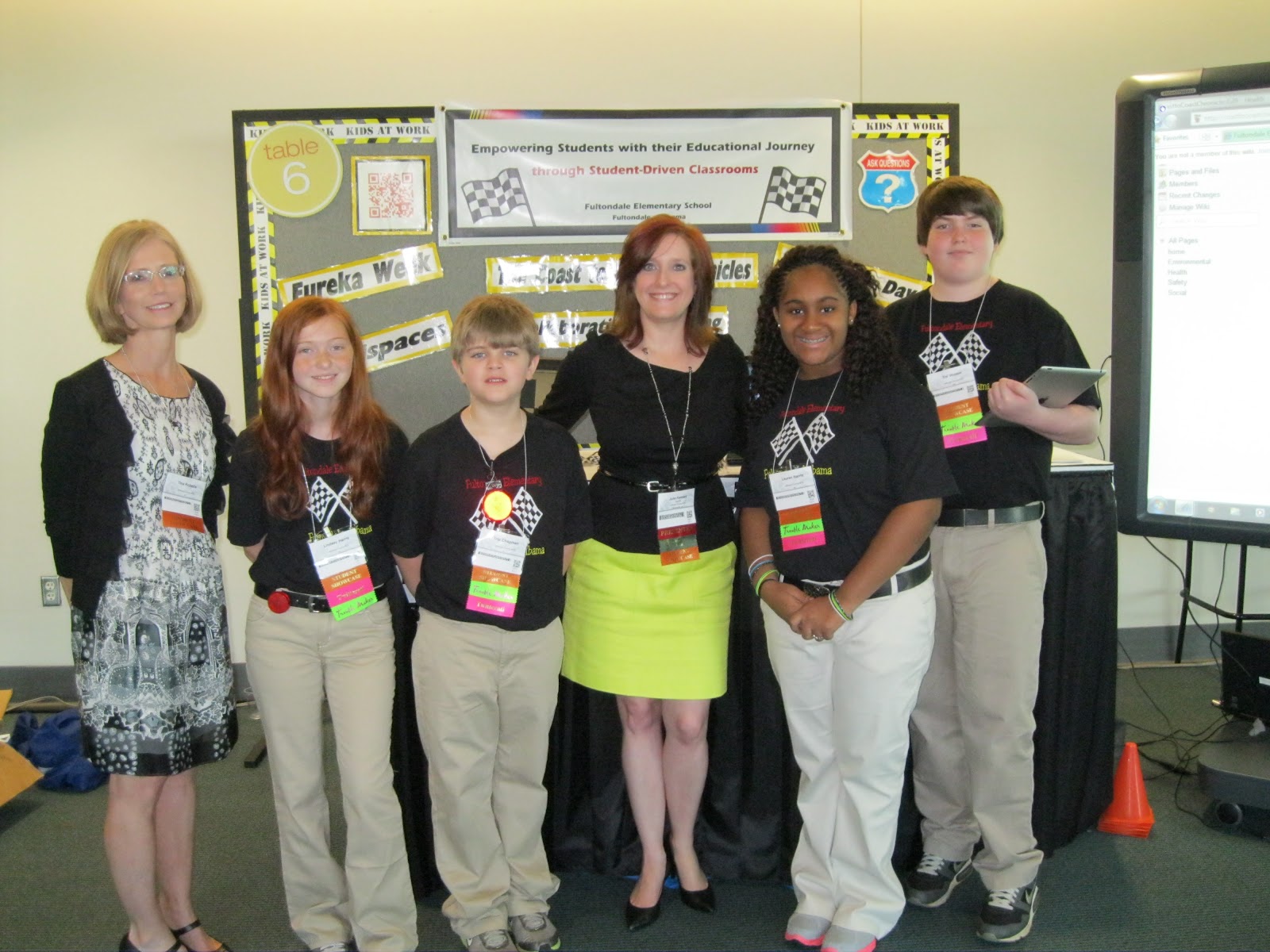
I've just returned home from my eleventh ISTE. My experience at ISTE is probably much different than most of the other 20,000+ people who attend because, for the last ten years, I have attended with my ten and eleven year old students. They have been invited to present a Student Showcase. I get the rare opportunity to see the wonderful, hectic, sometimes chaotic learning machine that is ISTE through the eyes of my students. I get to see what their perceptions are of other educators' opinion on what should be going on in today's classroom. Surprisingly enough, they are extremely tuned into what is worthwhile and what is pure "fluff." Each year, my students choose to spend less and less time in the exhibit hall and hotel pool and more and more time in formal sessions and speaking to people informally between sessions, on the conference bus, and impromptu networking sessions. They speak passionately about their learning and the technology that supports it.If you are willing to listen and converse with them (you'd probably be shocked by how many attendees don't and are downright rude to them) you will see that they have very powerful voices...each distinct one from the other.

As I'm reflecting on this year's experience, I have one even that keeping circling back to the front of my mind. I want to share that story with you here.

If you attended my students' presentation, you know that it is 100% their work. They prepare what they are going to say to attendees, they've designed the take-home souvenir (instead of a hand-out), and they've designed the display. Of course, everything that they are sharing is also 100% created and published by them as well. We usually get a very good crowd that visits us and the kids don't get to come up for air for over two hours.

This year, I had one student with me that we'll call Trent. Trent is a quiet guy with a great sense of humor. Through our student-directed classroom, he has become an extremely strong leader often setting aside his work momentarily to help a peer in need. He encourages others when they feel like success is out of their grasp. He is an amazing individual who doesn't pull any punches when you want the truth.

Each of my students simultaneously run their own little presentation with groups of educators throughout our allotted time. We really need one computer per student, but we weren't able to travel with that many computers this year. Trent asked if he could use our iPad,"I know it won't show many of the awesome projects that we did, but I know I can explain it well enough that they will get a good idea of what I'm talking about.That way everyone else can keep using the laptops." Pretty selfless for an eleven year old, huh?

As my students present I stand back, field any questions they feel they can't answer fully and provide any support that they need. They've told me that if I stand too close it makes them nervous...so I keep a small distance. I could overhear Trent speaking with a small group and doing a beautiful job. They had so many questions that he was able to field effortlessly. That small group dwindled down to one teacher. She continued to pepper him with questions and take notes furiously. Trent took his time to explain all the tools, helped her write down steps, and even helped her spell out the tool's name if she asked.

She thanked him after about thirty minutes and went on her way smiling. Trent looked up at me with a huge grin, "Mrs. Ramsay, I just changed that woman's life forever. She'll never teach the same again. And isn't that what all of this is all about anyway?" Before I could answer, he turned and started his next presentation with another group who had just walked up.

WOW! Trent understands the importance of going to a conference; he knows it's not just about getting, but about giving back; it's about sharing a piece of yourself. It really is about changing lives forever.

As educators it is so important that we take the time to let our students have these experiences. They need to share what they are learning with others of all ages and geographic locations. They need to know that what they are doing can positively impact more than just themselves. They need the opportunity to share their perspective in the field of education and beyond. As I've said many times, they are the reason we are constantly learning and growing. Let's not underestimate our learners, but give them the opportunities to change people's lives forever.


Monday, June 18, 2012

What Motivates Students Today?

Do you ever have the feeling that although you are speaking up, somehow your voice isn't heard? Those of you who follow my blog know that one of the issues close to my heart is the power of student-driven learning (see In Defense of Student-Directed Learning). I've attended several conferences and workshops lately where when I made a comment about putting the power of learning into our students' hands; people looked at me like I had three heads (could you imagine the hair styling time for three heads?). That's not going to change what I know to be true. Students want to learn, but what motivates them is not extrinsic rewards. It is our job to guide them in pursuing how they learn, what they learn, and how they share their learning with the world while not just mastering standards, but far exceeding them.

Enter Alan November, the keynote speaker for the Alabama Educational Technology Conference. This man has been providing students with the opportunity to apply what they are learning to solve real-world problems since the mid-1980's. His students find a need and they design a solution. His TED talk is very close to what his keynote was. He shared student ' stories that illustrated that what students really want is purpose, authenticity, a global voice, and time for mastery.


Throughout his keynote, I found myself wanting to stand and cheer. Here is a man who had his students living this over twenty years ago....it's nothing new. The stories he shared inspired me to try new things, really let my 5th graders have more freedom. I hope that you enjoy his talk as much as I did and I'd love to hear your thoughts on student-directed learning. And if you are in San Diego next week attending ISTE12, be sure to come by and hear my students tell you all about the power of student-directed learning.


 photo credit: . Entrer dans le rĂªve via photo pin cc

Friday, June 8, 2012

Professional Development: One Size Does Not Fit All

For many of us, one of the busiest times of the year is upon us.Yes, it's summer, but for most educators that means a summer filled with a myriad of opportunities to learn and connect with others. I have colleagues who think I'm crazy to spend my summer travelling to speak at a host of conferences. I had one teacher say to me, "I'm professionally developed enough. I've been teaching for 22 years. I think I know what I'm doing." I didn't quite know how to respond to her comment in that moment, but as I've had time to reflect, I think she embodies the perception that many teachers have. They have been forced to go through some workshop or training regardless of whether they need it or not. They view it as something they have to suffer through so that they can get back to what they want to do with their students in the classrooms.

Perhaps the problem isn't these mandatory training sessions, but the fact that many have lost sight that each teacher is an individual with a different background of experiences, different interests, and different talents. These need to be taken into consideration when pursuing professional growth. Aren't these the qualities that we seek out in our students so that we can best meet their needs?

People seem surprised by how many sessions I attend at the conferences where I present. I'm often asked how I choose which sessions to attend when there are so many from which to choose. Here are some of the factors that I take into consideration when selecting professional development for myself.

In what area do I need to grow professionally? My natural inclination is to gravitate towards presentations that include technology, differentiated instruction, or literacy. However, those are the areas that I present on myself. Is that what I really need? Although I do attend some of these sessions, lately, I've been seeking out opportunities to learn about teacher leadership, math (because I've just started teaching it), innovation, and strategies for (further) promoting student-directed learning. Like our students, we all know the areas in which we don't feel as strong as educators. This is an opportunity to strengthen those areas and make connections with other educators.

Who is the presenter? How many of us have gotten into a session and been "sold" a program or tool for the hour long session? It's rotten because often we know our school doesn't have the money to purchase the program. One of the first things that I consider is whether this person is in the classroom like me. I don't want to hear theory about how something could work in a  classroom. I want to see how it's used. I want real examples from real students. I want a practitioner, not a theorist. Do they actually practice what they preach or are they just good a research? Once you start looking, I think you'll be amazed at how this narrows down which opportunities you pursue.

Is this worth my time? Not every session is for every person. Just because someone is a renowned speaker that everyone wants to attend, it doesn't mean that it's what you need. Sometimes in spite of narrowing down the choices of sessions for ourselves, we might still find ourselves in a session where the speaker isn't offering any content that we need. If you get into a session and the presentation isn't what was portrayed in the program, it's okay to move on to another session. If a presenter rolls out a "death by PowerPoint" and reads every word on all slides, it tells me that they didn't value my time enough to be prepared for their presentation. Here's a novel idea: Get up and leave. Your time is valuable. Find something else from which you can glean something.

Although most of my examples involve attending a large conference, the same principles hold true for other professional development whether you are building a PLN through Twitter, Facebook, blogging, Second Life or you are attending virtual discussions and webinars. Your learning is personal. You are in charge of your own growth. Take a few minutes to consider if this is the learning that YOU need because ultimately, your students will be the ones to reap the benefits.

Monday, June 4, 2012

Education is NOT Broken

It's all around us: the negativity about what's wrong with education, what must be repaired. I've written several blogs explaining some of the practices that my students and I have put into place because there are things that need to be re-evaluated. However, in the last month I've had the great fortune to hear stories from some of the most amazing educators in Alabama. Many of them working in difficult, high-need schools across the state. The resiliency and creativity of educators and their students abound in spite of the challenges that many of us face day to day. I know these educators and students are all over the world, often fighting to overcome what may seem insurmountable obstacles to find success. They are the unsung heroes that we should be hearing about regularly. I'd like to share a few of the stories here to remind all of us what is right in classrooms and schools everywhere.

Until a few weeks ago, I had never heard about Green Ribbon Schools. Green Ribbon Schools (GRS) is an award program that recognizes schools participating in activities that promote and encourage a healthy and environmentally friendly learning environment. It's a program where students can learn to better use their resources and addresses the issue of childhood obesity by promoting health and fitness. Munford Elementary School in Talledega County partnered with the park rangers in the Talledega National Forest to create environmentally sustainable learning spaces, to protect health and foster wellness for Alabama students while saving energy and reducing costs. They also integrated forestry, conservation, and environmental education themes throughout the curriculum through "theme immersion." For their hard work and dedication, Munford Elementary School was a National Winner for the United States  Department of Education Green Ribbon School Award.

One of the must heart touching stories that I heard was from Kim Beaty who teaches at Hope Academy in the Eufaula City School System. Hope Academy is not your average public school. It's an alternative school for students who have personally (or through their families) experienced truly horrific things. No student should ever have to live through the violence, abuse, or, or crimes that they have endured. Most people would write these kids off as a "lost cause." But not Kim and her fellow teachers.  These teachers dedicate their time to helping these students become a powerful voice for change instead of just letting them coast until they drop out of  school. These teachers see the potential in every student and, in spite of obstacles, many of these students do successful earn their diplomas and enter the work force as successful members of society. 

Often we hear that students today are not interested in the world around them. This story proves that statement unequivocally incorrect. Here's the story of a teacher, Brian Copes, at Calera High School who challenged his students to build a basic utility vehicle that could be used in developing countries. Their challenge was to create these out of donated parts that could easily be found in these countries. The students not only created a vehicle that survive the remotest terrain, but they also built variations: a school bus, an ambulance, a drill for wells, and a plow. Additionally, after hearing from an area specialist that there are many people in these countries who are amputees, but cannot afford the $2000+ prosthetic, he let the students experiment and investigate with the prosthetic. Then they build replicas that could do the same job for under $100. These amazing students and their teacher are travelling to the Honduran Cloud Forest this summer to deliver one vehicle, help them construct a second vehicle, and fit amputees with their prosthetic.(Watch their amazing story here.) And did I mention, these are kids who haven't even graduated high school yet? They are confident, knowledgeable, and have a clear understanding of how math, science, and engineering directly impact the lives of people. (Yes, they've won multiple awards against university students, but that's not what drives these students.)

I hope that these stories encourage all of you to take a few minutes to see the trees in the giant forest of education. There are some real stories of triumph and student empowerment all around us. Yes, there is no doubt that there needs to be some change in education, but these are stories that must not be overlooked. If you've got a story of an unsung hero, I'd love for you to share it here. We would all benefit from celebrating these successes.

photo credit: Stuck in Customs via photo pin cc

Wednesday, May 30, 2012

What Great Teachers Do Differently

While I was at ASCD, I had the opportunity to hear Todd Whitaker speak. Some of the thoughts that he expressed have really been rolling around in my brain lately. His advice is plain old common sense, but like one of students said, "You know, common sense isn't so common." Sometimes, we may need reminding of these things to give us some persepective....especially as the school year is winding down and we are making plans for the next year.

We have a choice of what comes into our room whether it's positive or negative. As the teacher, we set the tone. We are the filter as to what gets through to our students and impacts our days, positively or negatively. We must treat every student with respect every day for the entire school year. We all know that learners who are treated with respect will, in turn, treat others with respect. This creates a positive culture where students feel open to exploring new ideas and trying new things.

Parents send us their best kids. I laughed when he said this, but as I pondered it, I realized that it is absolutely true. Those kids are the best the parents have. It is our job to nurture, educate, and give them the best that we've got. Making excuses does not help anyone. It's a waste of energy.We know that students don't have a choice in where they live, their socioeconomic level, or their family situation. Our job is not to judge them, but work with each of them, nuturing their talents, finding their challenges, and empowering them with the ability to be successful people who can make a difference in this world.

Great teachers are intentionalists. In a great teacher's classroom nothing happens randomly. Great teachers plan and guide students into correct behaviors instead of fighting those discipline fires that will continue to pop up throughout the year. They understand that they have the ability to respond to something or not to respond, remembering what is best for each of the students within our classrooms. In a great teacher's classroom, the students don't know how to push their teacher's buttons because they've never seen their teacher's buttons. It's easy for us to pulled into the "reality show" mentality where using sarcasm, insults, and outrageous behavior is acceptable. However, it is our job to make sure students know that being a teacher is an honorable career. We are professionals who carefully and intentionally make educated decisions for ourselves and for them.

Here's the good news: what teachers do matters. The bad news: what teachers do matters EVERY day. We never know what will stick with our students, good or bad. Sometimes a flippant response to one of them can stick in their minds for the rest of their lives (some time I'll have to write about why I became a teacher). We all have those days where we are exhausted, stressed, sick, or feeling blue. However, we need to remember that everything we say and do in the classroom has an audience. What we do matters. One comment or action can really impact our students positively or negatively. We are the professionals. We need to remember it's not about us...it's about them.

I know at this time of year, in spite of being exhausted, all of us are planning for our next group of students. I hope that these bits of wisdom help you (as they've helped me) to focus on what's most important...our students.

photo credit: mkrigsman via photo pin cc