Tuesday, September 4, 2012

Our First Day(s) of School

Several people have asked me what I do with my students for the first few days of school. So, I thought I would take some time and share what we did to get this year off to a great start.


  • We read The Dot by Peter H. Reynolds. This book always sets a great tone for the beginning of the school year. It has great life lessons about never giving up, always trying your best, overcoming misconceptions, and inspiring the uniqueness in others. After we read the book and had some amazing discussion, the students always ask if they can design their own unique dots to display. I love the creativity in each of these and how something so simple can have such a strong meaning for each learner.
  • On the first day, I always take time to introduce myself. They notice that I have several photos in my classroom and I tell them that we need to put pieces of them in our classroom too. You'd be amazed at how excited they are about being included in our learning environment in such a  simple way. Each student creates his/her own self-portraits which we display on the wall that you see when you first enter the classroom. The stay up the entire school year reminding them that this is their classroom.
  • So often I hear from parents something along the lines of..."He just hates math. I always hated math so we struggle through it each year." As a child who hated reading, I understand the dread and apprehension, but I don't want them to write off an entire subject because of previous experiences. To get a true feeling for where each student is in math and their perceptions of it, good or bad, I have my students write a Mathography...the story of their life with math. They write about how they feel about it, their experiences and how they see math in their lives. It is always an eye-opening experience for all of use. Usually, through their own reflections, they draw the conclusion of how important math is in our daily lives. It opens up the channel for some great class discussions.
  • Spaghetti and Marshmallows...that's right. Since our class is so student-directed and they need to learn the crucial skills of communication, collaboration, problem-solving, and critical thinking, I give each team of four students 20 pieces of raw spaghetti, 1 yard of tape, 1 yard of string, and 1 marshmallow. Their goal is to build the highest tower that can hold the jumbo marshmallow at the top. Some teams need encouragement as they start to struggle and many want to give up, but by asking guiding questions, they get inspiration and set off on another idea. (Check out the photo album of this year's challenge.)


  • Since we use many web tools, digital resources, and social media, it is imperative that my students develop good online habits. We use a resource called NetCetera to spark much conversation about cybersafety, netiquette, and cyberbullying. (I discuss this in further detail in my book.) On the first day, my students are introduced to Twitter and our class Twitter feed, @RamsaysClass. We talk about all of these good habits within the context of tweeting and the students set the guidelines. At the end of each day, each group writes one tweet on a sentence strip that we hang up in the hallway. This is a way that I can guide them into creating meaningful, powerful tweets for our class. Within three days, my students were ready to start conversing with the Twitterverse and all of the other students with whom we are connected.
  • Beginning to tweet led into our lessons on beginning to blog. Karen McMillan has created series of lessons that teach students how to blog by starting them off on paper. Before we begin blogging (on paper first then digitally), I lead a discussion with my students about what expectations they have for their blogs. These lessons are a huge hit with my students. It gives them experience in writing high quality posts and comments before actually setting off to write their digital blogs on KidBlog. (Check out the post that I wrote about their first blogging experience.)

  • Another activity in which my students engage is that they "build their wildselves." We want all of students to be safe when using digital tools, but we also want them to have some identity. BuiLD YouR WiLD SeLF is a site hosted by the New York Zoos and Aquarium. Students (and their teachers...because we all want one of these) visit the site and they create avatars that begin with kids and then you can add different animals parts like peacock feathers and octopus tentacles to the character. This is a great way for students to create an identity that's safe. My students use their wildselves in all of the different tools where an avatar can be used.
So that answers the question that so many people have been asking. To be honest, I don't think it's so  much about what you do as it's how you do the activities and lessons that you plan. For me, it's important that they start learning how to think, dig deeper, stretch their wings, be kind to one another, communicate well with others, and take responsibility for their own learning. The biggest shift for them is that they are put in charge of their learning...which is totally foreign to them when they enter my class. I hope that all of you have had as wonderful of a beginning of the school year as we have. I look forward to all of us learning together this school year...and beyond.

Thursday, August 23, 2012

An Original Tale for Teachers...Nikki the Giraffe

On the first day of school, this original tale was sent to me to remind me of the importance of what we do for our students in spite of the many challenges that we face in the classroom. It was such an uplifting and inspirational story that I asked for permission to publish here for all of you to enjoy as well. Meet Nikki...


Nikki was an amazing giraffe. She spent her time working hard to help others and be better each day for those who counted on her.

She was great in all forms of her life, especially her job. She was a walking instructor. As many know, when baby giraffes are born they take a minute to get up and going. Their uneasiness of being able to walk on their new stilted legs is obvious and can be very frustrating for them. That's where Nikki comes in. Every year she is met with the new challenges of working to get those new giraffe calves up and moving so they don't become easy prey to their predators and so they can begin to learn more and eventually fend for themselves.

Nikki's job is pretty involved. She gives of her time and she focuses on each individual giraffe. Some come along quickly and some come along slowly, but it's Nikki's job to be sure they are up and moving in a speedy time frame.

There are others in Nikki's herd who claim to do the same thing. Many of the other walking instructors have been in the their game so long that they almost get frustrated when new calves just can't seem to "get it". They berate and push and cajole to get these new babies up and moving. Many times the little ones get so frustrated that they cry and some give up completely because they refuse to be pushed. The older calves just move on without them and get the ones that are more naturally talented and able to get moving and they leave the slower ones to fend for themselves.

Not Nikki. She looks at each calf as the new creature that they are. She gets them each up and going at a pace they are comfortable with and that makes them want to keep trying. One by one, the calves in her care get up and start to teeter, then walk, and eventually run. Those slower to stand see the others and become more encouraged by them than Nikki. Many times Nikki will ask an already walking calf to go and help the ones having trouble. It's been some time since she learned to walk that maybe the encouragement of a peer would be better suited. Nikki stands by and watches and answers questions when needed, but for the most part her job is that of encourager and advisor.

There is never a forcing nature or a mean demeanor in her presence. She exudes patience and knows that her calves will all succeed to the measure they are meant to. She does all this with the constant nagging and backbiting of the other walk instructors. "She takes too long with each one", "All her calves love her. She must just be the 'fun one", "Parents always ask for Nikki. What's she got that we don't have. I mean, we've been doing it longer than her and everything".

It was true, but the reality was that Nikki loved what she did and had not allowed the weight or monotony of her job to get the best of her. She knew how to encourage and direct and to give guidance when necessary but for the most part she also knew that each little giraffe in her care would have to get it on their own to really make it in their world. Pushing them could be more detrimental than good so she took the time needed to be sure they were comfortable where they were and not where someone else thought they should be.

"Thank you Ms. Nikki" was a common theme as both mommy and daddy giraffes approached her. Calves who had learned from her would constantly come back to see her and even worked with the new ones to help her.

Nikki did more than just instruct. She taught little giraffes how to be successful at becoming big giraffes and to stand on their own 4 feet.
How many of us can see ourselves in Nikki? For me, I see the endurance, patience and kindness that I hope to exhibit with all of my "young giraffes" this year as I guide them to walk on their own learning path.  All of our students deserve educators like Nikki. Will you be a Nikki this year?

~Special thanks to Gene Ramsay for writing 'Nikki the Giraffe.' A best first-day-of-school gift I've ever received.
photo credit: ucumari via photo pin cc

Sunday, August 19, 2012

Finding Your Fortress of Solitude

In my last post, What's Your Superpower? Lessons Learned from Superheroes, I drew some comparisons between superheroes and educators. There is one additional lesson I feel like we can learn from superheroes that needs to be a separate post.

As a general population, I think we can easily identify with superheroes because they are seemingly ordinary people who do extraordinary things. They come through in a time of need and bring hope to those whose lives they touch. As teachers, we want to do the same for our students.

However, often, and especially at the beginning of the school year, it is easy to become overwhelmed. There are so many things to accomplish, many of which don't actually have anything to do with the actual teaching of our students. Then as school gets under way, we have data meetings, content area meetings, IEPs, grade level meetings...the list could go on and on. With each of these, there is usually a pile of work to be accomplished in addition to our classroom repsonsiblities.

For me, I tend to think in to-do lists. But the lists seems to grow so long, and then they jumble up with all of the plans and ideas I have for my students (even though I diligently use many productivity and time management tools). For many of us, it becomes a jumbled mess inside of our brains. What are we to do with all this scary gibberish inside of our heads? (If you find yourself struggling to stay organized and effectively manage your time, be sure to check out Frank Buck's website and blog...he's an educator's organizational guru.)

Let's take a cue from our favorite superheroes. After all, Superman has his Fortress of Solitude and Batman has his Bat Cave. They realize the importance of taking time away from the ensuing chaos to regroup, analyze, and strategize. Don't we deserve the same? If all we are doing is jumping from one fire to the next instead of stopping to clear the our minds, we aren't doing anyone any good...including ourselves.

I learn. What's your SuperPower? I feel strongly that for us to become the most powerful and effective educators that we can be, we must take time to become a reflective practitioner. Our success with our students depends upon us taking time each day to analyze what we did in class and how it impacted student learning. If something went well, we need to be able to identify what we did that caused that success so that we can recreate it and adapt for other lessons and learning activities that we lead. If what we did was unsuccessful and didn't positively impact students and learning, we need to identify the causing factor and strategize how we can make improvements in the future.

The thing about reflecting is that we each need to be transparent and honest with ourselves. No one, not even a superhero, is always successful. Situations changes, students come in with different life challenges and even disasters happen. The only way we can help each of our students every day is to diligently reflect and refine our teaching practice. This is how we learn and grow as educators.

This time may be while your are driving home at the end of a school day, when you are taking a shower, or through writing a blog. For me, this blog is serving as a reminder that in spite of all the deadlines and demands on my time, my primary focus must be how I use my time with my students. It's the choices I make with them that will impact them in the long run...not all the chaos filling up my mind.

Set aside some time to find your Fortress of Solitude. Become a reflective practitioner. Be strong and teach on!

Tuesday, August 7, 2012

What's Your Superpower? Lessons Learned from Superheroes

It seems like anywhere you turn now days there is a new superhero movie with the accompanying advertising and merchandising. Who doesn't love a good story where the good guy, usually the underdog, comes back against great odds to become victorious?

But, what is it about superheroes that appeals so much to us? Perhaps is the fact that they are seemingly ordinary people who do extraordinary things. Like us, they have ordinary jobs: computer programmers, newspaper reporters, photographers, a member of the armed service, or librarians. All of us can see a bit of ourselves in our favorite superheroes.

Also, we can learn valuable life lessons from our animated (and now live action) heroes. As many of us are beginning a new school year, here are a few of the lessons that apply in our classrooms with our new students.


  1. They have a secret identity. They realize that life isn't all about them (of course, Tony Stark and his huge ego is the exception). They go about their lives and let other people live their lives and solve their own problems. As teachers it is important for us not to become the Tony Stark of the classroom. That classroom and the learning therein isn't about us at all...it's about our students, their needs, their goals. Students today are masters of their own universe with the ever flowing information at their finger tips. They make decisions about what they learn, how they learn it, and how they share what they learn. They are connected with others 24/7. As teachers, it's our job to bring that into our classrooms. We need to give them the control and change our role to one of facilitator or lead learner in the classroom environment. 
  2. They always do what's right. Often superheroes are not popular, often being labeled as a nuisance or a vigilante. But, they also know that "with great power comes great responsibility." Unfortunately, often times when we try new strategies, techniques, tools, or lessons plans, we become unpopular with other educators. Teaching is not a popularity contest. It is our responsibility to do whatever it takes to reach each and every learner in our class. Be bold...think outside the box and try new things. They need our support, guidance, and leadership as they set their own goals and strive to meet them. 
  3. They dress the part. When a superhero shows up, you notice them. They immediately put the minds of those in distress at ease. They command respect. We should do the same for our students. They should be able to look at us and know that we do, in fact, have the ability to help them meet their challenges. They shouldn't have any worries in the classroom because they know it is in good hands...yours. You are the professional and although the classroom isn't about you, it sets a tone for your students about the expectations that you have from each of them each and every day. 
  4. They form alliances. Superheroes know that sometimes they are not up to the challenge alone. That's why we have the Justice League, Avengers, Fantastic Four and Xmen. They realize that that by working together, they become a much stronger force. It's the same with educators. All of us have challenges, but we are not alone. We need to find other educators who have experience, who have successfully met challenges, and who are willing to share. It's up to us to form our alliances by building our own PLN (personal learning network). With technology, it's easier than ever to build a relationship with other educators through Twitter, Facebook, blogs, and Second Life. We might be strong on our own, but together we can become invincible forces for our students.
  5. They save the world. We may not be fighting off Loki and an army of aliens (even though we may think there has been an invasion of the body snatchers with our students at times), but we control the worlds of our students. For many of them, school is the safest place in their lives. We don't know the struggles they face outside of the classroom walls. We must remember we have the power to change our students lives forever. 
So as we enter our classroom, for many of our students, we are a superhero in their lives. It's up to us to live in such a way that we deserve the honor and respect that our students give us. Best wishes as you set out to teach "Truth, Justice, and the Global Way."

 photo credit: Krissy.Venosdale via photo pin cc

Tuesday, July 17, 2012

Wild Jungle Brains...How to Tame the Beasts

Yes, that's right..my brain is a wild jungle full off all kinds of gibberish. I'm on overload right now. I know it's the summer, but I have been going at a frenzied pace speaking, researching, tweeting,  reading, writing, learning, blogging, planning because the summer is the time I can really dig into new ideas. I have the time to read. I spend more time on Twitter and reading other people's blogs. I meet smart educators at all of the conferences where I travel to speak. All of this brings amazing epiphanies and new plans for next year.

BUT...I find myself struggling now to focus on one thing. As I sit here typing on my antiquated desktop (my laptop decided to go on permanent vacation this summer), I found I needed some quiet time for my brain to slowly begin to formulate some clear thoughts. I needed to find some takeaways from all this PD I've been shamelessly partaking in for several weeks now.

That is when this occurred to me...maybe in the rush to meet all the standards, pacing guides, and mandates and still provide our students with the hands-on, student-directed learning they crave, we bombard our students with so much stimulation that they struggle to actually form one clear and concise thought or sentence. More is not actually better.

We have no idea what is already going on in their heads. They already have a jumble of thoughts before they walk into our classroom. We need to make sure that we are making purposeful choices in what we bring into our classroom, whether it's a hands-on activity or a new tech tool. We need to ask: Is this the most powerful opportunity to support my students' learning or is it a fun activity that kind of relates to the topic at hand?

We are the content specialists and strategists in the classroom. It is our responsibility to provide our students with the BEST support that we can. We aren't doing them any favors by bombarding them with a lot of mediocre projects/stations/tools/activities that will cloud their minds from what is most important...their learning. They need the time to formulate ideas, plan projects, reflect on their progress, and set their own learning goals. By providing them the support and time that they need, we can tame those overstimulated brains and help them find their own paths to success.

Thursday, July 12, 2012

Questions and Answers

As I was presenting my sessions at SDE's National Conference on Differentiated Instruction, several questions arose that I feel like deserve more attention. One thing that I always try to remember is that my perspective is different than many other teachers. Many teachers that attend my presentations and workshops are great teachers, but some haven't made the shift from teacher-driven to student-directed learning. Others want to make that shift, but they don't know how to go about making that a reality; they aren't able to "see" what it looks like in a real honest to goodness classroom.

I know, from my own experience, that it can be a scary proposition to let go of that [illusion of] control; when we are in front of the classroom, we feel like master and commander of our classroom.But the question that I challenge everyone who spends a majority of their time in front of their students disseminating information is: How do you know what each student is grasping while you are leading the instruction?

Does a traditional test measure everything that a learner can learn in a certain subject? Does a right answer necessarily indicate understanding any more than a incorrect answer indicates a lack if understanding? It is crucial for us to each consider the answers to these questions about our own practice. Without taking the time to evaluate and reflect on our own practice, we become irrelevant for our students. We must do what is best for them and their needs and not what is best [or easiest] for us.

Here are some of the queries that were posed to me this week as teachers were trying to "see" how they could make student-directed learning work for them:


1. Are these collaborative projects graded? Yes, a majority of these projects are graded. In my classroom, when we engage in a writing/publishing project, my students brainstorm their ideas of what the final outcome will be. As they begin to formulate an idea, a discussion ensues about what should be included. They decide the purpose, the audience, the tone, the type of writing that will best support the project, the content should be included. As they are discussing this, I'm asking them probing questions, having them justify their choices. They need to understand that the decisions they make should be substantive. 


Learning is the ultimate goal. In these discussions, the learners are designing a basic rubric that will guide them and ultimately assess them. They designed it, not me. What do you notice is missing? There is not one mention of the tool that the students will use for their final product. Learners need to understand that the ultimate goal is learning. Technology is just the tool to get them to their ultimate goal. 


2. If students aren't assigned a specific tool to use, how do they know what tool will support their project? Most of my students come to me with very limited experience using digital tools. Their previous school experience is mostly "drill and kill" games. So, this is how I do it. The first week of school we do not have any of our "extras" classes. That gives me additional time in the school day to do some additional activities. 


One activity in which my students engage is an online scavenger hunt. They work in partners and search all of our class' digital resources and tools that they will find useful throughout the year. In additional to our class website, wikis, and blog, they also search the projects that previous students have published. They are searching for specific information while experiencing a host of different digital options. This gives them a general idea of the types of things that are possible. Do they necessarily know the names of all the tools? No, but they begin to get an idea of what is possible when it comes to publishing. 


3. How do you find the time to teach the different tech tools that your students are going to use to publish their work? Since the lack of time is usually our biggest challenge, my students have found several ways to squeeze in more learning time. Many of my students arrive via bus an hour before school begins. When I arrive at school, I invite my students to come to our classroom to work. During this time, I can pull a small group and show them the basics of how a tool works. This is usually a 10 minute or less lesson to several students who a now the class experts. 


Many of my students are so excited to begin publishing their work, they don't want to wait until the next morning so they begin exploring a tool on their own. They explore, troubleshoot and depend on their peers if they get stuck. They enjoy becoming independent and working together to problem solve. They depend upon one another. In reality,very little class time is actually spent on the tech tool side of the projects. The focus is always on the learning. 

Thanks to all of you for your participation, comments, questions, and challenges this week. I appreciate all if the hardworking that you put into becoming the best teacher that you can be for your students. If you have any more questions, you know how to reach me. I'm only a blog, tweet, Facebook post, or email away.

Monday, July 2, 2012

ISTE: Changing Lives Forever

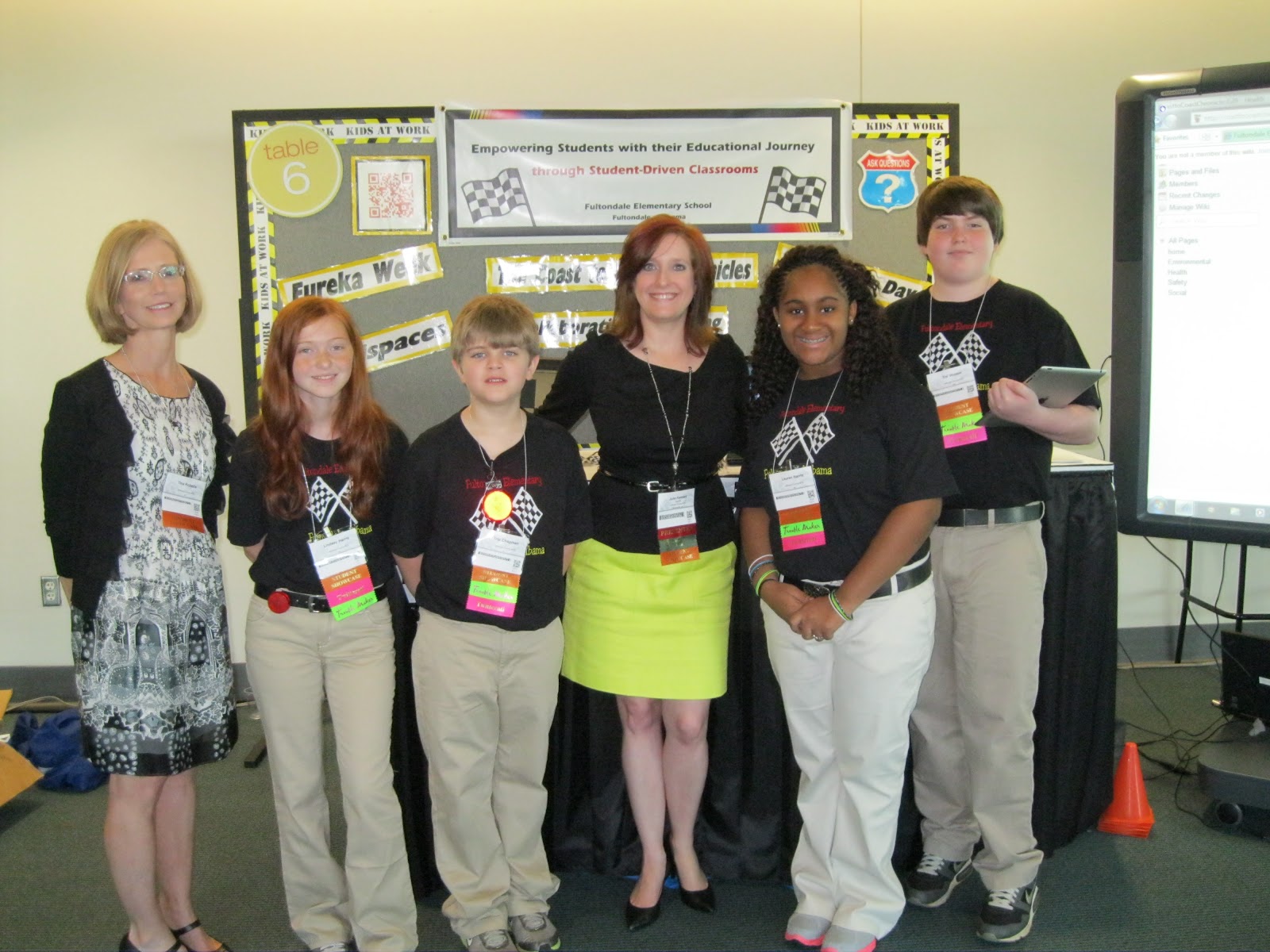
I've just returned home from my eleventh ISTE. My experience at ISTE is probably much different than most of the other 20,000+ people who attend because, for the last ten years, I have attended with my ten and eleven year old students. They have been invited to present a Student Showcase. I get the rare opportunity to see the wonderful, hectic, sometimes chaotic learning machine that is ISTE through the eyes of my students. I get to see what their perceptions are of other educators' opinion on what should be going on in today's classroom. Surprisingly enough, they are extremely tuned into what is worthwhile and what is pure "fluff." Each year, my students choose to spend less and less time in the exhibit hall and hotel pool and more and more time in formal sessions and speaking to people informally between sessions, on the conference bus, and impromptu networking sessions. They speak passionately about their learning and the technology that supports it.If you are willing to listen and converse with them (you'd probably be shocked by how many attendees don't and are downright rude to them) you will see that they have very powerful voices...each distinct one from the other.

As I'm reflecting on this year's experience, I have one even that keeping circling back to the front of my mind. I want to share that story with you here.

If you attended my students' presentation, you know that it is 100% their work. They prepare what they are going to say to attendees, they've designed the take-home souvenir (instead of a hand-out), and they've designed the display. Of course, everything that they are sharing is also 100% created and published by them as well. We usually get a very good crowd that visits us and the kids don't get to come up for air for over two hours.

This year, I had one student with me that we'll call Trent. Trent is a quiet guy with a great sense of humor. Through our student-directed classroom, he has become an extremely strong leader often setting aside his work momentarily to help a peer in need. He encourages others when they feel like success is out of their grasp. He is an amazing individual who doesn't pull any punches when you want the truth.

Each of my students simultaneously run their own little presentation with groups of educators throughout our allotted time. We really need one computer per student, but we weren't able to travel with that many computers this year. Trent asked if he could use our iPad,"I know it won't show many of the awesome projects that we did, but I know I can explain it well enough that they will get a good idea of what I'm talking about.That way everyone else can keep using the laptops." Pretty selfless for an eleven year old, huh?

As my students present I stand back, field any questions they feel they can't answer fully and provide any support that they need. They've told me that if I stand too close it makes them nervous...so I keep a small distance. I could overhear Trent speaking with a small group and doing a beautiful job. They had so many questions that he was able to field effortlessly. That small group dwindled down to one teacher. She continued to pepper him with questions and take notes furiously. Trent took his time to explain all the tools, helped her write down steps, and even helped her spell out the tool's name if she asked.

She thanked him after about thirty minutes and went on her way smiling. Trent looked up at me with a huge grin, "Mrs. Ramsay, I just changed that woman's life forever. She'll never teach the same again. And isn't that what all of this is all about anyway?" Before I could answer, he turned and started his next presentation with another group who had just walked up.

WOW! Trent understands the importance of going to a conference; he knows it's not just about getting, but about giving back; it's about sharing a piece of yourself. It really is about changing lives forever.

As educators it is so important that we take the time to let our students have these experiences. They need to share what they are learning with others of all ages and geographic locations. They need to know that what they are doing can positively impact more than just themselves. They need the opportunity to share their perspective in the field of education and beyond. As I've said many times, they are the reason we are constantly learning and growing. Let's not underestimate our learners, but give them the opportunities to change people's lives forever.