Showing posts with label authentic learning. Show all posts

Monday, January 9, 2017

Data: Hero or Villain?

If you're in education long enough, you will see trends come and go. Terminology changes. Instructional focus swings back and forth on a pendulum. As educators, it is very easy to get caught up in the pressure of jumping on the newest bandwagon. However, we must always keep our eyes on doing what is best for our students. We need to question each new strategy, tool, or practice that comes our way to see if it's a fit for our unique learners.

One word which I've heard come and go is "data." Because much of my career "data" has also come with a punitive connotation, it isn't my favorite word. It frequently is used in conjunction with standardized test scores...as in these test scores must go up or else. I can read and disaggregate data with the best of them, but it wasn't until I realized what a disservice I was doing to my students by focusing solely on standardized test data that I began to dig deeper into the crucial role of data, valid data, that I began to reframe my ideas.

The National Board for Professional Teaching Standards is based on Five Common Core Propositions. Proposition Number Three states:

Teachers Are Responsible for Managing and Monitoring Student Learning

Managing data is clearly an expectation for all educators, but how do we weave this into our daily practice without losing sight of what each of our students needs?

As I see it, teachers fall into one of three categories. Teachers may be data-driven with a singular focus on hard numbers. Often times these educators put on blinders and only look at their students through the lens of raising test scores. I've been in schools where we were all mandated to justify our instructional choices based on how it would raise those numbers. One day a week, every week, we were required to spend the day doing test prep. What I've observed is that in these situations, students and teachers get burned out. The love of learning and teaching dwindles for everyone. Often we resort to bribes to try to get teachers and students to care about those numbers without seeing the long-term damage it's reeking on our profession and our students as life-long learners, creative problem solvers, and empathetic human beings. The danger of being data-driven is that all of our focus becomes about numbers for one small aspect of learning and growing and we lose sight of what our students need. It tends to eliminate creative ventures, inquiry, exploration, self-expression, and student-voice.

When looking at data, there is another category of teacher. This is one who is living in data-denial. We all know these teachers. We may have been these teachers at some point. Ones who have complete disregard for data, formal or informal. Diagnostic, formative, summative or standardized. These are the teachers who are going to teach the way they want to teach regardless of what students need...because they really don't know what their students need. The danger here is that students easily fall between the cracks. Students go unchallenged and begin to fall behind in their growth. Individual interests aren't nurtured. Potential and hidden talents remained untapped.

Finally, there are teachers who are data-informed. These are the teachers who gather data from a wide range of sources. Data-informed teachers listen. They observe. They analyze...every student, every day. Data-informed teachers look at formal and informal data also taking into account students' interest and learning preferences. They create learning activities that foster student-voice, creativity, innovation, and individuality. These teachers understand that every student is in a different place on the learning continuum and by using a wide-range of data, from multiple sources, he/she is working as a partner with each learner to help him/her reach personal goals. In this type of classroom, the focus is on the student; the learning is diverse. Is there data? Absolutely. It's gathered every day to shape and inform the instruction for each student.

Data. It's easy to fall victim to the pressure and band-wagon of focusing solely on numbers from one source. We can easily become buried in all of those numbers. So much so, that we are tempted to completely disregard any data at all. Either way, if we do that, we have to take our eyes off of our learners and what they need. We aren't doing what's best for them. Students aren't going to remember some test that they took. They will remember how they felt when they were in your class. They will remember the things they created, their triumphs, the connections they made and how they used what they learned to make the world a better place.

Data: Hero or Villian? The answer ultimately is up to you.

Monday, March 24, 2014

It's Time for a Book Tasting

This year has been filled with so many wonderful things. One of which has been the large number of books that my students have shared with me. I have an ever-growing list of highly recommended books that no matter how much I read, I can never seem to put a sizable dent in. I love it! However, many times, my reader come to me looking for a recommendation based on what they've read. They typically find an author that they love and read everything that he/she has written (like me). This always brings to mind what Rick Riordan said in his keynote at IRA last year: as a teacher it is my responsibility to get the right book into the hands of the right reader.

With there being so many great books out there, that call to action seems almost daunting. How can I expose my students to a multitude of books from which to select all which could appeal to their specific needs and interests?  I was reminded of what a students said in a session at Teaching & Learning, she said that a recommendation would mean so much more coming from another student. And that is how our Book Tasting was born.

Three days before our first Book Tasting, I led a discussion on the
process they each go through in finding their next great read. My learners all admitted that they have varied tastes depending on what is going on in their lives at the time. That was the perfect portal for introducing the Book Tasting. Each student created a recipe for a book that they wanted to share that was also one that others may not have heard of before. They looked at recipes to determine what elements needed to be included in this style of writing in addition to what elements of the book that should be included to tempt the reader to read their scrumptious literary dish. The day before the book tasting, each student brought their recipe and a copy of their book to share. Because I teach multiple classes, I included all of the books from all of the students to give them a wider selection of books.

On Book Tasting Day, I set up the class like a diner including 50's Rock and Roll, tablecloths, flowers, a platter full of books, and a "Wait to Be Seated" sign at the door.  When I seated each party, they each were given a menu where they could add any of the dishes as an appetizer, main course, or dessert depending on their preferences. Then the learners dove into their platter of books, reading the recipe, a portion of the book, and discussing it with the other readers in their party. Some students really got drawn into reading books, unwilling to relinquish them for other learners at their table. After about ten minutes or so of previewing reading and discussing their platter, they would receive a whole new platter of books to savor and discuss with one another. In the course of the period, students tasted at least forty new books and almost all of them had written down more ideas for their independent reading than their menus could hold.

As I walked around the room and enjoyed listening and engaging in informal book chats with each of
my tables, I was thrilled at the level of excitement. Often a student would comment on one of the books on the platter and another reader at the table would share additional recommended reading based on their experiences. The students took their love of a certain book or author and shared it with their peers. The conversations were rich and demonstrated much about each one of my readers. They have learned how move beyond simple sharing the the plot to internalizing and connecting literature to other literature, lessons in other content area classes, and events in their loves. They discussed commonality in themes and analyzed an author's writing style. They even discussed how an author's writing had changed throughout their career and how the time period in which an author wrote directly impacted the style or content in a book.

At the end of class, they each left with a menu full of reading options...options they were excited about trying that came recommended from one of their peers. You know you've found something great when students all  complain that the class went by too fast and that they are afraid they may have missed a hidden treasure on one of the platters. Will we have another Book Tasting? Absolutely! I know those reading menus will be ready to be filled again soon.


Monday, March 17, 2014

Measuring Innovation?

I have just returned from Teaching & Learning 2014 in Washington, D.C. My head is full of new thoughts and ideas that will trickle their way out onto blogs in the next several days (or weeks). The idea of innovation is one that I have spent quite a bit of time contemplating over the last couple of years, in fact the session that I led was "Are you integrating or innovating with technology in the classroom?" One thing that I have learned is that there are so many nuances to innovation that we all have different definitions of what it is and how it looks in our classrooms.

However, in Bill Gates' plenary, while promoting innovative thinking, he made the statement that we needed to find a way to measure innovation. I sent this tweet:

 
and then this one 

Asking the question, "Is it possible?" bounced around in my head as I prepared to lead my presentation, an active discussion on innovation in the classroom with the support of technology. Based on my experience, innovation is a quality that can be nurtured much like creativity; by making it measurable means that we are going to take that quality and standardize it, which in essence extinguishes it. 

While these thoughts marinated, I attended Tony Wagner's Saturday morning plenary. His entire speech was so "tweetable" with revelations on innovation and how we, as educators, can foster it within our students. One thing that he said really resonated with me and my "bouncing question" was that innovators are critical thinkers. Critical thinkers are those that ask the right questions. Innovation is a team sport dedicated to removing the boundaries of content disciples in order to create, not simply consume content. 

As a teacher, we become a coach who empowers and enables students to ask deep, meaningful questions. We dedicate time for students to connect with one another, face-to-face and digitally, in order to ask one another questions, find solutions, share ideas, and push each other to new levels of thinking. We blur content areas lines because in life rarely is a problem dedicated strictly to academic discipline. Answers are found where content areas meet. We let them explore, discover, and create because it is not about finding one right answer. It's about empowering learners to take control of their learning, build meaning, and make a difference in the world.

So is it possible to measure innovation like we attempt to measure everything else in education? Absolutely not! It will take shape in each of our students in different ways. We will see it manifested over time with our coaching, encouraging,  and support. With respect to Bill Gates, what he is proposing is counterproductive to innovation itself. True innovation cannot (should not) be measured. It can be nurtured to flourish in each of our learners. So as we enter our classroom this week, let's put on the proverbial coach's whistle and get to coaching our students in their ability to ask questions. We have no idea what innovative idea is out there waiting to be discovered by one of our learners.

Wednesday, February 26, 2014

Welcome to the Land of If...Reflections on Innovation Day

What if students had the power to choose what they wanted to learn?

What if learners had the ability to choose how they learned?

What if our students could choose how to share their learning?

What if we lived in a world where a student's ability to think, imagine, 
and create carried more weight than standardized test scores?


What if....

As teachers, I think we often live in this Land of If. If only...fill in the blank. We know that our students' learning should be meaningful with connections to authentic, real world purposes, but it seems like in so many of our schools, we have so many mandates, practices and procedures our ability to teach (and our students' ability to learn) is shackled.

What can we do to help our students reach their maximum potential? My answer to this question came three years ago from Josh Stumpenhorst and Pernille Ripp as I saw their tweets and blogs about Innovation Day. Using their inspiration, the first two years, I facilitated an Innovation Day with my single group of students. With me changing schools this year, I knew there would be a greater challenge. I now teach three different groups of students in a middle school setting. When I presented the idea of Innovation Day, the wonderful, willing-to-try-anything team of 6th grade teachers embraced the idea of us planning an Innovation Day for the entire grade...200 students.

This day puts the students' completely in charge of their learning for one full school day. With the use of a planning sheet and one-on-one conferring with their ELA teachers, each student selected a wondering question or topic about which they have no knowledge, but they had a high interest in exploring. They devised a plan for creating a product to share with their peers to teach about what they learned. As teachers, we know that there is power in being able to not only learn something, but to turn around and teach others about it. Their topic, process for learning, and product were all in their own hands.

Welcome to the Land of If. On Innovation Day, students were grouped by similar topic with a teacher who could lend their expertise, if needed. Our learners engaged in a full day of learning, imagining, and creating only taking breaks to attend their elective class, PE, and lunch. By the end of the day, we had 200 phenomenal projects as diverse as our students.

The following day, students each took two minutes to share their learning with their peers. After about an hour of presentations, one of my learners said, "I can't believe how much I've learned in just one hour." All of the learners were excited by the passion exhibited by their peers. Although the students remained respectful of one another, they struggled to maintain focus for all of the presentations. After speaking with my teammate, Shelly Huver, who recommended that we turn their presentations into a gallery walk next year giving the learners the opportunity to learn and share at their own pace.

There were moments these two days where I felt that what I was witnessing was surreal. Had I fallen into an alternate universe where students were highly motivated while employing higher level thinking linked hand-in-hand with creativity? No, we had given students the opportunity to pursue their own interests. We gave them the opportunity to put into practice all the skills we had instilled in them this year. We had simply gotten out of their way and let them soar.

One of my colleagues, Lindsay Kilgore, came into our classroom and asked me the question that prompted the thoughts in this blog, "What if we could do this every day?" What if, indeed. Imagine the possibilities if we let our students drive.


Friday, February 7, 2014

The Power of Choice

Those of you who are familiar with my teaching and writing know that I am a huge proponent of student voice. However, there are still skeptics out there that argue that if given a choice, students will choose to do nothing, or at least nothing relevant to learning. In the interest of being totally transparent, I admit that I too was fearful of letting go of that "control" over what my students were learning. I erroneously believed that every student needs to complete the same exact learning activities with a strictly prescribed rubric that I created. After all, aren't I the teacher?

However, as I began truly evaluating my teaching practice, I realized that was missing the boat. Yes, my students were having fun and they were having academic success, but I realized that this is their learning journey, not mine. They needed the opportunity to make choice about what they would learn, how they would learn, and how they would demonstrate that learning. As the educator in the room, my role would be one of facilitator. I know where each student is on the learning continuum. My role becomes one of guiding them in the correct direction.

This year, I have a student intern. This has given me the opportunity to see my practice through fresh, new eyes. Yes, giving students choice does cause there to be "more spinning plates." However, each one of these plates is excited to learn. They are highly motivated. They dig deeper and reach farther than would ever had been possible because they had a choice.

A perfect example of this happened this week. My students are currently engaged in Genius Hour Projects (see Igniting the Learning Fire). One of my students, we'll call him Joel, had created a strong beginning idea for his project. He is a strong reader and writer; he truly loves fantasy and science fiction. His first idea was to discover the process that it takes to create and publish a fantasy chapter book. As he began to dig into the project, I left some feedback in his Google Drive document, and he left this response:


What I love about his response is that he took the time to reflect upon his initial idea and evaluate whether it would not only strengthen him as a writer, but also provide something of value to his readers. From speaking with his peers, he discovered that many of them wanted to write and publish a book, but they were struggling to formalize an idea. Joel realized that although he would be doing tremendously more writing be creating a multitude of open-ended, prologues in many different genres, he would also be laying the groundwork for his peers as well as the audience who will purchase his digital book. 

Without giving Joel time to think and create, the freedom to change his ideas, he would never have reached this level of thinking, not only for himself but for the others he will impact through his project.

As we enter out classrooms, it is important for us to provide these qualities to our students. We want them to become independent thinkers. We want for them to connect their content knowledge in meaningful, problem-solving, life-applicable experiences. The only way that can happen is we give them the power of choice.

Saturday, January 11, 2014

Saying Yes: Making Their Ideas a Reality

In my last post, Student Motivation: It's No Mystery, I shared the five-week mystery unit that my students designed and implemented. The depth of their learning and the ownership that they took was astounding. In their impromptu planning session, one idea kept re-occurring: the students wanted a real mystery to actually solve. I pondered over how to make this idea become a reality that would also promote collaboration, communication, problem-solving, and critical thinking.  I turned to my PLN, both in school and online, and although they shared some great ideas, nothing felt right...until one of my learners, we'll call her Annabeth, approached me with an idea.

Annabeth had the idea to write a mystery for the class (that's right folks; a middle school student ASKED to write). She wanted to call it "The Case of the Missing Teacher." I would be the missing teacher. She wrote down some initial ideas which included reaching out to a fellow 6th grade teacher, both of our administrators, our school counselor, and our school librarian. With little prompting, she applied everything she had learned about the structure of a well-written, highly interesting mystery. She spoke with each of the individuals to plan their role in our mystery, making sure that supervision of students would not be an issue (I was hidden in a storage room which backs up to our classroom, giving me the ability to hear their conversation).

The first clue was in the form of a warm-up with grammatical errors; using each error, the students could put together the name of the first individual who held the key to their journey to find their missing teacher. With a smile, Annabeth told me that the dead giveaway that the warm up was not from me was the fact that it told them to do a packet of worksheets. For each of the subsequent clues, Annabeth composed a poem with a riddle for the class to solve. It was so interesting to listen to the students working together to find me. It took them an hour and twenty minutes. Once found, and rescued, they students stumbled over one another trying to tell me about their adventure. They bragged on their ability to apply their knowledge and rescue me from "my kidnapper." They explained how what we had been learning about analyzing text, listening, problem-solving, and sharing ideas was the key to solving the mystery. Then it was revealed that this experience was not orchestrated by me at all....it was their peer, Annabeth. Needless to say, they were impressed and begged to do this again.

So as a classroom teacher, what can we take away from this experience? The answer to this question could easily become a series of blog posts. Personally, it showed the importance of listening to our students. If I had not been open to Annabeth's ideas and willing to help guide her through the logistical aspect of this project, my students would have missed out on the opportunity to put their knowledge and abilities to the test in an authentic manner. They learned firsthand the important of working together, problem solving, investigating options, following a process, communicating clearly, and analyzing text. Annabeth had the joy of seeing the impact that her writing, planning, and implementing had upon the learning of all of us.

Sometimes as teachers we get in the mindset of "no." We see the obstacles, not the possibilities. We worry about "covering the standards" or marking everything off of a checklist.  I know I always feel like there isn't enough time to provide my students with all of the learning experiences that I want for them. However, look at the learning that would not have transpired if I had said "no." Annabeth and her creative ideas reminded me that I need to live in a Yes-World. I need to make sure that I am not so busy that I don't stop to listen to my students' ideas. After all, it is not about me at all. It is really all about them.

Thank you, Annabeth, for the reminder.

Friday, January 3, 2014

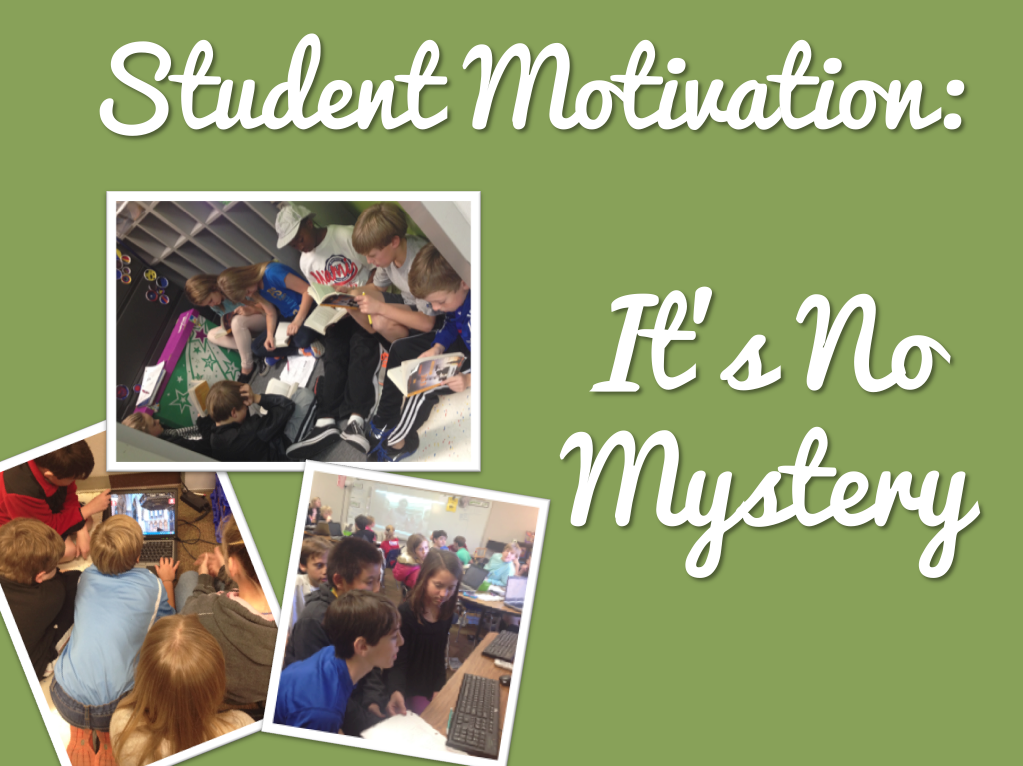
Student Motivation: It's No Mystery

This semester has been a whirlwind of excitement for me and my 6th grade students. So much has transpired that I am bursting to reflect upon and share with others. Moving to a middle school this year, I wondered about student motivation. Traditionally, middle level students are notorious for their apathy and pursuit of identity. Yes, I have spent more of my career in a middle school than an elementary school, but I couldn't help but wonder if what I had been practicing (and preaching loudly) regarding student motivation would translate to my new sixth graders.

Of course, my learners provided me with plenty of food for thought. This year as we were ensconced in the Global Read Aloud, one of my students asked me if we were going to be studying any mysteries this year. Since I am in a new school and I let my students lead my instructional plans, I responded to her that I wasn't sure. I asked, "What do you have in mind?" As she began speaking, slowly other students joined the conversation. What I found interesting was that in their excitement they not only made suggestions about learning activities but also tied in learning standards. Within ten minutes, eighteen of my students had joined the conversation and collaboratively planned a five week mystery unit. I had the pleasure of watching it take shape as they took notes, referred to resources on their devices, and discussed whether something promoted "real learning" or not.

Let's see what happens when students are given the ability to design their learning and how that impacts their motivation to learn. Fasten your seatbelt, here is a (brief) synopsis of their mystery unit.

With the guidance of our school librarian, we selected the book The London Eye Mystery, by Siobhan Dowd, as our main text, and used The Westing Game by Ellen Raskin, as a parallel text through their independent reading. Using both books opened many opportunities for students to deeply compare and contrast plot, character, setting, theme, audience, purpose, and the craft of writing.  Since many of my students had little background knowledge of British culture or history, that opened up opportunities to explore nonfiction texts to enhance their understanding of the novel, the framework where the story played out. This led to them exploring London through virtual field trips and publishing Travel Guides using Skitch.

Many British terms, phrases, and colloquialisms were included in the The London Eye Mystery; so, my students had the opportunity to put their skills at using context clues to work to determine the meaning of the text. They documented this learning on one of our Idea Walls to form a working vocabulary bank they called "Flibbertigibbets and Whatnots." This made them think about perspective, point of view, word choice, and an audience's background knowledge when composing a piece of writing.

As they analyzed the structure of a mystery, my learners also stretched their problem solving and critical analysis through image prompts and whodunit mystery puzzles. Students honed their debating/communication skills as they had to justify and support their claims in the solutions to these mysteries. They used the ability to dig deeply into the text of The London Eye Mystery to make inferences to create their "mystery motherboard" on our large Idea Wall. This wall grew and changed as we moved through the novel and students began to follow the clues in solving the mystery.

 In addition to participating in several Mystery Skypes, my students put to test their ability to analyze text in their pursuit of truth in investigating urban legends using a wide variety of digital and graphic sources. They took a topic of choice, became experts on that topic, synthesized that information, and drew conclusions on whether they were fact or fiction. Then, they took their learning and published "tabloids" on Smore providing resources to support their conclusions.

My students designed their exam and rubric, a complex, interactive Internet mystery, which put the reader to the task of using problem-solving and deductive skills in order to solve the puzzling question. And as a final culminating activity, the student each designed a complex Clue character. Their character had to have a background story, a sense of what motivates them to take action, family/friends/colleagues, and events that shaped who they are. Then the students came in character and we played Clue Queue (a Clue tournament).

Motivation? Is there any doubt that the students were excited each day to learn? My learners would come into class with additional ideas to enhance their learning and the learning of their peers. They took the learning beyond the classroom walls, often writing, blogging, researching, and creating something new to share with their fellow detectives the next day. In fact, as the unit came to an end, the students all commented that the time was too short. They wanted more time. More time? Were the students just "playing at school?" Absolutely not! These students dug deeply into their text. They found a meaningful way to connect the standards to their interests and needs. Did they have fun? There is no doubt about that. But that fun was enveloped in deep and meaningful learning that they not only shared with one another, but also with our digital tools to their global peers.

Is student motivation a mystery? No. Students know exactly what they enjoy and what will make learning in the classroom relevant for them inside and outside the classroom walls. All we have to do is ask and listen.


Tuesday, June 11, 2013

Mythbusters: Technology in the Classroom

I recently had the good fortune to hear Rick Riordan speak (he's the author of the Percy Jackson series...plus many, many more amazing books for middle level readers). Of course, when you mention Rick, one can't help but think about myths as those are the foundation of all of his books. His keynote was about the "Myths of Reading." This got me to thinking about the myths that many educators believe regarding technology in classroom. This is 2013 and I think that sometimes we get caught up in the minutia of our teaching and non-teaching responsibilities and forget that the world around us is changing. If we want to remain relevant for our students, then we too must adapt.

Here are the five most common myths regarding technology in the classroom that I hear from teachers. Let's bust these myths.

Myth 1: I don't know enough about technology to use it with my students.
Many of us grew up and were educated during the time where the teacher was the disseminator of information. The teacher was considered the content expert within the classroom. Once we begin to teach, it is easy to fall into the mindset that we must know everything and be able to answer all of our students' questions.
Yes, we are the content specialists and strategists in our classrooms, but students no longer need us to just deliver content. They have access to content 24/7 in the palms of their hands. They need us to guide them in how to use and apply this knowledge to create, collaborate, and critically solve authentic problems.
How do we overcome the fear of not being the classroom expert in technology? We change our mindset. Yes, we need to have some basic understanding of how a tool is used. However, the most important aspect is not how a tool works, but how a tool supports the learning needs of our students. My students learn how to use tech tools much faster and more efficiently than I do. Nevertheless, they understand that a tool is just that, a tool to support their learning. I am honest with my students and let them know that we are all learners looking for new ways to strengthen and grow as individuals. This takes the focus off of me (the teacher) and places it on the students and their learning.
Myth 2: Technology is an "extra" in the school day.
Believe it or not, I hear this one quite frequently. Often technology is treated as a separate entity where students go to a computer lab or the classroom computer/iPad to play games as a reward. Is that really the role of technology? Absolutely not! Technology is fully embedded in their daily lives. We need to embed technology seamlessly into our lessons and into their learning activities in a meaningful way. It's a tool, just like a pencil, a book, a globe, or a microscope. We only pull those tools out when they are relevant and meaningful for the learner. Technology is no different, but is a part of their lives; it cannot be ignored. As their teachers, we need to provide them with the opportunities for harnessing these tools to safely support their learning.
Myth 3: It is time consuming to teach students tech tools.
I agree that if I did a mini-lesson on all of the tools that my students use throughout the school year, it would take an enormous amount of time. That is why I spend very little time focusing on the tech tool. When we begin a project, we focus totally on the content standards and learning goals. We do not ever mention their mode of publishing (the tool) until they at the point of publishing. Then students select the tool that they feel will strengthen their voice in this project.
Many teachers ask how they know what their options are. There are several ways that I expose my learners to the different options for publishing their projects. First, at the beginning of school, we have an online scavenger hunt where the students search through our different school websites, wikis, and blogs. Through the scavenger hunt, students will see many different projects that past students have published. They may not remember the name of all of the projects, but they do remember what the final product looked like. 
Secondly, my students are connected with their global peers through projects like the Global Read Aloud. On these projects, they collaboratively work with other students and learn from them different tools and manners of publishing their work. Because they want to find something new to share, often my learners go searching for new tools and apps on their own and bring it to me to share how it will support their learning. When I find a new tool, I'll share it with a couple of students and have them explore it and review whether or not it would fit into the projects on which they are working.
These methods take very little class-time, but they put technology where it belongs in the learning environment...it is there to support, not be the driving force in the learning.
Myth 4: My students don't have keyboarding skills.
Quite frankly this one surprises me. However, many teachers equate technology with typing. Let's face it, today's students usually have an email account, but they rarely use it. They spend a majority of their time using a smart phone, tablet, or iPod Touch. Although these have keyboards, they are not traditional keyboards. They are very adept at using their thumbs/fingers to type on these devices. Should their ability use technology to support their learning be hindered by the fact that they are not using the traditional typing methods on a desktop or laptop? My 5th grade students have never been taught formal keyboarding skills. Would it be helpful for them to learn? Probably, but when given the choice of taking valuable school time to teach them keyboarding or giving them time to collaborate and create with their peers, I will always choose the latter. I think what we really need to focus upon is how these devices are helping them grow as learners rather than whether they fingers are on the correct keys when they are typing. 
Myth 5: Technology will motivate students.
When a teacher says this, I always wonder how long they expect the motivation to last. Students are exposed to so many technology gadgets at such a young age, if this is the sole source of motivation, you run the danger of desensitization.  I call this "Christmas Morning Syndrome." All kids are thrilled on Christmas morning by all their new toys. All they want to do is spend time playing with them. But, where are those toys in July? Usually sitting on a shelf or in a closet. Toys and gadgets only give a brief moment of motivation; the more students are exposed to these tools, the quicker they lose interest.
How do we avoid this in the classroom? We must evaluate what truly motivates students for the long term. When students are given the opportunity to make decisions and take ownership of their learning, levels of enthusiasm skyrocket. Today's learners want to connect and collaborate with others applying their knowledge in meaningful and authentic ways. They want to know how what they are doing in class affects their lives today...not some vague, undisclosed time in the distant future. Our learners have high expectations for what they want out of their education. Is technology present? Yes! Technology is the medium we can use to provide all of these aspects for their education, but technology is not what will motivate students for the long haul....student-directed learning is.
I know that this is not an exhaustive list of educational technology myths, but these are the ones I hear most frequently. What myths do you hear? I'd love for you to share some ways for busting common myths for technology in the classroom.

photo credit: marksmotos via photopin cc

Sunday, March 10, 2013

Teaching or Learning?

This week I have been involved in an ongoing conversation about whether as educators we should be focusing on our teaching or on student learning. As was contemplating this idea, an analogy came to mind that I feel represents how I feel about this discussion:
A teacher is like a good cab driver. A good cab driver knows the best routes to get from Point A to Point B. He knows how to get around construction, avoid troublesome traffic, and make the ride a pleasant one for the occupant. However, until someone gets into the cab, that knowledge is superfluous. Once the occupant gets into the cab and tells the driver where she wants to go, it is the driver’s abilities and skills that help her successfully reach her destination. He gets her to her destination avoiding construction, gliding around traffic jams, while still maintaining an enjoyable experience. As teachers we must be knowledgeable and skilled in strategies and ways to meet all of the challenges that students bring to us. However, without the students showing us their needs, we have no way of knowing which way to navigating their learning. 
I feel that this debate is really focusing on the role of the teacher and the role of the student. Do we want our learners to be passive recipients of information? Or, do we want them to dive into topics, applying their knowledge and skills in a real world, meaningful way? Do we want for our students to merely score well on a standardized test? Or do we want for them to become successful in their lives outside of the classroom walls?

What do you think? I'd love to hear your voice on this subject.

photo credit: Thomas Hawk via photopin cc

Thursday, January 24, 2013

It's Time to Let Go

This week, I read Chris Lehmann's blog post, Plan to Letting Go. It really drove me to reflect on the importance of giving our students not just the ability to learn, but the ability to learn and apply their knowledge independently.

I told my students at the beginning of the year that the right answer is not enough. Becoming databases filled with random information on various topics is not developing deep, critical thinkers. Learners need to be able to explain their reasoning, justify their answers, and use their knowledge to apply it to real problems. Students will not gain this ability if they sit all day listening to a teacher disseminate information.

As teachers, we naturally are helpers. When we see a student struggling or making mistakes, we immediately want to jump in and help by giving them the right answer. By doing that, what kind of learning are we fostering? We must guide them towards mastering the ability to think and reason, while instilling in them the confidence to tackle new challenges. It can be challenging and tedious work, especially when you are working with an inclusion class with a large population of English Language Learners. Perseverance is key to success. Then, when it seems that all of the guiding, questioning, and modeling is not making an impact, all of a sudden everything comes together.

A day like that happened in our classroom a couple of weeks before Winter Break. Since our class is student-driven, my students design not only their own learning projects, but also their own rubrics for the projects. At the end of the school year, I have had several students mention in passing that they wish they had a scrapbook of all of the projects that they had created. That spurred the idea of challenging them by giving them the opportunity to create digital portfolios to provide evidence of their learning in all content areas.

I created a class account on Weebly, which provides each student with webspace, and led them through a discussion of how they could use it to prove their learning (I'll share specifics about the portfolio in a later post). The discussion sparked so many ideas from my students; they had so many questions. As they began to work, I expected to have a demand on my attention to give encouragement, redirect attention back to the portfolio, troubleshoot technology issues, and ask guiding questions about the choices they were making to show their first semester learning. However, once they began work, I looked around and not a single student was demanding my attention. They were focused on learning how manipulate Weebly to make it do what they visualized in their heads. When they had a challenge, they turned to one another. One student even "Googled" a tech question to find out how to load something to his Weebly.

The conversations they had with one another were amazing; deep and thoughtful answers were given along with encouragement. They graciously showed one another their work and taught them how to do the same, if they were interested. My learners began to challenge one another to explain how the samples and projects they selected showed how they had met their personal learning goals. Then as the day came to a close, and I told them it was time to sign out and shut down the netbooks, there was an outcry of frustration. They did not want to stop...what were they doing...that's right, creating a form of formative assessment to prove their learning. Who ever hears of students begging to participate in assessment?

As they reluctantly packed up to go catch their buses, I was struck with the reminder that none of this would have happened had I not taken the time to build this framework for their learning and LET GO so they could thrive.

Please take a few minutes and think about your students. Are you giving them the guidance that they need to become motivated, independent learners and thinkers? I know it might be scary to think of letting go and letting them grow. However if you do let go, amazing things will happen.


photo credit: pinelife via photopin cc

Thursday, January 10, 2013

Let them Assess

Assessment. That is a word that can send cold shivers down the backs of teachers and students alike. In our society, that word has been linked to a "gotcha" mentality where standardized testing scores have become punitive towards districts, schools, teachers...sometimes affecting entire communities. I have spent a lot of time contemplating, researching, and discussing this topic and I realized that I needed to reframe my ideas and ultimately my teaching practice in the area of assessment.

Like many of you, I am in a district where standardized tests scores pull much weight and drive many of the decisions made at the district level. Often as classroom teachers, we may feel disempowered. Is this where we throw up our hands in defeat? And the most important question: Is this what is best for our students? I think that any one who works with students know that the answer is a resounding "NO."

The question that I often hear is, "So what do we do about it?" I thought I would take a few minutes to share where I began in my journey of rethinking assessment. As I have continued to grow (and still do each day), my practice has adapted. In the interest of not overwhelming anyone, I'll share more of my journey in future posts, but I wanted to share where I began.

Those of you that follow me or have read my book, Can We Skip Lunch and Keep Writing?, know that several years ago, I made the shift from a teacher-led classroom to a student-directed one. In this amazing journey, my students led the way with many ideas. The idea to let the students take control of their assessment came from one of my fifth graders.

Now like many of you, I have used rubrics my entire teaching career. I'm sure we've all had the frustration of going over a rubric in detail at the front end of a project; then we observe our students trudging ahead with little (or no) regard to how they will be assessed at the end. The shift was that I wanted to make should address students' lack of connection with the purpose of a rubric as well as their idea to take control of their own assessment. I would not be presenting them with the rubric; they would be creating it for each learning project.

When you stop and think about it, if we are giving them control over selecting what they learn within a topic (or standard), how they are going to learn it, and in what manner they are going to create something that proves that learning, shouldn't they also have control over how they are assessed on that learning?

In order for us to make this shift, I relied on my students' previous knowledge. Since third grade, they had been trained to write towards our state writing test using a rubric. They understood what the specific difference was in earning a 4, 3, 2, or 1 in each category on a rubric because they had already been doing that for at least two years. When we began a new project or learning activity, I would guide my students in designing the criteria. Then I led them into determining the specifics assigned to the 4, 3, 2, or 1.

Yes, when you look at it, their copy is much simpler than most rubrics, but this is their rubric, not mine. The "master" list of the specifics would stay on our interactive whiteboard for reference, as needed, although most students took down notes (by choice) as a reminder of how to earn each score. As is our regular practice, my learners would meet together with one another for peer reviews and ideas, as well as, conferring with me throughout the project.

Once we reached the end of a project, they would assess one another's work based on their rubric as would I. My initial trepidation was that they would assign high scores to one another afraid to be honest. On the contrary, I discovered that my students held extremely high expectations for one another. When you think upon it, it makes sense. They design the projects and set the expectations. They talk about it with one another and me a LOT throughout the process. They know exactly what is expected to prove their learning.

This put an integral part of the learning process firmly into my learners' hands. Assessment plays a vital role in determining what our students know, what they need to know, and how much they have grown in each area. It informs and guides our instruction so that we can help each of our students meet their fullest potential. Having this knowledge is important not just for us, but for our students as well. If we want for them to take ownership of their learning, they need to be informed and see the goals that they have set in front of themselves.

This is only the beginning for me an my students and we sharpen our assessment practices. Stay tuned as I continue to grow and reflect upon how we can empower our students with relevant and authentic assessment practices.

Tuesday, September 25, 2012

Looking to Connect Your Students? First Steps in Social Media

There is much debate about the use of social media in the classroom. Those of you who follow my Twitter/Facebook/blogging/speaking know that I am pro social media. Our job is to prepare our students for today's world. Our classroom is the opportunity to teach students the importance of making safe choices while they are engaged in social media...and let's face it, even our youngest students are already there. We can guide them in how to safely harness the power of social media in order to support their learning.

As I mentioned in my post, Our First Day(s) of School, we begin these discussions from the start of school. I want for them to develop these skills before we begin connecting with other students. Many may wonder how to take their first steps. When I started, I really had to search to find other classes with whom we could communicate, create, and collaborate. But the good news is there is a prefect project where you can make connections and have much support as you venture into this avenue. This project is the Global Read Aloud.

The Global Read Aloud is the brainchild of fifth grade Wisconsin teacher, Pernille Ripp, who had a vision of connecting students from all over the world through the reading of one book. Teachers are invited to participate, add their ideas and then a mutual, collaborative project is formed. This year the books selected are The One and Only Ivan by Katherine Applegate and Charlotte's Web by E. B. White.  You can select which book best meets the needs of your learners.

So what does social media in the classroom have to do with reading a book?  Simple, teachers register to connect with other teachers. You can connect through Skype, Twitter, Edmodo, Google Hangout, or KidBlog. If there is another way you would like to connect, simply put it on the form and see if anyone is interested in connecting in that way. The great thing about this project is that it is participant driven. The teachers who are here are here because they are passionate about connecting students through the reading of literature. If you have been wanting to try a new tool in your classroom, this is the perfect opportunity to do that because you have a very supportive network of teachers willing to help you. If you are unable or uncomfortable in participating using social media, there is also the Global Read Aloud wiki complete with the reading schedule, a map of participants, and a place for students to publish their writing and projects for other students to enjoy. This is a project that you can  mold into whatever the needs are for your students.

We know the power of reading; it takes the readers on new adventures, challenges their thinking, and inspires them to action. Thanks to Pernille and all of the teachers who’ve connected through the Global Read Aloud, we can bring the world into our classrooms, giving our students an authentic and exciting way to discuss literature and have their voices heard globally. 

If you haven't connected with the Global Read Aloud, you still have time. It begins October 1st. Won't you join us? Your students will become so passionate about reading, connecting, and collaborating, they will be begging to continue the learning long after the project ends.

Tuesday, September 4, 2012

Our First Day(s) of School

Several people have asked me what I do with my students for the first few days of school. So, I thought I would take some time and share what we did to get this year off to a great start.


  • We read The Dot by Peter H. Reynolds. This book always sets a great tone for the beginning of the school year. It has great life lessons about never giving up, always trying your best, overcoming misconceptions, and inspiring the uniqueness in others. After we read the book and had some amazing discussion, the students always ask if they can design their own unique dots to display. I love the creativity in each of these and how something so simple can have such a strong meaning for each learner.
  • On the first day, I always take time to introduce myself. They notice that I have several photos in my classroom and I tell them that we need to put pieces of them in our classroom too. You'd be amazed at how excited they are about being included in our learning environment in such a  simple way. Each student creates his/her own self-portraits which we display on the wall that you see when you first enter the classroom. The stay up the entire school year reminding them that this is their classroom.
  • So often I hear from parents something along the lines of..."He just hates math. I always hated math so we struggle through it each year." As a child who hated reading, I understand the dread and apprehension, but I don't want them to write off an entire subject because of previous experiences. To get a true feeling for where each student is in math and their perceptions of it, good or bad, I have my students write a Mathography...the story of their life with math. They write about how they feel about it, their experiences and how they see math in their lives. It is always an eye-opening experience for all of use. Usually, through their own reflections, they draw the conclusion of how important math is in our daily lives. It opens up the channel for some great class discussions.
  • Spaghetti and Marshmallows...that's right. Since our class is so student-directed and they need to learn the crucial skills of communication, collaboration, problem-solving, and critical thinking, I give each team of four students 20 pieces of raw spaghetti, 1 yard of tape, 1 yard of string, and 1 marshmallow. Their goal is to build the highest tower that can hold the jumbo marshmallow at the top. Some teams need encouragement as they start to struggle and many want to give up, but by asking guiding questions, they get inspiration and set off on another idea. (Check out the photo album of this year's challenge.)


  • Since we use many web tools, digital resources, and social media, it is imperative that my students develop good online habits. We use a resource called NetCetera to spark much conversation about cybersafety, netiquette, and cyberbullying. (I discuss this in further detail in my book.) On the first day, my students are introduced to Twitter and our class Twitter feed, @RamsaysClass. We talk about all of these good habits within the context of tweeting and the students set the guidelines. At the end of each day, each group writes one tweet on a sentence strip that we hang up in the hallway. This is a way that I can guide them into creating meaningful, powerful tweets for our class. Within three days, my students were ready to start conversing with the Twitterverse and all of the other students with whom we are connected.
  • Beginning to tweet led into our lessons on beginning to blog. Karen McMillan has created series of lessons that teach students how to blog by starting them off on paper. Before we begin blogging (on paper first then digitally), I lead a discussion with my students about what expectations they have for their blogs. These lessons are a huge hit with my students. It gives them experience in writing high quality posts and comments before actually setting off to write their digital blogs on KidBlog. (Check out the post that I wrote about their first blogging experience.)

  • Another activity in which my students engage is that they "build their wildselves." We want all of students to be safe when using digital tools, but we also want them to have some identity. BuiLD YouR WiLD SeLF is a site hosted by the New York Zoos and Aquarium. Students (and their teachers...because we all want one of these) visit the site and they create avatars that begin with kids and then you can add different animals parts like peacock feathers and octopus tentacles to the character. This is a great way for students to create an identity that's safe. My students use their wildselves in all of the different tools where an avatar can be used.
So that answers the question that so many people have been asking. To be honest, I don't think it's so  much about what you do as it's how you do the activities and lessons that you plan. For me, it's important that they start learning how to think, dig deeper, stretch their wings, be kind to one another, communicate well with others, and take responsibility for their own learning. The biggest shift for them is that they are put in charge of their learning...which is totally foreign to them when they enter my class. I hope that all of you have had as wonderful of a beginning of the school year as we have. I look forward to all of us learning together this school year...and beyond.

Tuesday, July 17, 2012

Wild Jungle Brains...How to Tame the Beasts

Yes, that's right..my brain is a wild jungle full off all kinds of gibberish. I'm on overload right now. I know it's the summer, but I have been going at a frenzied pace speaking, researching, tweeting,  reading, writing, learning, blogging, planning because the summer is the time I can really dig into new ideas. I have the time to read. I spend more time on Twitter and reading other people's blogs. I meet smart educators at all of the conferences where I travel to speak. All of this brings amazing epiphanies and new plans for next year.

BUT...I find myself struggling now to focus on one thing. As I sit here typing on my antiquated desktop (my laptop decided to go on permanent vacation this summer), I found I needed some quiet time for my brain to slowly begin to formulate some clear thoughts. I needed to find some takeaways from all this PD I've been shamelessly partaking in for several weeks now.

That is when this occurred to me...maybe in the rush to meet all the standards, pacing guides, and mandates and still provide our students with the hands-on, student-directed learning they crave, we bombard our students with so much stimulation that they struggle to actually form one clear and concise thought or sentence. More is not actually better.

We have no idea what is already going on in their heads. They already have a jumble of thoughts before they walk into our classroom. We need to make sure that we are making purposeful choices in what we bring into our classroom, whether it's a hands-on activity or a new tech tool. We need to ask: Is this the most powerful opportunity to support my students' learning or is it a fun activity that kind of relates to the topic at hand?

We are the content specialists and strategists in the classroom. It is our responsibility to provide our students with the BEST support that we can. We aren't doing them any favors by bombarding them with a lot of mediocre projects/stations/tools/activities that will cloud their minds from what is most important...their learning. They need the time to formulate ideas, plan projects, reflect on their progress, and set their own learning goals. By providing them the support and time that they need, we can tame those overstimulated brains and help them find their own paths to success.

Monday, June 18, 2012

What Motivates Students Today?

Do you ever have the feeling that although you are speaking up, somehow your voice isn't heard? Those of you who follow my blog know that one of the issues close to my heart is the power of student-driven learning (see In Defense of Student-Directed Learning). I've attended several conferences and workshops lately where when I made a comment about putting the power of learning into our students' hands; people looked at me like I had three heads (could you imagine the hair styling time for three heads?). That's not going to change what I know to be true. Students want to learn, but what motivates them is not extrinsic rewards. It is our job to guide them in pursuing how they learn, what they learn, and how they share their learning with the world while not just mastering standards, but far exceeding them.

Enter Alan November, the keynote speaker for the Alabama Educational Technology Conference. This man has been providing students with the opportunity to apply what they are learning to solve real-world problems since the mid-1980's. His students find a need and they design a solution. His TED talk is very close to what his keynote was. He shared student ' stories that illustrated that what students really want is purpose, authenticity, a global voice, and time for mastery.


Throughout his keynote, I found myself wanting to stand and cheer. Here is a man who had his students living this over twenty years ago....it's nothing new. The stories he shared inspired me to try new things, really let my 5th graders have more freedom. I hope that you enjoy his talk as much as I did and I'd love to hear your thoughts on student-directed learning. And if you are in San Diego next week attending ISTE12, be sure to come by and hear my students tell you all about the power of student-directed learning.


 photo credit: . Entrer dans le rêve via photo pin cc

Monday, June 4, 2012

Education is NOT Broken

It's all around us: the negativity about what's wrong with education, what must be repaired. I've written several blogs explaining some of the practices that my students and I have put into place because there are things that need to be re-evaluated. However, in the last month I've had the great fortune to hear stories from some of the most amazing educators in Alabama. Many of them working in difficult, high-need schools across the state. The resiliency and creativity of educators and their students abound in spite of the challenges that many of us face day to day. I know these educators and students are all over the world, often fighting to overcome what may seem insurmountable obstacles to find success. They are the unsung heroes that we should be hearing about regularly. I'd like to share a few of the stories here to remind all of us what is right in classrooms and schools everywhere.

Until a few weeks ago, I had never heard about Green Ribbon Schools. Green Ribbon Schools (GRS) is an award program that recognizes schools participating in activities that promote and encourage a healthy and environmentally friendly learning environment. It's a program where students can learn to better use their resources and addresses the issue of childhood obesity by promoting health and fitness. Munford Elementary School in Talledega County partnered with the park rangers in the Talledega National Forest to create environmentally sustainable learning spaces, to protect health and foster wellness for Alabama students while saving energy and reducing costs. They also integrated forestry, conservation, and environmental education themes throughout the curriculum through "theme immersion." For their hard work and dedication, Munford Elementary School was a National Winner for the United States  Department of Education Green Ribbon School Award.

One of the must heart touching stories that I heard was from Kim Beaty who teaches at Hope Academy in the Eufaula City School System. Hope Academy is not your average public school. It's an alternative school for students who have personally (or through their families) experienced truly horrific things. No student should ever have to live through the violence, abuse, or, or crimes that they have endured. Most people would write these kids off as a "lost cause." But not Kim and her fellow teachers.  These teachers dedicate their time to helping these students become a powerful voice for change instead of just letting them coast until they drop out of  school. These teachers see the potential in every student and, in spite of obstacles, many of these students do successful earn their diplomas and enter the work force as successful members of society. 

Often we hear that students today are not interested in the world around them. This story proves that statement unequivocally incorrect. Here's the story of a teacher, Brian Copes, at Calera High School who challenged his students to build a basic utility vehicle that could be used in developing countries. Their challenge was to create these out of donated parts that could easily be found in these countries. The students not only created a vehicle that survive the remotest terrain, but they also built variations: a school bus, an ambulance, a drill for wells, and a plow. Additionally, after hearing from an area specialist that there are many people in these countries who are amputees, but cannot afford the $2000+ prosthetic, he let the students experiment and investigate with the prosthetic. Then they build replicas that could do the same job for under $100. These amazing students and their teacher are travelling to the Honduran Cloud Forest this summer to deliver one vehicle, help them construct a second vehicle, and fit amputees with their prosthetic.(Watch their amazing story here.) And did I mention, these are kids who haven't even graduated high school yet? They are confident, knowledgeable, and have a clear understanding of how math, science, and engineering directly impact the lives of people. (Yes, they've won multiple awards against university students, but that's not what drives these students.)

I hope that these stories encourage all of you to take a few minutes to see the trees in the giant forest of education. There are some real stories of triumph and student empowerment all around us. Yes, there is no doubt that there needs to be some change in education, but these are stories that must not be overlooked. If you've got a story of an unsung hero, I'd love for you to share it here. We would all benefit from celebrating these successes.

photo credit: Stuck in Customs via photo pin cc

Tuesday, March 20, 2012

What does good teaching look like?

This is a question that I have been pondering a lot lately. What does good teaching really look like? Does it look like what we see on television, movies and commercials? Is it a teacher standing at the front of the room in front of a board lecturing students who are sitting in rows passively listening? Is it assigning students to watch lectures at home and then have them come to school to complete digital worksheets?

These are questions that all teachers need to ask themselves. One thing that I learned by going through the National Boards process and becoming a Candidate Support Provider is that there isn't just one right answer. However, there are some constants that you can find in the classrooms of each amazing teacher.

In these classrooms, students always come first. We cannot continue teaching in the same way that we've always taught because our students have changed. Just because it's easy for us, doesn't mean that it's what is best for our learners. Whatever their individual needs are, it is our responsibility to identify them and help them grow. Every decision we make, must focus on them and what they need to accomplish. We must get to know our students and have conversations with them. We need to let them design their learning environment, set their classroom norms, design their own assessment, and set their own goals for learning. Amazing teachers listen to their students and let them create solutions to academic and personal challenges.

Learning has to be meaningful and engaging. With technology, students are the masters of their own universe. They have a 24/7 constant flow of information and connection to those around the world. Everything in which they engage themselves is meaningful and purposeful to them. Students, no matter the age, need to find the relevance to what they are learning and how it improves them and the world around them.No longer are students enthusiastic about digging into a subject matter because it's going to be on a  test.  "About" presentations aren't engaging or meaningful as students are just spitting out facts that don't relate to their lives.They want to know how they will use the content standards now. They must have a reason to connect with their learning.

In these classrooms, the teacher is the facilitator learning, not the sole disseminator of information.We are the content specialists and the strategists. We need to guide our students in making important discoveries and reaching their academic and personal goals. Can this be done if the teacher is in the front of the room lecturing for the entire class without active student participation? No. It doesn't matter if we give the best lecture of our lives if we don't know what each student is thinking, processing, and applying  from the content into meaningful context for them. Our students need an opportunity to share their voices and their thoughts. They need to communicate with one another and with those around the world to share their learning and ideas.  With our guidance, they need to make choices about what they will learn, how they will learn it, and how they will share their learning with others.

Because none of us has the exact group of learners, the appearance of  good teaching will differ from classroom to classroom. However, outstanding teachers know that their students must come first and that they must be engaged in active, meaningful learning. It is important for us to reflect and make sure that we are doing everything we can to positively impact student learning. Without it, we've lost our lost our kids and ultimately...our future.


Wednesday, March 14, 2012

Making Math "Yummy"

This year I have continued my quest to find challenging mathematical problems that related to real life. This has been a real challenge. Most of what I've discovered has been too difficult or too easy for my fifth graders.I know that learners need to discover the relevance of what they are learning to their lives; it gives those standards a personal meaning to them. They realize that these aren't just a bunch of random procedures/processes/problems they are being forced to learn. They are relevant and useful. It totally changes their perception of learning.

This year, I was fortunate to stumble across a site called Yummy Math. I must admit that the title is what caught my eye from the beginning. At first glance the two words may seem at odds...unless you're talking about using some food items as manipulatives. Their tagline is "We provide teachers and students with mathematics relevant to our world today …"   As I investigated further, I realized these were a collection of "math stories" that set up a real-world scenario; then they pose questions for the students to ponder and problem-solve. They are timely with current events. Currently, there are math stories on March Madness, Pi Day, Green green Chicago River, and Shamrock Shakes. You can search by month or by math standard. Each math story involves multiple math standards and new stories are regularly added.

To be honest, these standards are a bit over my students' heads, but I loved the whole concept of real world scenarios that focus on multiple math skills while adding some interesting trivia or information; I decided to try it with my young mathematicians anyway. My students were immediately engrossed in these problems. We begin each of the stories by discussing the  beginning "set-up" together. Then they set to work in small groups as I travel from group to group to listen to their conversations and ask questions to discover their thought process. We periodically have a whole group conversations to share their discoveries. They get so excited about "figuring" something out, they don't stop to question whether or not this is a 5th grade standard. I never hear my students say, "This is too hard."  They see how the different math standards overlap and relate to one another.

They are not just solving problems with numbers either, they are having to write explanations for how they got to their conclusion. We all know that it is one thing for a students to just go through a  process...that doesn't denote a true understanding of a concept. It is a totally different thing if a student can explain not just what they've done to find a solution,but also why they've done it.

It's highly engaging and interesting for them to see how math supports life. It's relevant. Whenever we do a Yummy Math story, our math class goes on for over an hour and a half. When it's time to move to another subject, a chorus of "Awwwww, can't we have 5 more minutes?" ensues. One student told me that he loves yummy math because it's math for life. He is so right. Kids begging to keep solving problems? Absolutely!

~To the Yummy Math teachers, I hope I did justice describing your site. Please feel free to make comments adding any important information that I might have omitted. Thanks for such a great site!