Showing posts with label creativity. Show all posts

Monday, March 17, 2014

Measuring Innovation?

I have just returned from Teaching & Learning 2014 in Washington, D.C. My head is full of new thoughts and ideas that will trickle their way out onto blogs in the next several days (or weeks). The idea of innovation is one that I have spent quite a bit of time contemplating over the last couple of years, in fact the session that I led was "Are you integrating or innovating with technology in the classroom?" One thing that I have learned is that there are so many nuances to innovation that we all have different definitions of what it is and how it looks in our classrooms.

However, in Bill Gates' plenary, while promoting innovative thinking, he made the statement that we needed to find a way to measure innovation. I sent this tweet:

 
and then this one 

Asking the question, "Is it possible?" bounced around in my head as I prepared to lead my presentation, an active discussion on innovation in the classroom with the support of technology. Based on my experience, innovation is a quality that can be nurtured much like creativity; by making it measurable means that we are going to take that quality and standardize it, which in essence extinguishes it. 

While these thoughts marinated, I attended Tony Wagner's Saturday morning plenary. His entire speech was so "tweetable" with revelations on innovation and how we, as educators, can foster it within our students. One thing that he said really resonated with me and my "bouncing question" was that innovators are critical thinkers. Critical thinkers are those that ask the right questions. Innovation is a team sport dedicated to removing the boundaries of content disciples in order to create, not simply consume content. 

As a teacher, we become a coach who empowers and enables students to ask deep, meaningful questions. We dedicate time for students to connect with one another, face-to-face and digitally, in order to ask one another questions, find solutions, share ideas, and push each other to new levels of thinking. We blur content areas lines because in life rarely is a problem dedicated strictly to academic discipline. Answers are found where content areas meet. We let them explore, discover, and create because it is not about finding one right answer. It's about empowering learners to take control of their learning, build meaning, and make a difference in the world.

So is it possible to measure innovation like we attempt to measure everything else in education? Absolutely not! It will take shape in each of our students in different ways. We will see it manifested over time with our coaching, encouraging,  and support. With respect to Bill Gates, what he is proposing is counterproductive to innovation itself. True innovation cannot (should not) be measured. It can be nurtured to flourish in each of our learners. So as we enter our classroom this week, let's put on the proverbial coach's whistle and get to coaching our students in their ability to ask questions. We have no idea what innovative idea is out there waiting to be discovered by one of our learners.

Wednesday, February 26, 2014

Welcome to the Land of If...Reflections on Innovation Day

What if students had the power to choose what they wanted to learn?

What if learners had the ability to choose how they learned?

What if our students could choose how to share their learning?

What if we lived in a world where a student's ability to think, imagine, 
and create carried more weight than standardized test scores?


What if....

As teachers, I think we often live in this Land of If. If only...fill in the blank. We know that our students' learning should be meaningful with connections to authentic, real world purposes, but it seems like in so many of our schools, we have so many mandates, practices and procedures our ability to teach (and our students' ability to learn) is shackled.

What can we do to help our students reach their maximum potential? My answer to this question came three years ago from Josh Stumpenhorst and Pernille Ripp as I saw their tweets and blogs about Innovation Day. Using their inspiration, the first two years, I facilitated an Innovation Day with my single group of students. With me changing schools this year, I knew there would be a greater challenge. I now teach three different groups of students in a middle school setting. When I presented the idea of Innovation Day, the wonderful, willing-to-try-anything team of 6th grade teachers embraced the idea of us planning an Innovation Day for the entire grade...200 students.

This day puts the students' completely in charge of their learning for one full school day. With the use of a planning sheet and one-on-one conferring with their ELA teachers, each student selected a wondering question or topic about which they have no knowledge, but they had a high interest in exploring. They devised a plan for creating a product to share with their peers to teach about what they learned. As teachers, we know that there is power in being able to not only learn something, but to turn around and teach others about it. Their topic, process for learning, and product were all in their own hands.

Welcome to the Land of If. On Innovation Day, students were grouped by similar topic with a teacher who could lend their expertise, if needed. Our learners engaged in a full day of learning, imagining, and creating only taking breaks to attend their elective class, PE, and lunch. By the end of the day, we had 200 phenomenal projects as diverse as our students.

The following day, students each took two minutes to share their learning with their peers. After about an hour of presentations, one of my learners said, "I can't believe how much I've learned in just one hour." All of the learners were excited by the passion exhibited by their peers. Although the students remained respectful of one another, they struggled to maintain focus for all of the presentations. After speaking with my teammate, Shelly Huver, who recommended that we turn their presentations into a gallery walk next year giving the learners the opportunity to learn and share at their own pace.

There were moments these two days where I felt that what I was witnessing was surreal. Had I fallen into an alternate universe where students were highly motivated while employing higher level thinking linked hand-in-hand with creativity? No, we had given students the opportunity to pursue their own interests. We gave them the opportunity to put into practice all the skills we had instilled in them this year. We had simply gotten out of their way and let them soar.

One of my colleagues, Lindsay Kilgore, came into our classroom and asked me the question that prompted the thoughts in this blog, "What if we could do this every day?" What if, indeed. Imagine the possibilities if we let our students drive.


Wednesday, January 29, 2014

Can You Assess in Six Words...No Less?

As I mentioned in Let Them Assess, my students and I have really been evaluating assessment practices within our classroom. As I reflect upon my practice, it occurred to me that so many of my practices inherently have an aspect of assessment, for me as well as my learners. One of these practices is the six word memoirs that my students create throughout the school year.

After providing them with multiple examples to study and analyze, we had a compelling discussion about methods for creating an entire story in only six words. My learners remarked on the use of inference, imagery, and figurative language. Then, I gave them the challenge of writing about how they had changed as learners since the beginning of the school year. My goal was for them to take time and reflect on their own growth, beyond the mastery of standards. I wanted them to become introspective in evaluating the impact that our time together had upon them as more than just learners, but individuals.

Because this writing activity is only six words, even my students who are struggling readers and writer found this a non-intimidating writing activity and eagerly attacked their writing seeking to express their learning stories. Conversely, my honors students struggled to limit their ideas to only six words. They had so much they wanted to express, yet the six words limit seemed to become an obstacle. However, they learned how to evaluate not just the denotation of a word, but also the connotation, the emotion it evoked in a reader. Although the students initially began the writing individually, they ultimately leaned upon one another for advice, feedback, and inspiration.

Photo: rosmary on Flickr
The results were much more than expected. It gave me a peek into their own self-perceptions. I saw their honesty, humor, hopes, and dreams. Students that I was not sure I had quite reached, composed intriguing pieces giving me glimpses into the recesses of their hearts and minds. For all of us, it was a time of celebration of their individual growth and a plan for their future. We were all able to evaluate what was worthwhile and what needed to be altered for the future. For many of my learners, it became the banner of their success and expressed their hopes for the future. What was the most thrilling to me were their explanation behind their memoirs. They took complete ownership over their stories and willingly related their growth, struggles, triumphs, defeats, and how all of that culminated into their "final" product. (One student pointed out that a memoir is never finished because they keep changing each day.)

So, can six words have any impact on student learning? Without a doubt! Can six words help students reflect, evaluate, and strategize their learning journey? Absolutely! Can a prompt which limits the number of words inspire creativity and give the reader a peek into the author's hearts and minds? Unquestionably! What can you do with six little words? Take a look at a few of their six word memoirs and just imagine the learning potential it can bring to each student.

Was blind now I can see.~C.B 
I was an ant ; Now a skyscraper.~L.B 
First came rain then came rainbows. ~ P.S 
I was smart, now I'm wise. ~N.E  
Some talent, now overflowing with abilities. ~ A.G 
Always dark. Light ahead for learning. ~C.B.  
Was a dreamer, now a believer. L.A. 
Was a canvas, now painted gold. ~D.C. 

Enter the room, opened my eyes. ~A.P.

Saturday, January 11, 2014

Saying Yes: Making Their Ideas a Reality

In my last post, Student Motivation: It's No Mystery, I shared the five-week mystery unit that my students designed and implemented. The depth of their learning and the ownership that they took was astounding. In their impromptu planning session, one idea kept re-occurring: the students wanted a real mystery to actually solve. I pondered over how to make this idea become a reality that would also promote collaboration, communication, problem-solving, and critical thinking.  I turned to my PLN, both in school and online, and although they shared some great ideas, nothing felt right...until one of my learners, we'll call her Annabeth, approached me with an idea.

Annabeth had the idea to write a mystery for the class (that's right folks; a middle school student ASKED to write). She wanted to call it "The Case of the Missing Teacher." I would be the missing teacher. She wrote down some initial ideas which included reaching out to a fellow 6th grade teacher, both of our administrators, our school counselor, and our school librarian. With little prompting, she applied everything she had learned about the structure of a well-written, highly interesting mystery. She spoke with each of the individuals to plan their role in our mystery, making sure that supervision of students would not be an issue (I was hidden in a storage room which backs up to our classroom, giving me the ability to hear their conversation).

The first clue was in the form of a warm-up with grammatical errors; using each error, the students could put together the name of the first individual who held the key to their journey to find their missing teacher. With a smile, Annabeth told me that the dead giveaway that the warm up was not from me was the fact that it told them to do a packet of worksheets. For each of the subsequent clues, Annabeth composed a poem with a riddle for the class to solve. It was so interesting to listen to the students working together to find me. It took them an hour and twenty minutes. Once found, and rescued, they students stumbled over one another trying to tell me about their adventure. They bragged on their ability to apply their knowledge and rescue me from "my kidnapper." They explained how what we had been learning about analyzing text, listening, problem-solving, and sharing ideas was the key to solving the mystery. Then it was revealed that this experience was not orchestrated by me at all....it was their peer, Annabeth. Needless to say, they were impressed and begged to do this again.

So as a classroom teacher, what can we take away from this experience? The answer to this question could easily become a series of blog posts. Personally, it showed the importance of listening to our students. If I had not been open to Annabeth's ideas and willing to help guide her through the logistical aspect of this project, my students would have missed out on the opportunity to put their knowledge and abilities to the test in an authentic manner. They learned firsthand the important of working together, problem solving, investigating options, following a process, communicating clearly, and analyzing text. Annabeth had the joy of seeing the impact that her writing, planning, and implementing had upon the learning of all of us.

Sometimes as teachers we get in the mindset of "no." We see the obstacles, not the possibilities. We worry about "covering the standards" or marking everything off of a checklist.  I know I always feel like there isn't enough time to provide my students with all of the learning experiences that I want for them. However, look at the learning that would not have transpired if I had said "no." Annabeth and her creative ideas reminded me that I need to live in a Yes-World. I need to make sure that I am not so busy that I don't stop to listen to my students' ideas. After all, it is not about me at all. It is really all about them.

Thank you, Annabeth, for the reminder.

Saturday, November 3, 2012

A Wow Way to Support Student Learning

Those of you who follow me through other social media know that my students participated in the Global Read Aloud where 24,000 students worldwide read, discussed, analyzed, and published work based on one book. This year the book selected was The One and Only Ivan by Katherine Applegate. To say that my students enjoyed it was an understatement. Not only did they enjoy getting to know these well-written, deeply engaging characters, they also had an outstanding piece of literature to analyze through the lens of a writer.

This book was based on the real life of a gorilla named Ivan. One of the experiences that we (me and the other teachers in our school engaged in the GRA) wanted to provide for our students was being able to visit the Atlanta Zoo, the (eventual) home of Ivan. None of our students had been to the Atlanta Zoo (which is really worth a trip) and many had never been to Atlanta which is only 2 hours away from where we live in Alabama. We knew that this would be an amazing learning experience for our students.

Initially, we planned on taking several digital cameras for the students to take photos of our trip. However, one of my students suggested that we turn those photos into "movie to share with all of the other kids who can't go to see Ivan's home." Pretty brilliant, huh? They all agreed. That's where some real creativity took hold. With that in mind, students brought their own devices on the trip, took photos and shot video of their experiences.

Once we returned, I introduced them to TripWow, a free and very user-friendly tool by Trip Advisor that takes photos and turns them into a travel documentary. My students took all of the photos, debated about which photos best taught their audience, combined them together, added captions, and published it for all of the others students.

The discussions about what they had learned were so rich, they found they couldn't say everything that they wanted in the brief captions on TripWow. That's right, they felt the need to write more...to share their learning with others. So they turned to our class blog. Once they started collaboratively working on a class post to publish to accompany the TripWow,  they discovered that the learning that they wanted to share with their global peers was too long for a class post. There were also more photos and videos that they wanted to include. So they turned to their own blogs.

They have spent the majority of this week writing, editing, collaborating, and publishing because they felt the need to give back and share with their GRA learning community. As I reflect back on this week, it really does make me say, "Wow!" Look at how they took a simple experience and turned it into something amazing that could teach so many others. They truly understand the importance and power of harnessing digital tools and social media to empower not just their learning, but the learning of thousands of others.

Without further ado, here's their TripWow...

The Atlanta Zoo Slideshow: Mrs.’s trip to Atlanta was created with TripAdvisor TripWow!

Tuesday, September 4, 2012

Our First Day(s) of School

Several people have asked me what I do with my students for the first few days of school. So, I thought I would take some time and share what we did to get this year off to a great start.


  • We read The Dot by Peter H. Reynolds. This book always sets a great tone for the beginning of the school year. It has great life lessons about never giving up, always trying your best, overcoming misconceptions, and inspiring the uniqueness in others. After we read the book and had some amazing discussion, the students always ask if they can design their own unique dots to display. I love the creativity in each of these and how something so simple can have such a strong meaning for each learner.
  • On the first day, I always take time to introduce myself. They notice that I have several photos in my classroom and I tell them that we need to put pieces of them in our classroom too. You'd be amazed at how excited they are about being included in our learning environment in such a  simple way. Each student creates his/her own self-portraits which we display on the wall that you see when you first enter the classroom. The stay up the entire school year reminding them that this is their classroom.
  • So often I hear from parents something along the lines of..."He just hates math. I always hated math so we struggle through it each year." As a child who hated reading, I understand the dread and apprehension, but I don't want them to write off an entire subject because of previous experiences. To get a true feeling for where each student is in math and their perceptions of it, good or bad, I have my students write a Mathography...the story of their life with math. They write about how they feel about it, their experiences and how they see math in their lives. It is always an eye-opening experience for all of use. Usually, through their own reflections, they draw the conclusion of how important math is in our daily lives. It opens up the channel for some great class discussions.
  • Spaghetti and Marshmallows...that's right. Since our class is so student-directed and they need to learn the crucial skills of communication, collaboration, problem-solving, and critical thinking, I give each team of four students 20 pieces of raw spaghetti, 1 yard of tape, 1 yard of string, and 1 marshmallow. Their goal is to build the highest tower that can hold the jumbo marshmallow at the top. Some teams need encouragement as they start to struggle and many want to give up, but by asking guiding questions, they get inspiration and set off on another idea. (Check out the photo album of this year's challenge.)


  • Since we use many web tools, digital resources, and social media, it is imperative that my students develop good online habits. We use a resource called NetCetera to spark much conversation about cybersafety, netiquette, and cyberbullying. (I discuss this in further detail in my book.) On the first day, my students are introduced to Twitter and our class Twitter feed, @RamsaysClass. We talk about all of these good habits within the context of tweeting and the students set the guidelines. At the end of each day, each group writes one tweet on a sentence strip that we hang up in the hallway. This is a way that I can guide them into creating meaningful, powerful tweets for our class. Within three days, my students were ready to start conversing with the Twitterverse and all of the other students with whom we are connected.
  • Beginning to tweet led into our lessons on beginning to blog. Karen McMillan has created series of lessons that teach students how to blog by starting them off on paper. Before we begin blogging (on paper first then digitally), I lead a discussion with my students about what expectations they have for their blogs. These lessons are a huge hit with my students. It gives them experience in writing high quality posts and comments before actually setting off to write their digital blogs on KidBlog. (Check out the post that I wrote about their first blogging experience.)

  • Another activity in which my students engage is that they "build their wildselves." We want all of students to be safe when using digital tools, but we also want them to have some identity. BuiLD YouR WiLD SeLF is a site hosted by the New York Zoos and Aquarium. Students (and their teachers...because we all want one of these) visit the site and they create avatars that begin with kids and then you can add different animals parts like peacock feathers and octopus tentacles to the character. This is a great way for students to create an identity that's safe. My students use their wildselves in all of the different tools where an avatar can be used.
So that answers the question that so many people have been asking. To be honest, I don't think it's so  much about what you do as it's how you do the activities and lessons that you plan. For me, it's important that they start learning how to think, dig deeper, stretch their wings, be kind to one another, communicate well with others, and take responsibility for their own learning. The biggest shift for them is that they are put in charge of their learning...which is totally foreign to them when they enter my class. I hope that all of you have had as wonderful of a beginning of the school year as we have. I look forward to all of us learning together this school year...and beyond.

Monday, June 18, 2012

What Motivates Students Today?

Do you ever have the feeling that although you are speaking up, somehow your voice isn't heard? Those of you who follow my blog know that one of the issues close to my heart is the power of student-driven learning (see In Defense of Student-Directed Learning). I've attended several conferences and workshops lately where when I made a comment about putting the power of learning into our students' hands; people looked at me like I had three heads (could you imagine the hair styling time for three heads?). That's not going to change what I know to be true. Students want to learn, but what motivates them is not extrinsic rewards. It is our job to guide them in pursuing how they learn, what they learn, and how they share their learning with the world while not just mastering standards, but far exceeding them.

Enter Alan November, the keynote speaker for the Alabama Educational Technology Conference. This man has been providing students with the opportunity to apply what they are learning to solve real-world problems since the mid-1980's. His students find a need and they design a solution. His TED talk is very close to what his keynote was. He shared student ' stories that illustrated that what students really want is purpose, authenticity, a global voice, and time for mastery.


Throughout his keynote, I found myself wanting to stand and cheer. Here is a man who had his students living this over twenty years ago....it's nothing new. The stories he shared inspired me to try new things, really let my 5th graders have more freedom. I hope that you enjoy his talk as much as I did and I'd love to hear your thoughts on student-directed learning. And if you are in San Diego next week attending ISTE12, be sure to come by and hear my students tell you all about the power of student-directed learning.


 photo credit: . Entrer dans le rêve via photo pin cc

Monday, June 4, 2012

Education is NOT Broken

It's all around us: the negativity about what's wrong with education, what must be repaired. I've written several blogs explaining some of the practices that my students and I have put into place because there are things that need to be re-evaluated. However, in the last month I've had the great fortune to hear stories from some of the most amazing educators in Alabama. Many of them working in difficult, high-need schools across the state. The resiliency and creativity of educators and their students abound in spite of the challenges that many of us face day to day. I know these educators and students are all over the world, often fighting to overcome what may seem insurmountable obstacles to find success. They are the unsung heroes that we should be hearing about regularly. I'd like to share a few of the stories here to remind all of us what is right in classrooms and schools everywhere.

Until a few weeks ago, I had never heard about Green Ribbon Schools. Green Ribbon Schools (GRS) is an award program that recognizes schools participating in activities that promote and encourage a healthy and environmentally friendly learning environment. It's a program where students can learn to better use their resources and addresses the issue of childhood obesity by promoting health and fitness. Munford Elementary School in Talledega County partnered with the park rangers in the Talledega National Forest to create environmentally sustainable learning spaces, to protect health and foster wellness for Alabama students while saving energy and reducing costs. They also integrated forestry, conservation, and environmental education themes throughout the curriculum through "theme immersion." For their hard work and dedication, Munford Elementary School was a National Winner for the United States  Department of Education Green Ribbon School Award.

One of the must heart touching stories that I heard was from Kim Beaty who teaches at Hope Academy in the Eufaula City School System. Hope Academy is not your average public school. It's an alternative school for students who have personally (or through their families) experienced truly horrific things. No student should ever have to live through the violence, abuse, or, or crimes that they have endured. Most people would write these kids off as a "lost cause." But not Kim and her fellow teachers.  These teachers dedicate their time to helping these students become a powerful voice for change instead of just letting them coast until they drop out of  school. These teachers see the potential in every student and, in spite of obstacles, many of these students do successful earn their diplomas and enter the work force as successful members of society. 

Often we hear that students today are not interested in the world around them. This story proves that statement unequivocally incorrect. Here's the story of a teacher, Brian Copes, at Calera High School who challenged his students to build a basic utility vehicle that could be used in developing countries. Their challenge was to create these out of donated parts that could easily be found in these countries. The students not only created a vehicle that survive the remotest terrain, but they also built variations: a school bus, an ambulance, a drill for wells, and a plow. Additionally, after hearing from an area specialist that there are many people in these countries who are amputees, but cannot afford the $2000+ prosthetic, he let the students experiment and investigate with the prosthetic. Then they build replicas that could do the same job for under $100. These amazing students and their teacher are travelling to the Honduran Cloud Forest this summer to deliver one vehicle, help them construct a second vehicle, and fit amputees with their prosthetic.(Watch their amazing story here.) And did I mention, these are kids who haven't even graduated high school yet? They are confident, knowledgeable, and have a clear understanding of how math, science, and engineering directly impact the lives of people. (Yes, they've won multiple awards against university students, but that's not what drives these students.)

I hope that these stories encourage all of you to take a few minutes to see the trees in the giant forest of education. There are some real stories of triumph and student empowerment all around us. Yes, there is no doubt that there needs to be some change in education, but these are stories that must not be overlooked. If you've got a story of an unsung hero, I'd love for you to share it here. We would all benefit from celebrating these successes.

photo credit: Stuck in Customs via photo pin cc

Tuesday, April 17, 2012

A Few of Our Favorite Poetry Books

Since April is National Poetry Month, I thought I would do a short post on some of my current students' favorite poetry books. Last week, I hosted a Link Party where everyone could add their favorite poetry resources, lessons, blogs, or projects.There were a total of 46 links added.

My students have had a great time collaboratively publishing poetry with some third grade students. Here are some of the (maybe lesser known) books they enjoyed reading as mentor texts in addition to the ones they read digitally on our LiveBinder.

This year, our school hosted author and poet Diane Z. Shore. She is an amazing speaker who really gets the students enthusiastic about writing. Her interactive presentation teaches the young writers about the power of figurative language in writing. Many of her poems have been published in Highlights magazine or turned into picture books for younger students. These two books are anthologies from many different poets, as well as her. You can tell from the titles why kids love these poems.


As a self-contained teacher who teaches all content areas, I bring literature into all content areas. My students love the writing of Greg Tang. We read many of his books in our math lessons. My students were so inspired by Math-terpieces, that they created their own digital version for their collaborative writing partners.


Another fun math poetry/riddle book that my students enjoy is Riddle-iculous Math by Joan Holub. Two of my students were so inspired by this book, that they designed an entire lesson (that actually took two class periods) of math riddles to help review some of the math standards that we had already explored earlier in the year.

These are our current favorites, but we are always looking for more inspiration. Do your students have a favorite poem, poet or poetry book? I'd love to learn some new titles to share with my learners.

Thursday, March 29, 2012

Serious Fun at ASCD

Yes, I used the "F" word in my title...fun. Fun is a word that has been banned from many individual's vocabulary when speaking about education. People tend to feel that the word "fun" means that there is a free-for-all playground going on in the classroom with little to no learning occurring. That is unfortunate because fun, humor, cartoons, synectics, word play, analogies and true passion are all fun and foster creativity. This is one of my big take-aways from ASCD12 (more blogs to follow). There needs to be more fun in the learning process.

Now, let me be clear, if you asked one if my students if they had fun learning or being a member of our class, they would say "yes" without hesitation. However, there are aspects of this fun, creative thinking that I have overlooked in my classroom. By starting the day by putting up a cartoon or analogy for the students to reflect upon and respond to, they get another mode in which to become familiar. It reaches a different type of learner, sparks a different part of the brain. It helps them to really analyze (and perhaps get a good laugh) about a topic that they may not have taken the time to analyze.

With Rick Wormeli
By giving my students the opportunity to use synectics, where students compare two things that would not seem to have a relationship promotes creative thinking skills. If learners use these relationships, building metaphors, it takes learning that they are doing and puts it into their long term memory. It fosters learners who think outside the box and critical thinking skills that prepares them for their future. As Rick Wormeli said, "Novices think in pieces. Experts make connections." And don't we want our students to become those experts?

Reed Timmer
A true expert is someone who has a passion for their expertise and is so excited about their topic that they can't wait to share it with others. Anyone who was in the general session with Storm Chaser Reed Timmer knows what I'm talking about. He is so excited about storm chasing and the practical use of STEM in a real world application that it makes anyone listening tune in closely and care about what he's discussing. Passion is contagious. If we are passionate about learning and teaching, our students will be too. They will listen closely, become actively engaged, and strive harder to become those experts. We need to keep this in mind every day when we stand in front of our learners.

So I'd like to thank Rick Wormeli, Reed Timmer, Carolyn Hirst-Loucks and Kim P. Loucks for reminding me of the importance of fun in the classroom. Because (as I'm often reminded by my husband) if you're not having fun, you're doing something wrong.


Thursday, February 23, 2012

In Defense of Student-Directed Learning

Recently, I was in a training session where we observed a lesson. Once it was over, we were led into a group discussion about what we had observed. Immediately negative comments were made placing the blame solely on the students. As the negativity escalated, I knew I needed to speak up. I also knew how they would react, but I jumped into those shark infested waters anyway.

Even though many of our children have no support system at home, we can give them the skills to learn at school. If they become invested in what they are learning and they see the relevance, they will WANT to learn and practice what we do in the classroom...even when they aren't in the classroom.Students need to be given the opportunity to explore how each standard we teach relates to their lives. They need to have the guidance from us to find how learning this content will make their lives better. Then, we need to give them the opportunity to explore, design and create something new with what they have learned. If we give them this, they will be self-motivated to learn...not because of some grade or a test, but because they LOVE it.

I know there is plenty of research out there that supports student-directed learning. However, I don't need research to know that this is a valid way of facilitating learning.  I see it every day in my class. I have had students that are exceptional education students, who are so low or such behavior problems, I was told they wouldn't even be able to function within the classroom. My administrator admits to putting the more challenging students in my classroom because "they always make such great gains and reach a level of success that they've never had before." (See Let's Celebrate or When Things Click or  Becoming Techknowledgeable) I'm not saying this to pat myself on the back, but to give examples of how successful this is with students...academically high or low; wealthy or homeless; Asian, Latino, African American, or Caucasian. When you have 10 year olds who don't want to go home at the end of the day or they want to spend their Friday afternoon doing research to prepare for a lesson they are going to teach older students via Skype, you know that it works. (See Students as Teachers). It works because we are giving students the power and responsibility to drive their own learning.

The reason I spoke up was because the students of those teachers were being sold short. Their potential wasn't being explored. That love of learning hadn't been ignited. I hurt for those kids.

Isn't it our responsibility to do whatever we can to meet the needs of our students? We can't afford to waste any time giving them the tools to success. Because when you ultimately think about it, we are only hurting our future selves. These are the kids who will be running the world in a few years. We can't afford to sit on the sidelines and point fingers at the students. Students know how they learn best if they are given the opportunity. They are the SOLUTION.


Tuesday, February 14, 2012

How We Love to Learn

One thing that I've observed that makes a huge difference in student motivation is HOW the students learn the content. I've written other blog posts on this subject (see An Afternoon in Pleasantville and A Tale of Two Tools and Learning Inside the Box) but this past week, we've put a little different twist on it. We are working on the 10th Edition of the Coast to Coast Chronicles. The students wanted to learn more about the scientific method for this edition.

One of the collaborative projects we are doing is a Voice Thread of poetry on different science topics.This is a way for the students to connect, broaden their horizons in the field of science, and sharpen their poetry writing skills. We are working directly with a 3rd grade class in our building along with the students across the country. For this activity my students and the 3rd graders were put into heterogeneous groups across the grade levels. The first day, they brainstormed different topics that interested them in science. Because my students had just had Innovation Day, they were really thinking outside of the box. My learners did an amazing job of guiding the 3rd graders into topics in which they were unfamiliar.  The conversations were amazing. When the groups had a time to add their ideas to a words splash, because of the way that my students had encouraged and nurtured their ideas, all of the students participated in sharing their thoughts and why that topic was of interest to them as a group.

The second time we met, the learners began building context and meaning with different types of poetry. Because SimplyBox has closed their site, we moved to LiveBinders. Some of my previous students (who are now in 6th grade) and I created a Poetry LiveBinder of examples of different types of poetry. As with all genres of writing, I want my students to read real examples (mentor texts) to building their understanding of the characteristics of that type of writing. As one student said, "If I want to write great poetry, I need to read great poetry."  With the LiveBinders, you can create a collection of URLs, files, images, video or text on a particular topic. It is a great collaborative tool because you can invite collaborators to add to the binder.  It also allows the user to embed it into another site, which made it easy for my students to access.

As the writers were reading and discussing the different genres of poetry, the 3rd grade teacher and I were moving around the room, joining groups, listening to their conversations and asking guiding questions. They were already selecting a genre that they wanted to compose. What was validating to hear was that they weren't just choosing a particular genre randomly, they were thinking about how that genre would support their science topic.  All 50+ of these students were engaged in deep and meaningful conversations. With their previous experience, my students already knew where this was headed and guided their younger partners who stepped up to the challenge and joined right in the conversations.

Before they began composing, the learners set the criteria for their writing. This is where the real evidence of the learning manifested itself; not just my students but also the 3rd graders had a clear understanding of not only their genre of poetry, but also what things needed to be included with their topic, the audience and the purpose. As they began creating their poetry, they divided up the work. In most groups, you had a researcher to check facts, a recorder to write the ideas, and editor/time keeper, and an illustrator. With this lesson, everyone, no matter their exceptionalities, were able to successfully participate.

Of course the enthusiasm was intoxicating...all of the learners enjoyed themselves and they gained a much deeper understanding of poetry and their science topic. When kids complain about having to pack up to go home because they want to keep reading and writing, you know you've found a winning idea.


Wednesday, February 8, 2012

Time to Innovate...Our Innovation Day


What is Innovation Day? Innovation Day was born in the business world and originally called a FedEx Day (because it’s delivered in 24 hours or less). Anyone who has read Daniel Pink’s book, Drive: The Surprising Truth About What Motivates Us, is familiar with this concept which increases productivity and motivation among their employees while fostering creative thinking and problem solving. The employees are given employees the time to explore new and creative ideas during the regular work day. These ideas made their way into the innovative classrooms of Josh Stumpenhorst and Pernille Ripp (and into my Google Reader).

An activity that gives students the ability to drive their own learning and fosters creative thinking and problem solving is an opportunity that I really want to provide to my students. They would be given one day to learn about any subject that interested them...one that we didn't study in school. I knew this concept was new to everyone involved…administrators, parents, and students. Because we are a nontraditional classroom, I knew my students would be the easiest to prepare for this activity, but as we know, often other adults are the last ones to try a new idea. I went to our new administrator and explained the Innovation Day concept with the proposed learning outcomes. I asked if we could have one day out of strict schedule to try this out. Thankfully, she agreed. Thanks to Pernille, I adapted her pre-planning sheet to send home to the parents. I also sent an email explaining the concepts and my learning objective to the parents. Every parent supported our day and returned the pre-planning sheets signed.

Now it was time to prepare the students. As with so many activities in the classroom, I knew that the success of this day really depended on how well the students had prepared before the actual day. About two weeks before our Innovation Day, we began reading Mistakes that Worked by Charlotte Foltz Jones. This fascinating book includes a host of daily items that we enjoy daily that were created by accident. They are organized into short stories which worked well with our schedule. This book fostered some amazing, deep discussion about creativity, pursuing your passion, and thinking outside of the box. 

That discussion spurred my learners into looking into other innovators that impacted their lives every day. They began drawing comparisons between these different people and the qualities that they had in common. My students wanted to publish their findings, so we turned to ClassTools.net's Fakebook maker. They had a blast create these Fakebook pages of the innovators they had been researching.

Then it was time for them to select a topic that they wanted to spend one day becoming the expert on and creating the project to share with their peers. We spent some time conferring. There were a lot of probing, guiding questions here as many of them we stumped when it came time for them to choose any subject that interested them. They seemed overwhelmed with all of the possibilities. After some conversation, everyone narrowed down their topic, filled in their planning sheet, and had their parents sign it.

One thing that I hadn't anticipated was that they were so excited, that many of them started their projects at home. Some of them spent hours researching and working because they wanted to learn more. When the day arrived, the excitement was palpable. Our classroom was a flurry of diligent students focused on their tasks and all of their supplies spread into every nook and cranny of our room.
Here are some of the projects:
  1. Testing combinations of all natural fruit juices to create a healthy way to season food
  2. The invention of a 31-day medication dispenser (no medication was used)
  3. The history of handbags with an Animoto movie
  4. An original play complete with props, costumes, and sets
  5. Eight pieces of art with different medium inspired by Claude Monet
  6. A model of a hydroelectric plant
  7. A diorama of a spider's habitat
  8. A battle scene from a World War 1
  9. Prezi of Jackie Robinson
  10. Flipchart of the life of Elvis Presley
  11. Three scarves made out of recycled materials with a digital how to slideshow 
  12. A balanced meal plan
  13. Handmade fleece pillow and blanket
  14. Voki and ProProfs Quiz on Jesse Owens
  15. A mural of a clownfish with an accompanying lesson on a clownfish
  16. A map of all of the battles of World War 2
  17. An original fable published on StoryJumper
  18. A book of brain teasers published on StoryJumper
  19. A model house built to scale
  20. A 3D model (with removable sides) of an Egyptian pyramid
  21. A bird house build to fit the specific size of a red cardinal
As you can see, creativity and critical thinking flourished this day. There simply aren't enough superlatives to describe the excitement and level of engagement that my students had. As one student said, "This is a day where the teachers and students switch roles. The students become the teachers and the teachers learn about what interests the students and how they learn best."

You can find all of our Innovation Day projects, photos, testimonials (text and video), reviews of Mistakes that Worked, and their fakebook pages on our Innovation Day wiki. We hope you enjoy looking at them as much as we enjoyed creating them. The question on all of my students' lips was "Can we do this again?" Without a doubt!

Thursday, January 12, 2012

Weebly to the Rescue

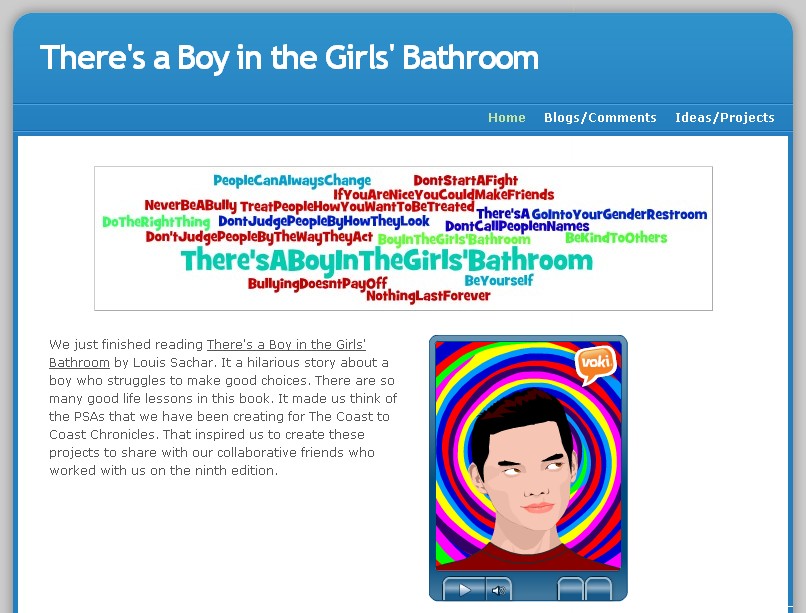
As my students were putting the finishing touches on their collaborative PSAs that they were creating with students from across the country, we were reading There's a Boy in the Girls' Bathroom by Louis Sachar. One of my goals this year is to bring more literature into our day in spite of our rigid schedule and prescriptive reading program. (See blog A Book in a Day) I select books that have high interest for the students in my class, that spur great conversations, and that reinforce the standards that we're studying. This book has many of the themes that that go along with the Coast to Coast Chronicles Edition 9's theme. The 200+ students wanted to create and collaborate on the theme of "Making a Difference." These PSAs were for The Coast to Coast Chronicles.

As we finished up our book, my learners asked if they could create different projects to go with the book that would also connect to their collaborative work on the Coast to Coast Chronicles. That's right...they asked to do these projects. They brainstormed all kinds of ideas about what they wanted to create. As with everything else, we only had a small amount of time that they could work on this project from start to finish. They wanted to publish "a digital poster that would hold their different projects." My first thought was that we would use Glogster. But after a few minutes, we discovered that it was blocked at school. One student said, "I wish we could just create a website or something." Great idea. That's when Weebly came to the rescue.

http://theresaboyinthegirlsbathroom.weebly.com/
Weebly is a free site (there is an upgraded paid version) that allows one to create websites. It has a very easy drag and drop interface that my students navigated very quickly. There are preset themes and templates to get you started. While two of my students started setting up the page for the class, the other students broke into pairs and began planning and writing their projects.

I conferred with each pair several times throughout this project. They knew that they were responsible for explaining what they were creating and why it supported the themes of the book and the Coast to Coast Chronicles. Several of them wanted to tell about the story and the themes through a certain character's point of view. After writing, and conferring with me, they decided that Voki would be a great way to publish this. (See blog on Voki). Another team wanted to use the camera and act out what they had learned from the book about bullying. They decided to publish is as a Voice Thread. Others wanted to write poetry. They wanted to create songs with their poetry. We pulled up Songify on my smart phone, they selected the music that they wanted to use, read their poetry into the phone and published their song.

http://theresaboyinthegirlsbathroom.weebly.com/
My learners were so excited about what they were creating because they felt like it was going to be a surprise to all of their collaborative Coast to Coast partners....a little something extra for this edition. Of all the tools used, the one that's holding it all together is Weebly. It may not be as flashy as a VoiceThread, Voki, or song, but without it my students' planning would have probably stopped short. It housed all of their creativity and supported so much learning. So although it probably won't be discussed much when the other students see our Weebly, my students know that it's the tool that made it all this student-directed learning possible.


Thursday, October 20, 2011

What's In Your Writing Tool Belt?

With today being the National Day on Writing, my students and I have spent some time discussing "why I write." They have actually created tweets to add to the hashtag #whyIwrite throughout the day today. When I think about the what has made the biggest difference in my students' perception of creating and writing, it has to be that they now write and publish for an authentic audience...not just for me or some mystery scorer. Their writing has an audience and a purpose.

So on this National Day on Writing, I would like to share our top ten favorite tools that support writing. These tools empower my writers by strengthening their voice.


  1. KidBlog- Those of you who have been following my blog know that my learners have latched onto blogging like a fish to water. They have become voracious writers sharing what they are learning, reading, exploring, or contemplating. Rarely is there a time when at least one of my students isn't blogging. They have found the power of personal reflection and love the aspect that what they write has an audience who will continue their conversations and challenge one another's thinking.
  2. Voice Thread- This is a truly collaborative tool that allows participants to make comments and continue conversations. Usually my writers create a piece of writing, upload it, record it and then their peers will comment upon one another's writing. Comments can be done with text, voice, video, or doodling. 
  3. Wikispaces- Wikis are a fast and simple way for students to collaboratively publish their writing projects. It gives you the ability to not only insert text, but also insert Word documents, audio files, URLs, PowerPoints, video files, spreadsheets, and photos. And if that wasn't enough, you can also embed projects like VoiceThread, ToonDoos, Vokis, Xtranormal, Wallwishers, and Livebinders directly into a wiki.
  4. ToonDoo- ToonDoo is a tool that lets the writer create a comic strip. They provide a huge gallery of clip art and speech bubbles, my my creative students love drawing their own illustrations, scanning them and uploading them into their ToonDoos. You can also upload photos. If your students want to create more of a comic book page than a comic strip (like my students), you can try using ComicLife.
  5. PhotoStory-My learners love taking their writing and turning it into a digital story. When they finish publishing,  we often have a viewing party.  The tool that we turn to most often is PhotoStory.It is very intuitive to use as it walks the user through every step of the publishing process.
  6. Audacity- If you are looking for a tool for your learners to create an audio file or podcast, Audacity is user friendly. There are the basic functions of recording a piece of writing as well as a lot of bells and whistles which can really tap into a student's creativity.
  7. Lintor Publishing- I described Lintor Make-a-Book in this blog post.  Because sometimes writers still want a tool that allows then to hold, carry, and physically share their books with others, my writers love using Lintor's products. They provide a variety of templates as well as book sizes so that students have the opportunity to create their own hard copy, hardcover book from start to finish.
  8. Twitter-In class, we have a Twitter account. Many of you may be wondering about this as a publishing tool as a user only has 140 characters. However, with Twitter, my learners have to learn about being succinct and powerful in their words choices. It has really helped them to focus on their message and the best way to get that message across to their followers. They all agree that standard English is what we use when we tweet from school...no "text speak" so that all of our audience understands what they are saying.
  9. StoryJumper-In this post, I wrote about a project that my writers created using StoryJumper. StoryJumper allows students to create digital storybooks which can also be purchased should someone want a copy. StoryJumper has huge selection of clipart and backgrounds, but writers also have the ability to upload their own artwork and photographs, which my learners love.
  10. Voki- I wrote about Vokis in this blog post.Voki allows the user to create a personalized talking avatar that can be easily embedded into wikis, blogs, profiles, and email.Voki has the option for the creator to type the text they want spoken or record their voices with their avatar. 
So there's our list...for now. Ask us again what our favorite publishing tools are in an hour and you would probably get a different list. The one constant is the role that these tools play in our stduents' writing....they support the writing; they are not the driving force. We would love to hear about any publishing tool that your students enjoy. Have a happy National Day on Writing today.

Wednesday, October 5, 2011

An Afternoon in "Pleasantville"

Today, we had the most pleasant afternoon. My students spent this afternoon blogging, answering questions and making comments to their collaborative partners on Moodle, and working on a Global Read Aloud Project. They were all sitting in different small groups all over the room, occasionally chatting about what they were thinking about, writing, or creating. There was just a nice, low hum of happy kids discussing what they were learning with one another. I loved it!

Moments like this just make me want to do a little dance. They are so highly engaged and independent from depending on me to tell them what to do. Of course, this afternoon didn't just happen. It's taken weeks of modeling, discussing and practicing how and why we use these tools and what behaviors they deem appropriate. They've set their own expectations and they are holding one another to those expectations.

The great thing about this afternoon (besides listening to their happy, thought-provoking and somewhat humorous comments) was that this gave me the opportunity to work with some students one-on-one. While they were all actively engaged in meaningful work, I was reading through their pending blog posts. By looking at their writing, I was able to determine if they had a misunderstanding with their grasp of not only content area but also with grammar and mechanics.

It was a great opportunity to visit with my students and have them explain what they saw in their writing that could improve it for the reader. Almost all of them would take a minute to look at what they had written and determine what should be corrected. Others needed a bit more prompting, but by leading them to making those discoveries meant much more to them. They found the error; they determined what needed to be corrected; they determined why it needed to be corrected. (By the way, those of you itching to write a comment about how blogging shouldn't be evaluated, need to read these previous posts: Did I Make the Grade? The Reading Log Conundrum and What is Homework? It's not a luxury that I have where I teach right now.)

This method of conferring, letting the students make the edits and corrections with your guidance, is much more powerful for the students. We use this in my classroom for all of our writing assignments regardless of genre, content area, or method of publishing. It allows them to make these discoveries for themselves. It's no longer a teacher telling them what to do and how to do it. It's them making these choices because it strengthens their voice in whatever they are writing.

So, I look forward to many more days like this where my writers are all engaged in meaningful, (and let's face it) fun and yet rigorous work. Now back to reading those blogs....they have passed 400 blogs since school has started. What do you think? Do my kids like to write, or what?

Sunday, September 25, 2011

A Tale of Two Tools

In a small school, not too far away, two tech tools hesitantly stepped into a classroom of excited fifth graders. The anxious fifth graders were sitting in pairs with net-books at their fingertips awaiting a new experience...one that could make them experts. The first tool, Lit2Go boldly stepped up first.


Lit2Go knew his power. He has hundreds of pieces of literature to share with the world. They are in print and MP3 and he can find what anyone needs whether by author, title, reading level, or subject matter. If those don't work, he also has the power to search by keyword. He's confident in his abilities to put quality literature into the hands of every student.

The students excitedly put Lit2Go to good use and found examples of 71 different fables to read, listen to and discuss with their partners.But where would these students put their new-found knowledge? That's when Lit2Go remembered his friend who had come into the classroom with him. He looked around and saw Lino-it waiting patiently for her turn.

Lit2Go called, "Hey, Lino-it! These kids need you. They have all of these new discoveries about writing in the fable genre, but they have nowhere to put all of this new knowledge. Can you help them?"

"You know, I'm the master of organizing important things. They can put post-it notes on me and I'll help them collaboratively build a wall that they can use day after day while they are writing," Lino-it confidently replied.

Together Lit2Go and Lino-it worked to help these fifth graders become experts at analyzing and creating fables of their own.The students loved that they had a plethora of fables to read and learn from. They were thrilled about how they could individualize the look and organization of their post-its on Lino-it, building their own tool to help them create fables for their collaborative fable anthology project.

At the end of class, Lit2Go and Lino-it gave each other a high-five, "Smack!" They knew that they had done their job and supported the learning and discovery of an amazing group of fifth grade students. These students were now fable-writing experts thanks to their support. They look forward to teaming up again whenever the need arises.They wave "good-bye" to the class as they set out in search of another class that may need their support.

The moral of this story is that powerful student learning is enhanced by quality tools like Lit2Go and Lino-it....so choose wisely.

(PS My students..who have discovered this blog...may point out that I missed a few of the characteristics that they discovered about fable writing in my little fable here. That's fine with me...they are the experts now.)

Tuesday, September 20, 2011

What is Writing?

I was recently sitting  in a grade level data meeting. As usual, I sit and listen, often keeping my comments to myself as my opinions and viewpoints are often counterproductive to the mission of the people driving these meetings. However, as the discussion turns to standardized testing, the comment was made that the students could not write as evidenced on the recent scores.   What they were calling writing is the portion where students answer an open-ended test question in reading or math. Yes, they physically have to use a pencil to compose an answer, but is that really writing?

I continued to sit and listen until I finally had to jump in.What they were describing is not writing unless you are calling the action of using a pencil to compose words on a page writing. Now don't get me wrong. My students do well on open-ended questions. I teach them a basic formula for answering this type of question that even my lowest of students can use with success.

When I expressed my opinion that what they were describing was not writing, I was met with confused faces. I honestly don't think they had ever thought about the true difference in the physical act and the craft. Unfortunately, the only "writing" that is given any credence is the writing that is done for standardized testing.

Not only was I irritated that they refused to listen, but I worried about the students who would never know the thrill of composing something that reaches others or helps them to explore who they are as people. What if students aren't given the opportunity to create something new and communicate it to others through their writing? Think about all of the ways that we write every day...mostly using a keyboard or touch screen. Students do it everyday through texting, messaging in games, blogging, Facebook, etc. Shouldn't they have the opportunity to learn how to amplify their voice through the written word at school?

This was still bothering me when my students and I returned to the classroom. So I asked them to explain through their blogs what writing is to them. It was not an assignment, just a request. I just wondered if my 10 year old students understood what teachers missed. Here are three examples of what I found:
I think we write so we can first of all learn. The only way we can learn certain things is by reading. Another reason we read and write is to express our feelings about different topics. Two more reasons that I think we write are to share our learned findings with other people and to explain how to do things. Everyone should write. ~LH
What is inspired writing?  Inspired writing is a good way to connect to your conscience. The hardest part of inspired writing is allowing the writing to happen instead of questioning what people will think about it. But how do I know my writing is true? It’s what speaks to me that’s true. When I write I think about what would interest my readers about this writing or what could make it better, but I also must be true to myself. I hope you begin writing with the intention to share your soul or the thoughts that amaze you.  ~KV 
When I write I like to express what I think about the question or the answers I write down.  Also, some grown ups don’t like to write anything even sometimes for work.  Writing is fun to me  because when you write you can express your feelings in it. That is why I like poetry. ~KA 
Do my students understand the importance writing? Is it more than the physical act of picking up a pencil or pen and putting it to paper? You can tell from these three examples (I could have put many more) that they each understand not only what writing is but also why we write.

I recently read that one of the biggest downfalls of students today is their inability to communicate. One of the biggest ways that we can communicate with one another is to write.. compose, create, explore. So no matter what age group or content area, please encourage your students to write. So even if you feel uncomfortable as a writing teacher, I hope that the quote below will give you something to think about.
We write because my teacher said so. We write to prepare for standardized testing. We write to explore who we are, to connect to those in the world around us, and to create something new.


Sunday, August 21, 2011

Did I Make the Grade?

I've just finished my first week of school with my new class of fifth graders. This week, we started out building a strong foundation for the rest of the year. We did many of the same activities that I discussed in Chapter One of Can We Skip Lunch and Keep Writing?, but we also stretched and adapted those strategies as they best met the needs of my students. Much of what we do springs from conversations from reading Frindle by Andrew Clements. It serves as a great example of writing as he expertly weaves together the different modes of writing and the use of figurative language, with an entertaining story for middle aged readers. As we read it, I encourage my students to not only enjoy and discuss the humorous story, but also to begin looking at it through a writer's eyes.

As we are reading, my students begin to create a list of "Characteristics of Great Writing." My new students begin a bit hesitantly to add to the list as I've requested that they explain and justify their answers. I ask a lot of questions to guide them in this kind of thinking. They've been so trained to think that there is only one possible answer or conclusion to a question that when I told them that most questions have a multitude of possible answers, you could see a burden being lifted off of their shoulders. They were so eager to grasp this new kind of thinking. This discussion led students to making conclusions not only about the craft of writing, but also they purpose of composing using correct grammar and mechanics.

All of these fabulous conversations lead us into our blogging conversation. None of my students have ever blogged before and most of them were unclear about what a blog was. I used a variation on McTeach's blogging lesson, but the students naturally linked the importance of good writing from our Frindle discussions to our blogs. We also read and discussed parts of Net Cetera (I ordered copies for each family) to ensure that the students understood digital citizenship, Internet safety, and cyberbullying.

One strategy that I love is that I let my learners create their own criteria/rubrics for each of our activities. It puts the power of expectations into their own hands. After all, this is their blog, they should have a say over what should be included. (Note: I realize that many feel that blogs should not be evaluated. However, those that read my blog regularly know that this is not a luxury that I have in my classroom. See: Homework and Reading Logs)

Since this was the first criteria they were going to create, I led them through it as a class. Here is the list that they created of their Blogging Expectations:


  1. Use proper capitalization, organization, punctuation, and spelling. (As they explained, "If you don't edit, it doesn't matter what you've written; no one will understand you.")
  2. Be safe with all of your choices.
  3. Create posts that show what we've learned.
  4. Always use appropriate and kind words.
  5. Think about the audience.
  6. Explain and give great details in your posts. ( As one student said, "Who wants to read something that's boring?")
  7. Compose three or more blog posts a week. (They really wanted to have more in this number, but several students do not have access to a computer outside of school hours.This was a heated debate...pretty cool that most of the kids were fighting for MORE work instead of less, huh?)
  8. At least one of your blog posts will be about what you are reading. (The class actually cheered when they figured out this was going to replace the dreaded reading logs.)
  9. Create comments that are thoughtful, relevant, and continue the conversation.(One learner actually pointed out that by creating comments like this, they were also giving evidence that they were reading...score another point for getting rid of reading logs, but still meeting that independent reading standard on the report card. Yep, he got a high five...wish I had though of that.)
  10. Practice using characteristics of great writing in every post.
Is this the of expectations that I would have made for them? Absolutely not! It is infinitely better. This list demonstrated to me how well they had grasped all of the activities and discussions that we had done all week. They tied it all together and saw the relevance of how all of the pieces of the puzzle fit together better than I did. What I didn't realize (until we were done) was that they were grading me on how well I had done this week. Did I make the grade? Did I grow as a teacher this week? I think so. This group of learners are going to keep me on my toes. The sky's the limit now. Who knows what tomorrow is going to bring?