Showing posts with label teaching. Show all posts

Thursday, June 7, 2018

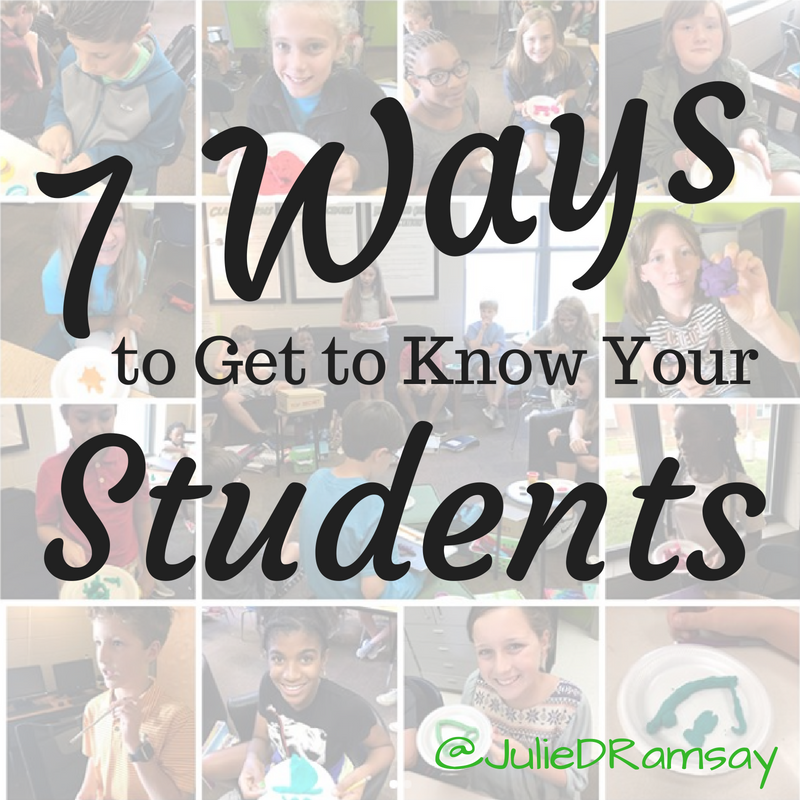
7 Ways to Get to Know Your Students

As teachers, we know the importance of building relationships with our students. How can we teach them unless we know them? They have to trust us, and it's impossible to trust someone who doesn't know who we truly are.

As I make plans for this upcoming school year, where we will be blending together four different, diverse schools, I know that building meaningful relationships with my students will be a key to making this a smooth transition.  Over the years, I've honed my practices to things where I felt everyone could be successful and no one would be embarrassed. While this includes our ELLs and ExEd students, it's also important to remember that for some of our students, time away from school is a nightmare. Writing prompts asking them to share about their summer break shines a spotlight on the fact that they may have spent the time living horrors they don't want their peers to know about. 


With that in mind, here are my top 7 ways I use to get to know my students.


  1. Student Survey & Parent Survey: On the first day of school, I present my students with the opportunity to answer a few basic questions about themselves. It's similar to an interest inventory, but I also include things like their learning preference and favorite school memory to provide me a peek into their perceptions and expectations for learning. Also, I send home a "Welcome to Sixth Grade Letter" inviting parents to take a Parent Survey. Who knows the students better than their parents who have been with them for the duration of their lives? Both of these are simple Google Forms that do not take much time for them to complete. Typically, I get almost 100% of my students to complete their form, and I usually get about two-thirds from the parents. This provides me with valuable insight to begin shaping my instructional strategies from day one.
  2. Self-sculptures & Name Game: On the second day of school, students find Play-Doh waiting
    To watch visit http://bit.ly/NameGame17
    for them at their seats. They are challenged to create a sculpture that represents who they are within seven minutes (I've found that five is too short, and ten is too long). Then we take turns sharing our sculpture and naming each of the people who went before them sharing what they sculpted and how it represents that person. I make sure that I also sculpt something because I want them to know that we are all a part of this learning community together. I share with my students that learning names is VERY challenging for me, but that I am going to challenge myself to know all 100 of my students' names by the end of the day. I strategical position students for when they take their turn based on the information I collected from the surveys from day one. I take a turn periodically throughout the activity so that students get to hear the names and information repeatedly. It's funny, students periodically bring up the different things they learned about each other throughout the school year. (Check out this video where my turn was captured on Twitter by one of our district admins last year.)
  3. True Colors Test: Five years ago, our sixth-grade team went through an intensive journey of self-understanding and characteristics of how to communicate effectively with one another. We took several researched-based personality assessments. Through those conversations, we came to the conclusion that our students needed to be empowered with this knowledge about themselves, their peers, and their teachers. About a week into school, all sixth-grade students take the True Colors personality test. Once they have the results, we discuss learning and interpersonal communication strategies they can use to advocate for themselves as well as effectively communicate and collaborate with one another. This year, the entire school participated, and students received rubber wristbands to identify their True Color. As their teacher, it gave me pertinent information on how best to reach each student and the types of challenges where they would thrive.
  4. Passion Blog Post: Our first assignment is for students to write about one of their passions. They are challenged with choosing something that most people may not know about them. It can be a hobby, a favorite, or something they collect. As we move through the writing process, I meet with each student one-on-one. This gives me the opportunity to have an individual conversation with each student on a topic that they chose and that they love. Not only do I get to know some academic strengths and weakness as well as one of their personal interests, I have the opportunity to work at strengthening our relationship and building trust.
  5. Tagxedo Dots: Every year, my students participate in International Dot Day, a day devoted to focusing on how students can make a mark on the world based on Peter H. Reynolds' book The Dot (see this).  One of the activities in which each of my students engages is to create a word cloud comprised of 40+ words that describe her/him. I encourage them to dig deeply into their unique qualities. They print these out in the shape of a dot using Tagxedo and we hang these up around the room for the entire year. It's a piece of them that always stays in our learning environment. Because students have been with me for about a month, they feel more comfortable opening up and sharing pieces of who they are through these dot word clouds, which provides me a different look into the unique individuals they each are.
  6. Teacher Feedback: If you want to know how well you are reaching students, why not ask them? Four times a year, I ask my students to write me a letter, blog post, or email telling me what I've done as their teacher to help them find success. I also ask them to share some strategies, tools or activities I could implement to further support them as a learner. I encourage honesty; I let them know that I need their honesty to become the best teacher for each individual. Yes, sometimes you need a thick skin. Yes, sometimes you need a tissue because you laugh so hard you cry. Ultimately, I've found these messages from my learners to be the biggest catalyst for my professional growth.
  7. Outside Events: Our learners need to know that we care about them as individuals. This stretches beyond the classroom walls and dedicated school hours. They need to see us at their community theatre and dance productions. They want us to cheer them on at athletic events and competitions.  For many of our learners, we may be the only person in their lives who truly care about what happens to them. And while it's not possible to attend everything, our learners need to see that our concern for them is truly genuine and not limited to a few moments during one part of their lifelong journey.

What have you found is an effective way to get to know your students? Do you have a favorite activity or strategy that you use? I'd love to grow my "Get to Know You" repertoire. Be sure to leave a comment below or hit me on Twitter (@JulieDRamsay) or on my Facebook page.

Wednesday, January 11, 2017

Are Master Teachers Also Master Storytellers?

I love stories. Reading them, listening to them, watching them. Through stories, we can live many lifetimes. Travel to exotic places. Have amazing, death-defying adventures. Save the world. Experience life from a different perspective. As humans, we enjoy connecting with others. Through compelling stories, we get that opportunity, whether the characters are fact or fiction. Great stories touch our hearts and propel us forward as new, different individuals. When we read, hear, or view great stories, we want to know what happens to these characters. Will they survive? Will they be happy? We become invested in them.

As I reflect upon this, I can't help but think back to some of the most compelling stories that have stuck with me over the years. I remember having some fantastic teachers who wove the most intriguing stories that drew their audience (their students) into the world they were sharing with us, whether it was fact or fiction. What they said mattered to us as students because we became invested.

When I entered the classroom, without recognizing it (at first), I began emulating these fantastic teachers by weaving stories for my own students. It wasn't until I was observed by another teacher who pointed out that the students were hanging on my every word; they were engaging and interacting just when the story called for it. It was a history class and I was telling "The True History Story" about a historical event....one that history books dared to leave out. That's when I realized that storytelling is a crucial skill for teachers to employ with their students.

We want our students to connect with our content. We want it to matter to them. By creating stories that set the stage for a lesson or frame a new concept, we are opening up a new world for them. When it's done well, learners connect and ask questions. They develop empathy for others. Students see the relevance of why they are learning what we are asking them to learn. Students become invested.

So when you enter the classroom and it's time to teach a new concept, introduce a new style of writing, dive into a new author, or explore a new principle, ask yourself, "How can I weave this into a story that will hook my students and make the learning meaningful?" It can be as simple as changing the lighting or arrangement of the classroom. Sometimes you take on a different persona or change your voice. Stories have power, a power to elevate our students and propel them forward to do great things. What story will you tell?

Wednesday, December 14, 2016

So You've Had a Bad Day

We've all had them...seriously. Those days that never seem to end. Nothing seems to go right. Your to-do list continues to grow. All around you, you see others whose lives seem picture-perfect both in the classroom and personally. Yet, you are struggling to make it through a single lesson....and those lessons are far from the vision that you had for them. You have students who need help academically, socially and in their personal lives and you feel like you are failing them every single day. You begin to wonder, "What am I doing wrong? What am I missing that everyone else seems to have figured out?" You may even be in a place where you are questioning your ability to continue in this position. What do you do when you have THOSE days?

In the interest of being transparent, I must admit that I have been having a series of THOSE days recently. And as I sit here writing, I have been trying to reflect on my choices and how I can change my mindset to best provide my students what they desperately need.

One thing that we all need reminding of is that we cannot compare ourselves to the highlight reels that other educators post. We are living the good, bad and ugly. We see it all. Typically, excitement leads us all to  share our successes with others. We've built relationships. We want to pay forward to those who have helped us out by sharing successes. Although these posts come from a wonderful place, as the audience, we need to remember that for every success there is a cache of failures. As educators, we are lifelong learners who have learned that failures can be a very positive way of growing. Unfortunately, we don't always share THOSE experiences which leave the appearance that everything is smooth sailing. I guarantee that every single educator that you admire, no matter who they are, is having that same feeling of inadequacy from time to time. That feeling is typical for educators because we all feel the weight of responsibility that we are carrying with us every day. Our students need us...

For many of our students, we are the light in their days. We are a break from their reality beyond the classroom walls. We are the safe place that inspires, encourages, nurtures and guides them into being the best part of themselves. We are equipping them for their future; the future they imagine for themselves. That is indeed a  grave responsibility. However, as I look back on some of my most significant successes with students, many of them have been born out of a failure, where something unintended happened. When we have a lesson that is less than stellar or the new strategy that we were hoping would support a student in a particular area of need, we all (and I'm speaking to myself here) need to remember that our students are going to learn from our example and how we handle things when the train comes off the rail. We need to remember that we are teaching humans, not content. Our actions speak much louder than just our words.

And with that idea in mind, we need to remain focused on our mission. It is easy to become derailed. We all have things that impede our time or ability to effectively teach our learners. We have pressure to give standardized assessments and collect data. Lots and lots of data. We have book studies, action research, new school procedures and committees that need our participation. There are parent conferences, IEP meetings, eligibility meetings, 504 meetings, RtI meetings, department meetings, faculty meetings and grade level meetings. We serve lunch duty, bus duty, and hall duty. We coach, mentor, sponsor, and lead professional development. Many of these come with their set of time, responsibilities and work. As educators, we have so many (worthwhile) things pulling at our precious time; it's easy to lose our focus. When we become overwhelmed, it is crucial that we remember WHY we do this: our students need us. They need us every day. We need to make them our number one priority.

It's okay to have a bad day. We all have them. Sometimes we have a bunch of them in a row. But as the lead learner in our classrooms, it's how we handle them that can make a world of difference in the lives of our students.

Saturday, February 27, 2016

Feedback: Taking it to Heart

Feedback. It's a topic about which I have written quite a bit, especially in the realm of its integral role with student learning. However earlier this week, I got to experience the role that feedback should have upon the instruction provided to the learners. I know that all of us have dutifully completed surveys at the end of a day of professional learning only to see that no changes are made to subsequent events. As a participant, it implies that your voice isn't important; others know better than you. You become a victim to what others want for you rather than having that control over the learning process.

I can honestly say that my experience with the Network to Transform Teaching Hub team was the complete opposite. Never in my experience, have I observed a group of organizers take the feedback left at the end of one day, to immediately turn around and spend hours making alterations and adjustments to the following day's agenda based on what the learners needed or wanted from the experience. I want to point out that all the participants received an agenda (a plan) that I can only imagine took days to create in advance of the learning session. Yet, the Hub team valued what everyone said and were willing to make adaptations to meet our needs.

For me, this served as a perfect model for how accomplished teachers would approach their classrooms. We all collect information and data from our students, but the real question is what do we actually do with it? Do we listen to what our students are actually saying and make changes to our plans based on what we hear? Are we valuing what our students need, what they want out of their learning experiences?

For several years, I have asked my students to provide me feedback on our classroom throughout the school year: What went well? What didn't go well? What goals do you have? What changes can we make to better support your learning? As the recipient of that feedback, you have to be willing to hear some things that may be very hard to hear. I've had some learners provide feedback that has brought me to tears, but when I honestly looked at the choices that I made, I could see the disparity between what I thought I was doing to support learning and what the student perceived.  Even though we may spend hours planning to meet the needs of our diverse learners, the truth is we don't know how our intentions translate to each one of them unless we take the time to ask, truly listen, and put their ideas into action. Because the reality is that this learning is about them, not us. They deserve the best learning opportunities possible. We just have to provide the tools, guidance and pathways to get them where they want to go.

Want to read more about feedback in our classroom?


Thursday, February 25, 2016

Learning is Hard

This week, I have been immersed in a four day learning session. While the work is extremely valuable and exciting for student learning, it is completely out of my day-to-day realm. I possess very little foundation in this type of work (in spite of completing my homework in advance). As I reflected at the end of the day yesterday, I realized that much of what I was experiencing can be very similar to what some of our students may experience within our classrooms everyday. As someone who strives to learn and grow every single day, it was an eye-opening experience to sit in this role.

This lead me to question the choices I make with and for my students. Am I providing them the supports that they need to make sense of the content with which we are working? Do I give them some context upon which to hang new ideas and then the time to process and discuss these ideas? Am I stopping throughout the learning process to check for understanding or am I trudging forward full speed ahead oblivious to the fact that a student is sitting there completely lost and frustrated?

Furthermore, what are my students experiencing? Are they so overwhelmed that they complete shut down? Do they feel like they are the only one in the room who doesn't get it? Are we giving them an opportunity to vent their frustration? (Thank you, Emma) Are they getting the encouragement and one-on-one support that they need to keep moving forward instead of completely giving up? (Again, thank you, Emma)

Learning is hard. Sometimes it's scary. As the lead learner in our classroom it our obligation to look out for every single student put into our charge. Sometimes it's important to put ourselves into their shoes and feel how overwhelming, messy, and ultimately, exhilarating learning can be.

Wednesday, February 17, 2016

What do you value?

This past weekend was the University of Montevallo's annual homecoming, College Night.  For College Night, students break into two teams, gold and purple. Each side spends three to four weeks writing and producing an original musical. Everything is done by students: costuming, musical compositions, choreography, set design/building, lighting. The two sides perform, amidst each side's chanting and cheering and it's scored by a panel of judges. A tradition like none other in the United States, it began in 1919 and is a considered a local legacy by the Library of Congress.

As we were ensconced with all the different College Night celebrations, it occurred to me that many of the attributes that we value in our classroom are also valued at Montevallo: creativity, collaboration, community, voice, hard work and acceptance.

It's obvious, to even a casual observer, that the University of Montevallo values those traits. As a teacher I couldn't help but wonder how we demonstrate what we value within our classrooms? What does a casual observer see when he/she walks into our learning space? Are students sitting in quiet rows working on test-prep? Are learners sitting all over the space, collaborating in face-to-face and digital formats? Are they building and making things? Are they applying their learning in meaningful ways? Is everything focused towards a score on a standardized test, or are students pushed to demonstrate mastery on authentic problems? Where we invest our time and energy shows what we value.

I think whether we make conscious decisions or not, what we value as an educator can be seen with our students in our learning spaces. Sometimes, we need to take a look in as an outsider to see if what we value is truly what is being manifested in our classrooms. If someone who didn't know you came into your classroom, what would they see?

Let's take these ideas and build the best learning experiences possible for our students.

Monday, March 9, 2015

Fairy Wings, Time Portals, and Falling Down the Rabbit Hole

Like many classroom teachers, I will do whatever is in my power to provide my students with the level of support and challenge that they need to meet their goals. I strive to put the fun into every day. There is plenty of research that supports that fun is a legitimate, pedagogical choice in teaching a person something new. It removes fear from trying something new, produces dopamine and endorphins in the brain causing conenctions, and opens the gateways of moving new ideas into cognition. Recently, I have been in a search for new ways to bring fun into my classroom. I say new, but what I discovered in my search was something that I did as a new teacher; somewhere along the way, it dropped out of my practice. What was that? you may ask. That was the joy of bringing "guests" into my classroom...guest as in me dressed up in a costume and interacting with my students from a different perspective.

This idea occurred to me as I faced the grand task of teaching A Christmas Carol to my sixth grade students. I have been very fortunate to collaboratively plan with my ELA colleagues this year. They had done a unit centered around A Christmas Carol in past that had been extremely successful in helping students master multiple standards. I immediately began to question my ability to not only effectively use the text to provide modeling of literacy standards but also and adeptly scaffold their learning within this complicated text. Furthermore, I was keenly aware that this would be their first experience with classic literature. I want my students to LOVE literature as much as I do and I didn't want build up negative opinions about these texts years before they would tackle them in the future.

While I was racking my brain, an idea crystallized. Wouldn't it be cool if kids could travel through time to see how different life was during the 1840s and 1850s in England and how that directly impacts the writing of that time? Since I found myself lacking a working TARDIS of my own, I decided to bring history to them. I decorated our classroom like Victorian Christmas time and came to school as "Clara Bennett" from 1852 England. I dressed like her, spoke like her, and created a deep history that wove together Victorian life in England and the United States (which included their 6th grade history content; fortunately, Dickens did a tour in the US which lent itself perfectly to my story).

When student arrived, they travelled through our "time portal" and then we began our conversation. Now I knew this would be fun for them, and I expected it to last for about 20 minutes of class. What I didn't expect was how engrossed in it my 6th graders would become. They asked endless questions. They had to learn to accurately describe and explain things during their time (microwaves, cell phones, televisions, video games, etc.) to someone with no background knowledge. This honed their communication skills better than any activity that I could have designed and they were totally hooked on Victorian England. 

The next day, when class began they told me about my ancestor (their conclusion), Clara Bennett, and in detail about the life of Charles Dickens and Victorian life in England and America. When I asked if they wanted to read some of Charles Dickens' work, the answer was a resounding yes.

I had forgotten the impact that a costume could have upon students. Since then I have dressed up as "Faire E. Wiing" a travel consultant who connects students with a personalized travel adventure in the Fairy Tale realm. I've taken on the persona of the Mad Hatter when students shared their narrative writing projects. Each time, the students treat our learning as something special, out of the ordinary. For them it's a time to sit up, take notice because something special is going on that they don't want to miss. And true to that brain research, my students gain a deeper understanding of whatever content we are discussing and adroitly apply it to future learning.

Last week, we had several guests come to our classroom and I overheard one student tell one of our visitors, "You better keep your eyes open and be ready in Ramsayland because you never know who is going to show up to take us on an adventure." With that endorsement, I know I need to continue to look for other ways to purposefully bring the fun to their learning. I realized that as educators, we need to be willing to fall down that rabbit hole and embrace whatever method we find in meeting the needs of our learners. 

photo credit: Time & Money via photopin (license)

Saturday, April 12, 2014

From Numbers to Meaningful Feedback

In the world of education there seems to always be a new crop of buzz words creeping into our professional conversations. One thing that I've observed is that we all may use the same words, but often we are speaking a different language. Just like my students and I discuss how we each build different perspectives/connections based on our schema (background experiences), the same is true of us as educators. We may change our vocabulary without altering our practice.

I recently completed a graduate program in Teacher Leadership. One of the best aspects of this program was my experience of viewing things from the perspective of a student again. As I traversed this world of academia, I discovered that although many of my professors used the word feedback, they had little understanding of its true meaning.  I would diligently complete my projects or papers, asking questions along the way for clarification of the expectations, submit the assignment, and then receive a score.  The most frustrating part of this process was not the heavy workload or the irrelevant projects that sucked away my time, but the utter lack of feedback. I would receive a number score with a comment along the lines of "good job." I was flummoxed. I couldn't help but ask: Good job with what? How do I grow? How do I improve? Could my writing improve? Was there a way to deepen my content knowledge? Did I make some grammatical or mechanics errors that I could or should avoid in the future?

As I wondered about the disconnect in what a professor said and what he/she did, I began turning that question on my own practice with my learners. Was I saying one thing and doing something completely different? The number score and "good job"type of comments had long been left behind as I began conferring with my students and letting them set their own academic and personal goals. I realized that often my students would come back to me and inquire about their feedback in these sessions. They needed something tangible upon which to return to remind them of specifically how they needed to grow or where they were headed as a learner. That's when I began leaving private comments on their blogs and their Google Drive work. If I ever failed to leave feedback, my students would come back and ask for it; this showed me that they valued having my input to guide their choices and help them to grow as learners. One student actually told me this year that she was so glad that I didn't just give them a number. In her words, "Numbers don't really mean anything."

How many times are we guilty of slapping a number or a checkmark on the top of a paper or project? What signal is that sending our learners? What does the focus become? It's telling our students that the grade on a assignment is just a hoop they have to jump through to progress to the next assignment. It completely eliminates a focus on their learning. Learning is fluid and ongoing. Although students may master a standard, there is always room for growth. Yes, I teach sixth graders ELA, but I have several students who are working on mastering seventh and eighth grade standards. Isn't that what we want for our students? To continue their learning journey, wherever it may take them throughout a lifetime? There is no end game when it comes to learning.

As I was contemplating all these thoughts, it occurred to me that I needed to know what my students truly thought about our classroom. They understood and craved meaningful feedback; it's an integral part of our learning environment. So, I asked my students to provide me with meaningful feedback on our class. I completely trusted them because they understand the power of feedback. It needs to be honest, specific, and provide prompting for future growth. Here is some of the feedback I received:
"One thing I especially like is this: Blogging. I like writing creatively online more than turning in a sheet of paper. It has helped my writing grow because I can get immediate responses and corrections." ~AB
"Another thing that I liked is the pretest. The purpose of our pretest is to show our teacher (aka Miss Ramsay) what we already know. If you were to make a lower grade then you would be in small group,but say you aced the pretest you could still ask to be in small group. That way you can always make sure you really know the material well and can use it in your writing." ~Richard 
"This is random but it would be fun if we had a part of the website or blog where we build up a book list for anyone who doesn’t have anything to read. Each student could add one book each week including the title, author, theme, and a short summary that shows the main point of the book. " ~Annabeth
"Genius Hour could possibly be one of my favorite things though. I loved the freedom in it and that I am getting to do a topic I am interested in and teaching it through art. I have the whole picture planned out in my head and I am really excited to put it on the paper. " ~Belle
"The thing that I really liked about this class is small group.If you were having trouble with the subject you were learning and the test was in two days but you couldn't catch on when the teacher was teaching to the whole class, then you could ask for some help and sometimes you can even get a one on one lesson with the teacher, which can really help a lot." ~Peter
Do my students understand meaningful feedback? Absolutely. As a teacher, if you want to know how to improve, ask your students. They have the answers. From their feedback do I have areas to change, ways to grow? Absolutely. I also get to see their perspective of my practice. I realize that it matters not how well intentioned my choices are if they do not support my specific students' learning. In all of their feedback, do you know what was missing? That's right, a number. And although my students did give some "good job" kind of comments, they always backed up their answers with meaningful examples and ways I could help support their learning. One thing's for certain, my sixth graders could sure teach those professors a thing or two about feedback...and I love it!

P.S. I received permission from students to share their feedback. All student names have been changed.

photo credit: Vince Alongi via photopin cc

Sunday, July 7, 2013

You Can Handle the Truth

Truth. Sometimes it creeps up on us. Sometimes it rips right through us like a horrific hurricane. Truth. Sometimes we can ignore it. Other times it's irrefutable. Truth. It can set you free. It can be terrifying. Truth. I had to take a long look at myself as an educator and face it. There it was. In spite of all of my advocacy for a teacher's continued professional growth, in many areas, I had stopped growing. Truth. My enthusiasm and passion for teaching was beginning to fade. How had this happened to me?

At first, I wrote this off as being overly committed. For a full time classroom teacher, I have a full speaking schedule. Although I give my students my first priority, there are a few days where I am out of the classroom. I try to travel as much on weekends and holidays so that I can continue to share my students' stories and the impact that should have on our teaching practice. I also write a monthly column, Plugged In, for the International Reading Association, in addition to pieces that I write for several other educational organizations and the two new books that I have underway. I am also a full time grad student which consumes much of my evenings. This, of course, is in addition to keeping my priorities of faith, family, and friends at the forefront of my life. However, were my commitments really the cause of my light dimming?

As I reflected on these ideas, I realized that my professional commitments were not the cause. Truth was unblinkingly staring me in the face. I had to face the fact that I needed to make a change. Fear set in. Although life in the classroom is never easy or boring, I realized that much of what I was doing had become routine, mundane even (to me). My students still loved to come to school to learn...begged for it even. I didn't want for that to change. How could I have let this happen? I love teaching and learning from my students every day, but I knew that before my practice began to negatively change I had to make a change. I needed to face the fear and find a new challenge.

With this truth staring me in the face, this winter, I began praying and looking for new opportunities. It seemed that everywhere I went to speak or learn, I had amazing conversations with middle level educators. I began to long to return to teach in a middle school. Along my journey, the last several months, I met some of the most amazing English teachers, which reminded me of where I began my profession, teaching English at a urban middle school. And there it was, Truth. I longed to return to where I began my career, as an ELA teacher in a middle school. So many of those teachers had come to learn from me, but what they didn't realize is that they helped me find a path. (Thank you!)

Now that I had a path, I knew I needed to continue to find a new home. Facing some hard truths about why I wasn't growing, I understood what I needed. Iron sharpens iron. I knew that I would need to find a community of learners where I could continue to sharpen my teaching practice. I wanted a place where I had opportunities to collaborate and grow as a professional. I wanted to find a new "home" where I could provide my students with the best learning opportunities that I could offer. A place that was open to new, innovative ideas. A place where teachers and students could be creative. I continued to pray and search for this place. Does this place even exist?

The answer was a resounding, "Yes!" I have found a new home and in the short time since I became part of their team, my passion and creativity has escalated exponentially. Each day, I wake up with a renewed energy and an abundance of ideas. I cannot wait to meet my new students and work with the amazing educators that have already inspired me more than they know. Truth was I had drifted further than even I had known. It wasn't easy to face that truth, but because I did I have a feeling of rejuvenation that I didn't even know was possible.

I realize that this is a very personal story, one that was difficult to share, one that in many ways is out of character for my writing. But, I felt that by sharing, maybe someone would stop and re-evaluate their own choices. Often times as teachers, we make excuses as to why we can't try something new: new strategy, new tool, new practice, new position. I see it all the time. I think we fail to stop and truly look at the truth staring us in face. We may be unhappy in our current situation, but do we stop and look at the truth of the matter? Do we stop and re-evaluate if our decisions are what's best not just for us, but most importantly, for our students? Do we let fear of failure, fear of change, or fear of the unknown stop us? Do we let fear overshadow truth?

That is the real danger, fear....stepping outside of your comfort zone. We can see the truth and let fear stomp it out. If we are stepping into a new position, new school, new district, new community, there will always be those anxious feelings, but we cannot let that cloud the truth. As long as we are educators, we must remain passionate and excited about what we do everyday. Without that, our lights will dim; we will lose our drive to meet the needs of every student. Truth is that our profession is crucial for the success of future generations. Our learners are counting on us. Will you stop and look at Truth?

Epilogue: Yes, I have found a new "home." I will be teaching 6th graders ELA at Rock Quarry Middle School. I am so excited to be able to learn from and collaborate with the amazing educators there, many of whom have already reached out and welcomed me to their team.

Thursday, June 27, 2013

Concerned Teacher...thoughts from ISTE13

Everything is Bigger in Texas.
ISTE is "my conference." If I don't go to any other conference during the year, I always block out time to be there. This year was my twelfth year...eleven of those I have presented. Yes, ISTE is bigger than life; I guess what they say about everything being bigger in Texas is true at ISTE too. However, as I begin to process and contemplate on my experiences over the last few days, I have to say that I am concerned.  I am concerned that as educators, we have lost sight of what really matters. This conference is not a technology conference; it's an EDUCATIONAL technology conference. It concerns me that many of my fellow educators have lost sight of that distinction.

With so many options at ISTE, it is difficult to select the right events, sessions, and activities. The word I heard most often was "overwhelming." Today, our students are diverse individuals with unique needs. There is not a one-size-fits-all solution. As educators, we must have a plethora of options. Using my previous ISTE experience, I looked for sessions that would deepen my understanding as a teacher. I want to continue to grow and learn new ways to provide my students with the best possible learning opportunities.  I want to sharpen my teaching practice. After all, this is an educational conference...we're all educators.

As I attended session after session, I became a bit disheartened. In almost every session, the entire focus was on tools and apps. Very few student examples of work were shown. The work that was used as examples, although fun to watch, held very little merit. After a day and a half of this, I sent out this tweet:


I am a concerned teacher. Where is the high level of engagement? Where are the learning activities that are promoting higher level thinking and problem-solving? How are students connecting their learning to their lives? Where is the creation of something new to share with an authentic audience? And collaboration...maybe I have a different definition than many others. I believe collaboration is when students each contribute something unique to a project. 

I began to wonder if I had unrealistic expectations. If so, I realized that I would not have very many to attend my session, "Are you integrating or innovating with technology?," because in my session there is a heavy focus on best practices and the role that technology has within our classrooms and schools. Yes, I share tools and apps; yes, I share student examples. But these tools and examples are used to support how we as teachers need to change our thinking and our practice in order to empower students. The conversation we had during this hour I found exhilarating. Many of the people who attended (it ended up being a closed session with people being turned away) expressed similar concerns to mine. They also had been looking for substance that they could take back to their schools and districts.

Of course, there is a place for the "60-tools-in-60-minutes" type of sessions as we do need to know what is out there, but it doesn't need to stop there. As Vicki Davis tweeted, we must "transcend hype and share practical ways that give us hope to reach all kids." We need to remember to keep our focus and become discriminating in our teaching practice. Dressing up a pig doesn't change the fact that it's a pig. Likewise, all the bells, whistles, and animations does not take the place of true learning and teaching. After all, it is not about the tools....it's about the learning...and our students are counting on us.

P.S. I'm positive there were other sessions out there offering fantastic models, practices, and ideas. I'm sorry I didn't find you this year. Please realize that I'm writing from my own experiences. Thank you ~J

Sunday, March 10, 2013

Teaching or Learning?

This week I have been involved in an ongoing conversation about whether as educators we should be focusing on our teaching or on student learning. As was contemplating this idea, an analogy came to mind that I feel represents how I feel about this discussion:
A teacher is like a good cab driver. A good cab driver knows the best routes to get from Point A to Point B. He knows how to get around construction, avoid troublesome traffic, and make the ride a pleasant one for the occupant. However, until someone gets into the cab, that knowledge is superfluous. Once the occupant gets into the cab and tells the driver where she wants to go, it is the driver’s abilities and skills that help her successfully reach her destination. He gets her to her destination avoiding construction, gliding around traffic jams, while still maintaining an enjoyable experience. As teachers we must be knowledgeable and skilled in strategies and ways to meet all of the challenges that students bring to us. However, without the students showing us their needs, we have no way of knowing which way to navigating their learning. 
I feel that this debate is really focusing on the role of the teacher and the role of the student. Do we want our learners to be passive recipients of information? Or, do we want them to dive into topics, applying their knowledge and skills in a real world, meaningful way? Do we want for our students to merely score well on a standardized test? Or do we want for them to become successful in their lives outside of the classroom walls?

What do you think? I'd love to hear your voice on this subject.

photo credit: Thomas Hawk via photopin cc

Wednesday, October 10, 2012

Professional Learning: Is it Pulling Teeth or a Sundae with a Cherry on Top?

I have written several posts in the last couple of years regarding our growth as professional educators (see the links at the bottom of this post). Recently, I have been doing much reading and contemplating about the forms that professional learning can take in today's world. Several years ago the term Professional Learning Communities (PLC) started popping up in blog posts, research, articles, and conference sessions. Those of us who have been in education know that there seems to be an ebb and flow of new ideas and initiatives which, in their essence, are a really good idea, but somehow get turned into something far from the initial vision. Unfortunately, those who are not fully aware of these new ideas, take these seemingly positive movements/programs/ideas and can quickly turn them into something negative.

I think that the whole idea of a PLC is one of these ideas. I have heard several stories similar to this one. A faculty was presented with a book that they were required to read as part of a Continuing School Improvement Plan. As they did the required reading and engaged in the required activities, there was an undercurrent of negativity. Teachers may even say, "I've taught for fifteen years. I think I know what I'm doing. I'm professionally developed enough." Then the faculty goes on to have mandated PLC meetings as grade levels, content areas, teachers with ELLs, and teachers with ExEd inclusion classes. They were always reminded that these meetings were mandatory. All of the paperwork that they had to complete as evidence was mandatory. Do you see a reoccurring theme here? Required. Mandatory.

I believe that most educators really do want to do whatever they can to help meet the needs of each of their learners. That is what PLCs do. Teachers with a wide range of experience meet to discuss challenges and look for possible solutions together. There is a dialogue. Sometimes there is a healthy debate. However, there is always an overlying mission of focusing on helping students become successful. It's a positive experience. The conversations are energizing. The collaborations help teachers to find that passion that led them to teaching in the first place because it is all focused on the students.

What's the difference between the two? One is forced; the other one is inspiring. That is such a small shift, but it makes such a huge perception in how educators engage with one another.

We are fortunate to live in a time where we can find the PLC that we need, even if there is not one where we teach. To me, that is where Personal Learning Networks come into play. If we don't have access to a PLC where we teach, through the use of social media and digital tools, we have access to educators from around the world with whom we can connect. As most educators are, these connected educators are willing to discuss the challenges that we might having and provide insight on how to meet those challenges. These are the people who are in the classroom trenches every day just like you. They know what works because they are living it.

Several years ago, I found myself craving some professional growth that was not available to me locally. I began to connect with other educators through Second Life, Twitter, blogs, nings, and Facebook. They helped me address the challenges that I was facing. They celebrated my successes. They asked my opinion in helping them to meet their challenges. It became an online relationship where we all contributed. I found myself renewed each day after connecting with these educators. As I awoke each day to go to school, I couldn't wait to try out something new I had learned.

I was so excited about my PLN that I realized that I wanted to provide this type of collaborative learning to my fifth grade students. That is when there was a real shift in our classroom. My learners began forming their own PLN. First they built it within our classroom, and then online through social media as we connected with students from all over the world. My learners look to their peers for assistance now instead of to me. They problem solve together collaboratively. Each day they enter the classroom excited by the possibilities without fear of the unknown. They are fearless because they know that they have a strong network to support them on their learning path.

Isn't that the purpose of building PLC and PLN, to empower our students with the tools to become self-motivated students with an unquenchable thirst to learn? So next time, when one of those required meetings comes up, remember what your mission should be, helping your students. And if you find yourself in a quandary as to what to do in a particular situation, keep in mind that there is a world of possibilities available at your finger tips online. All you've got to do is grab a spoon and dive in.

So is professional learning like pulling teeth or is it the sundae with a cherry on top? I'd love to hear your thoughts.

Some of my other posts about professional learning:


 Sundae: photo credit: stevendepolo via photopin cc 

Tuesday, September 11, 2012

When the Shift Happens

As school is beginning, we hear many educators talking about their preparations.

"In my classroom..."
"My discipline plans is...."
"The classroom procedures I designed..."
"The lesson plans I created..."

I had the opportunity to speak to a conference of new teachers and those who were new to our system. One point that I made that elicited many confused looks was when I said that our classroom is not about us at all. 

Yes, we make preparations for our students; we learn stronger strategies for reaching all of our students; we design a learning environment that is conducive to learning and meets the needs of all the different learning modalities. We plan, read, reflect, and change our plans as necessary, but that classroom is not about us and what is best (or easiest) for us as educators.

We must be flexible enough to adapt our plans, find new resources, and allow our students to explore areas that interest them. We all have pacing guides and standards that the students need to explore and master, however our job is to facilitate that learning, putting the responsibility of learning and succeeding into our students hands.

One of the easiest shifts that we can make is to change I, me, my, and mine to we, us, and our. It lets our students know that although you are there and you are the professional in the classroom, we are all on this journey together. We are all learners and all teachers. That shift drastically changes our learners' perception of their role in the learning environment. Their motivation and drive to learn sky-rockets. They begin to crave learning and when it's time to leave our classrooms to go home, they beg to stay. (They may even be like mine and ask "Can we skip lunch and keep writing?")

So as we enter our classrooms, let's keep these simple ideas in mind. Let's become partners with our students in the learning because when this shift happens, amazing things happen in our classrooms.

Photo: Krissy.Venosdale's photostream

Tuesday, September 4, 2012

Our First Day(s) of School

Several people have asked me what I do with my students for the first few days of school. So, I thought I would take some time and share what we did to get this year off to a great start.


  • We read The Dot by Peter H. Reynolds. This book always sets a great tone for the beginning of the school year. It has great life lessons about never giving up, always trying your best, overcoming misconceptions, and inspiring the uniqueness in others. After we read the book and had some amazing discussion, the students always ask if they can design their own unique dots to display. I love the creativity in each of these and how something so simple can have such a strong meaning for each learner.
  • On the first day, I always take time to introduce myself. They notice that I have several photos in my classroom and I tell them that we need to put pieces of them in our classroom too. You'd be amazed at how excited they are about being included in our learning environment in such a  simple way. Each student creates his/her own self-portraits which we display on the wall that you see when you first enter the classroom. The stay up the entire school year reminding them that this is their classroom.
  • So often I hear from parents something along the lines of..."He just hates math. I always hated math so we struggle through it each year." As a child who hated reading, I understand the dread and apprehension, but I don't want them to write off an entire subject because of previous experiences. To get a true feeling for where each student is in math and their perceptions of it, good or bad, I have my students write a Mathography...the story of their life with math. They write about how they feel about it, their experiences and how they see math in their lives. It is always an eye-opening experience for all of use. Usually, through their own reflections, they draw the conclusion of how important math is in our daily lives. It opens up the channel for some great class discussions.
  • Spaghetti and Marshmallows...that's right. Since our class is so student-directed and they need to learn the crucial skills of communication, collaboration, problem-solving, and critical thinking, I give each team of four students 20 pieces of raw spaghetti, 1 yard of tape, 1 yard of string, and 1 marshmallow. Their goal is to build the highest tower that can hold the jumbo marshmallow at the top. Some teams need encouragement as they start to struggle and many want to give up, but by asking guiding questions, they get inspiration and set off on another idea. (Check out the photo album of this year's challenge.)


  • Since we use many web tools, digital resources, and social media, it is imperative that my students develop good online habits. We use a resource called NetCetera to spark much conversation about cybersafety, netiquette, and cyberbullying. (I discuss this in further detail in my book.) On the first day, my students are introduced to Twitter and our class Twitter feed, @RamsaysClass. We talk about all of these good habits within the context of tweeting and the students set the guidelines. At the end of each day, each group writes one tweet on a sentence strip that we hang up in the hallway. This is a way that I can guide them into creating meaningful, powerful tweets for our class. Within three days, my students were ready to start conversing with the Twitterverse and all of the other students with whom we are connected.
  • Beginning to tweet led into our lessons on beginning to blog. Karen McMillan has created series of lessons that teach students how to blog by starting them off on paper. Before we begin blogging (on paper first then digitally), I lead a discussion with my students about what expectations they have for their blogs. These lessons are a huge hit with my students. It gives them experience in writing high quality posts and comments before actually setting off to write their digital blogs on KidBlog. (Check out the post that I wrote about their first blogging experience.)

  • Another activity in which my students engage is that they "build their wildselves." We want all of students to be safe when using digital tools, but we also want them to have some identity. BuiLD YouR WiLD SeLF is a site hosted by the New York Zoos and Aquarium. Students (and their teachers...because we all want one of these) visit the site and they create avatars that begin with kids and then you can add different animals parts like peacock feathers and octopus tentacles to the character. This is a great way for students to create an identity that's safe. My students use their wildselves in all of the different tools where an avatar can be used.
So that answers the question that so many people have been asking. To be honest, I don't think it's so  much about what you do as it's how you do the activities and lessons that you plan. For me, it's important that they start learning how to think, dig deeper, stretch their wings, be kind to one another, communicate well with others, and take responsibility for their own learning. The biggest shift for them is that they are put in charge of their learning...which is totally foreign to them when they enter my class. I hope that all of you have had as wonderful of a beginning of the school year as we have. I look forward to all of us learning together this school year...and beyond.

Friday, June 8, 2012

Professional Development: One Size Does Not Fit All

For many of us, one of the busiest times of the year is upon us.Yes, it's summer, but for most educators that means a summer filled with a myriad of opportunities to learn and connect with others. I have colleagues who think I'm crazy to spend my summer travelling to speak at a host of conferences. I had one teacher say to me, "I'm professionally developed enough. I've been teaching for 22 years. I think I know what I'm doing." I didn't quite know how to respond to her comment in that moment, but as I've had time to reflect, I think she embodies the perception that many teachers have. They have been forced to go through some workshop or training regardless of whether they need it or not. They view it as something they have to suffer through so that they can get back to what they want to do with their students in the classrooms.

Perhaps the problem isn't these mandatory training sessions, but the fact that many have lost sight that each teacher is an individual with a different background of experiences, different interests, and different talents. These need to be taken into consideration when pursuing professional growth. Aren't these the qualities that we seek out in our students so that we can best meet their needs?

People seem surprised by how many sessions I attend at the conferences where I present. I'm often asked how I choose which sessions to attend when there are so many from which to choose. Here are some of the factors that I take into consideration when selecting professional development for myself.

In what area do I need to grow professionally? My natural inclination is to gravitate towards presentations that include technology, differentiated instruction, or literacy. However, those are the areas that I present on myself. Is that what I really need? Although I do attend some of these sessions, lately, I've been seeking out opportunities to learn about teacher leadership, math (because I've just started teaching it), innovation, and strategies for (further) promoting student-directed learning. Like our students, we all know the areas in which we don't feel as strong as educators. This is an opportunity to strengthen those areas and make connections with other educators.

Who is the presenter? How many of us have gotten into a session and been "sold" a program or tool for the hour long session? It's rotten because often we know our school doesn't have the money to purchase the program. One of the first things that I consider is whether this person is in the classroom like me. I don't want to hear theory about how something could work in a  classroom. I want to see how it's used. I want real examples from real students. I want a practitioner, not a theorist. Do they actually practice what they preach or are they just good a research? Once you start looking, I think you'll be amazed at how this narrows down which opportunities you pursue.

Is this worth my time? Not every session is for every person. Just because someone is a renowned speaker that everyone wants to attend, it doesn't mean that it's what you need. Sometimes in spite of narrowing down the choices of sessions for ourselves, we might still find ourselves in a session where the speaker isn't offering any content that we need. If you get into a session and the presentation isn't what was portrayed in the program, it's okay to move on to another session. If a presenter rolls out a "death by PowerPoint" and reads every word on all slides, it tells me that they didn't value my time enough to be prepared for their presentation. Here's a novel idea: Get up and leave. Your time is valuable. Find something else from which you can glean something.

Although most of my examples involve attending a large conference, the same principles hold true for other professional development whether you are building a PLN through Twitter, Facebook, blogging, Second Life or you are attending virtual discussions and webinars. Your learning is personal. You are in charge of your own growth. Take a few minutes to consider if this is the learning that YOU need because ultimately, your students will be the ones to reap the benefits.

Monday, June 4, 2012

Education is NOT Broken

It's all around us: the negativity about what's wrong with education, what must be repaired. I've written several blogs explaining some of the practices that my students and I have put into place because there are things that need to be re-evaluated. However, in the last month I've had the great fortune to hear stories from some of the most amazing educators in Alabama. Many of them working in difficult, high-need schools across the state. The resiliency and creativity of educators and their students abound in spite of the challenges that many of us face day to day. I know these educators and students are all over the world, often fighting to overcome what may seem insurmountable obstacles to find success. They are the unsung heroes that we should be hearing about regularly. I'd like to share a few of the stories here to remind all of us what is right in classrooms and schools everywhere.

Until a few weeks ago, I had never heard about Green Ribbon Schools. Green Ribbon Schools (GRS) is an award program that recognizes schools participating in activities that promote and encourage a healthy and environmentally friendly learning environment. It's a program where students can learn to better use their resources and addresses the issue of childhood obesity by promoting health and fitness. Munford Elementary School in Talledega County partnered with the park rangers in the Talledega National Forest to create environmentally sustainable learning spaces, to protect health and foster wellness for Alabama students while saving energy and reducing costs. They also integrated forestry, conservation, and environmental education themes throughout the curriculum through "theme immersion." For their hard work and dedication, Munford Elementary School was a National Winner for the United States  Department of Education Green Ribbon School Award.

One of the must heart touching stories that I heard was from Kim Beaty who teaches at Hope Academy in the Eufaula City School System. Hope Academy is not your average public school. It's an alternative school for students who have personally (or through their families) experienced truly horrific things. No student should ever have to live through the violence, abuse, or, or crimes that they have endured. Most people would write these kids off as a "lost cause." But not Kim and her fellow teachers.  These teachers dedicate their time to helping these students become a powerful voice for change instead of just letting them coast until they drop out of  school. These teachers see the potential in every student and, in spite of obstacles, many of these students do successful earn their diplomas and enter the work force as successful members of society. 

Often we hear that students today are not interested in the world around them. This story proves that statement unequivocally incorrect. Here's the story of a teacher, Brian Copes, at Calera High School who challenged his students to build a basic utility vehicle that could be used in developing countries. Their challenge was to create these out of donated parts that could easily be found in these countries. The students not only created a vehicle that survive the remotest terrain, but they also built variations: a school bus, an ambulance, a drill for wells, and a plow. Additionally, after hearing from an area specialist that there are many people in these countries who are amputees, but cannot afford the $2000+ prosthetic, he let the students experiment and investigate with the prosthetic. Then they build replicas that could do the same job for under $100. These amazing students and their teacher are travelling to the Honduran Cloud Forest this summer to deliver one vehicle, help them construct a second vehicle, and fit amputees with their prosthetic.(Watch their amazing story here.) And did I mention, these are kids who haven't even graduated high school yet? They are confident, knowledgeable, and have a clear understanding of how math, science, and engineering directly impact the lives of people. (Yes, they've won multiple awards against university students, but that's not what drives these students.)

I hope that these stories encourage all of you to take a few minutes to see the trees in the giant forest of education. There are some real stories of triumph and student empowerment all around us. Yes, there is no doubt that there needs to be some change in education, but these are stories that must not be overlooked. If you've got a story of an unsung hero, I'd love for you to share it here. We would all benefit from celebrating these successes.

photo credit: Stuck in Customs via photo pin cc

Saturday, April 7, 2012

Celebrating National Poetry Month

In celebration of April being National Poetry Month, I thought I would host a Linky Party. One of my most popular blog posts is What's in Your Writing Toolbelt? where I shared our 10 favorite publishing tools. I know how much we love learning something new that we can use in our own classrooms to support our students' learning. The most powerful way that we can learn is from one another. A Link Party is a great way we can share what we love with others in our PLN. Please share links to your favorite poetry website, resources, lessons, blogs or publishing tools that we can use to celebrate National Poetry Month with our learners.


Thursday, March 29, 2012

Serious Fun at ASCD

Yes, I used the "F" word in my title...fun. Fun is a word that has been banned from many individual's vocabulary when speaking about education. People tend to feel that the word "fun" means that there is a free-for-all playground going on in the classroom with little to no learning occurring. That is unfortunate because fun, humor, cartoons, synectics, word play, analogies and true passion are all fun and foster creativity. This is one of my big take-aways from ASCD12 (more blogs to follow). There needs to be more fun in the learning process.

Now, let me be clear, if you asked one if my students if they had fun learning or being a member of our class, they would say "yes" without hesitation. However, there are aspects of this fun, creative thinking that I have overlooked in my classroom. By starting the day by putting up a cartoon or analogy for the students to reflect upon and respond to, they get another mode in which to become familiar. It reaches a different type of learner, sparks a different part of the brain. It helps them to really analyze (and perhaps get a good laugh) about a topic that they may not have taken the time to analyze.

With Rick Wormeli
By giving my students the opportunity to use synectics, where students compare two things that would not seem to have a relationship promotes creative thinking skills. If learners use these relationships, building metaphors, it takes learning that they are doing and puts it into their long term memory. It fosters learners who think outside the box and critical thinking skills that prepares them for their future. As Rick Wormeli said, "Novices think in pieces. Experts make connections." And don't we want our students to become those experts?

Reed Timmer
A true expert is someone who has a passion for their expertise and is so excited about their topic that they can't wait to share it with others. Anyone who was in the general session with Storm Chaser Reed Timmer knows what I'm talking about. He is so excited about storm chasing and the practical use of STEM in a real world application that it makes anyone listening tune in closely and care about what he's discussing. Passion is contagious. If we are passionate about learning and teaching, our students will be too. They will listen closely, become actively engaged, and strive harder to become those experts. We need to keep this in mind every day when we stand in front of our learners.

So I'd like to thank Rick Wormeli, Reed Timmer, Carolyn Hirst-Loucks and Kim P. Loucks for reminding me of the importance of fun in the classroom. Because (as I'm often reminded by my husband) if you're not having fun, you're doing something wrong.


Tuesday, March 20, 2012

What does good teaching look like?

This is a question that I have been pondering a lot lately. What does good teaching really look like? Does it look like what we see on television, movies and commercials? Is it a teacher standing at the front of the room in front of a board lecturing students who are sitting in rows passively listening? Is it assigning students to watch lectures at home and then have them come to school to complete digital worksheets?

These are questions that all teachers need to ask themselves. One thing that I learned by going through the National Boards process and becoming a Candidate Support Provider is that there isn't just one right answer. However, there are some constants that you can find in the classrooms of each amazing teacher.

In these classrooms, students always come first. We cannot continue teaching in the same way that we've always taught because our students have changed. Just because it's easy for us, doesn't mean that it's what is best for our learners. Whatever their individual needs are, it is our responsibility to identify them and help them grow. Every decision we make, must focus on them and what they need to accomplish. We must get to know our students and have conversations with them. We need to let them design their learning environment, set their classroom norms, design their own assessment, and set their own goals for learning. Amazing teachers listen to their students and let them create solutions to academic and personal challenges.

Learning has to be meaningful and engaging. With technology, students are the masters of their own universe. They have a 24/7 constant flow of information and connection to those around the world. Everything in which they engage themselves is meaningful and purposeful to them. Students, no matter the age, need to find the relevance to what they are learning and how it improves them and the world around them.No longer are students enthusiastic about digging into a subject matter because it's going to be on a  test.  "About" presentations aren't engaging or meaningful as students are just spitting out facts that don't relate to their lives.They want to know how they will use the content standards now. They must have a reason to connect with their learning.

In these classrooms, the teacher is the facilitator learning, not the sole disseminator of information.We are the content specialists and the strategists. We need to guide our students in making important discoveries and reaching their academic and personal goals. Can this be done if the teacher is in the front of the room lecturing for the entire class without active student participation? No. It doesn't matter if we give the best lecture of our lives if we don't know what each student is thinking, processing, and applying  from the content into meaningful context for them. Our students need an opportunity to share their voices and their thoughts. They need to communicate with one another and with those around the world to share their learning and ideas.  With our guidance, they need to make choices about what they will learn, how they will learn it, and how they will share their learning with others.

Because none of us has the exact group of learners, the appearance of  good teaching will differ from classroom to classroom. However, outstanding teachers know that their students must come first and that they must be engaged in active, meaningful learning. It is important for us to reflect and make sure that we are doing everything we can to positively impact student learning. Without it, we've lost our lost our kids and ultimately...our future.


Thursday, October 20, 2011

What's In Your Writing Tool Belt?

With today being the National Day on Writing, my students and I have spent some time discussing "why I write." They have actually created tweets to add to the hashtag #whyIwrite throughout the day today. When I think about the what has made the biggest difference in my students' perception of creating and writing, it has to be that they now write and publish for an authentic audience...not just for me or some mystery scorer. Their writing has an audience and a purpose.

So on this National Day on Writing, I would like to share our top ten favorite tools that support writing. These tools empower my writers by strengthening their voice.


  1. KidBlog- Those of you who have been following my blog know that my learners have latched onto blogging like a fish to water. They have become voracious writers sharing what they are learning, reading, exploring, or contemplating. Rarely is there a time when at least one of my students isn't blogging. They have found the power of personal reflection and love the aspect that what they write has an audience who will continue their conversations and challenge one another's thinking.
  2. Voice Thread- This is a truly collaborative tool that allows participants to make comments and continue conversations. Usually my writers create a piece of writing, upload it, record it and then their peers will comment upon one another's writing. Comments can be done with text, voice, video, or doodling. 
  3. Wikispaces- Wikis are a fast and simple way for students to collaboratively publish their writing projects. It gives you the ability to not only insert text, but also insert Word documents, audio files, URLs, PowerPoints, video files, spreadsheets, and photos. And if that wasn't enough, you can also embed projects like VoiceThread, ToonDoos, Vokis, Xtranormal, Wallwishers, and Livebinders directly into a wiki.
  4. ToonDoo- ToonDoo is a tool that lets the writer create a comic strip. They provide a huge gallery of clip art and speech bubbles, my my creative students love drawing their own illustrations, scanning them and uploading them into their ToonDoos. You can also upload photos. If your students want to create more of a comic book page than a comic strip (like my students), you can try using ComicLife.
  5. PhotoStory-My learners love taking their writing and turning it into a digital story. When they finish publishing,  we often have a viewing party.  The tool that we turn to most often is PhotoStory.It is very intuitive to use as it walks the user through every step of the publishing process.
  6. Audacity- If you are looking for a tool for your learners to create an audio file or podcast, Audacity is user friendly. There are the basic functions of recording a piece of writing as well as a lot of bells and whistles which can really tap into a student's creativity.
  7. Lintor Publishing- I described Lintor Make-a-Book in this blog post.  Because sometimes writers still want a tool that allows then to hold, carry, and physically share their books with others, my writers love using Lintor's products. They provide a variety of templates as well as book sizes so that students have the opportunity to create their own hard copy, hardcover book from start to finish.
  8. Twitter-In class, we have a Twitter account. Many of you may be wondering about this as a publishing tool as a user only has 140 characters. However, with Twitter, my learners have to learn about being succinct and powerful in their words choices. It has really helped them to focus on their message and the best way to get that message across to their followers. They all agree that standard English is what we use when we tweet from school...no "text speak" so that all of our audience understands what they are saying.
  9. StoryJumper-In this post, I wrote about a project that my writers created using StoryJumper. StoryJumper allows students to create digital storybooks which can also be purchased should someone want a copy. StoryJumper has huge selection of clipart and backgrounds, but writers also have the ability to upload their own artwork and photographs, which my learners love.
  10. Voki- I wrote about Vokis in this blog post.Voki allows the user to create a personalized talking avatar that can be easily embedded into wikis, blogs, profiles, and email.Voki has the option for the creator to type the text they want spoken or record their voices with their avatar. 
So there's our list...for now. Ask us again what our favorite publishing tools are in an hour and you would probably get a different list. The one constant is the role that these tools play in our stduents' writing....they support the writing; they are not the driving force. We would love to hear about any publishing tool that your students enjoy. Have a happy National Day on Writing today.