Showing posts with label education. Show all posts

Monday, January 18, 2016

Being Present and Making Moments

At the beginning of a new calendar year, there is much discussion about goals and resolutions. Although my students composed a an email on futureme.org outlining their plan for the second semester, we set goals in our classroom just about every day regardless of what the date on the calendar reads. Each day is fresh with new ideas, new possibilities, new opportunities. Each day, we are a little different and therefore our path may need to be altered.

Yet, as my students were discussing and writing an email to their future selves, I began to think about what changes I wanted to make, personally and professionally. With the integration of digital tools into our every day lives, we have opportunities to connect and collaborate with people globally. I know I am a much better teacher, a much better person, because of these regular connections through social media. However, as a result, like many of my students and friends, I realize that we often disconnect with those around us in the three-dimensional world to catch up with those in our digital world. Have you ever looked around restaurants? It is very common to see a group of people (of all ages) dining together, but not conversing because they are each on devices.  This happens in professional settings too. 

As I reflected on this, a thought crystallized. We only have limited amounts of time with our students, with our family, with our friends. Once a moment is gone, it will never return. We need to clear time and mental space to truly be present in each of our moments with others. 

For me, I realized that my mind was too cluttered to be able to enjoy moments giggling with my nieces or planning an amazing simulation for my students. I had to clear things off of my plate and out of my mind. That meant saying "no" to truly worthwhile opportunities. It meant removing devices from some of my activities. I have to have space to be creative and breathe so that I can be the best teacher for my students and the best version of me for my family and friends.

Teaching is not about content, it's about students. Life isn't about a checklist, it's about the people that we surround ourselves with and the choices we make. So whether we are conferring with a student on writing, facilitating an improv activity with our class, meeting with a parent to design a path to lead to a student's greatest success, hiking with friends, cooking dinner for loved ones, or binge watching TV in your PJs with your family, let's all strive to make moments. Be present...because that's the greatest gift we can give another person.

Tuesday, September 4, 2012

Our First Day(s) of School

Several people have asked me what I do with my students for the first few days of school. So, I thought I would take some time and share what we did to get this year off to a great start.


  • We read The Dot by Peter H. Reynolds. This book always sets a great tone for the beginning of the school year. It has great life lessons about never giving up, always trying your best, overcoming misconceptions, and inspiring the uniqueness in others. After we read the book and had some amazing discussion, the students always ask if they can design their own unique dots to display. I love the creativity in each of these and how something so simple can have such a strong meaning for each learner.
  • On the first day, I always take time to introduce myself. They notice that I have several photos in my classroom and I tell them that we need to put pieces of them in our classroom too. You'd be amazed at how excited they are about being included in our learning environment in such a  simple way. Each student creates his/her own self-portraits which we display on the wall that you see when you first enter the classroom. The stay up the entire school year reminding them that this is their classroom.
  • So often I hear from parents something along the lines of..."He just hates math. I always hated math so we struggle through it each year." As a child who hated reading, I understand the dread and apprehension, but I don't want them to write off an entire subject because of previous experiences. To get a true feeling for where each student is in math and their perceptions of it, good or bad, I have my students write a Mathography...the story of their life with math. They write about how they feel about it, their experiences and how they see math in their lives. It is always an eye-opening experience for all of use. Usually, through their own reflections, they draw the conclusion of how important math is in our daily lives. It opens up the channel for some great class discussions.
  • Spaghetti and Marshmallows...that's right. Since our class is so student-directed and they need to learn the crucial skills of communication, collaboration, problem-solving, and critical thinking, I give each team of four students 20 pieces of raw spaghetti, 1 yard of tape, 1 yard of string, and 1 marshmallow. Their goal is to build the highest tower that can hold the jumbo marshmallow at the top. Some teams need encouragement as they start to struggle and many want to give up, but by asking guiding questions, they get inspiration and set off on another idea. (Check out the photo album of this year's challenge.)


  • Since we use many web tools, digital resources, and social media, it is imperative that my students develop good online habits. We use a resource called NetCetera to spark much conversation about cybersafety, netiquette, and cyberbullying. (I discuss this in further detail in my book.) On the first day, my students are introduced to Twitter and our class Twitter feed, @RamsaysClass. We talk about all of these good habits within the context of tweeting and the students set the guidelines. At the end of each day, each group writes one tweet on a sentence strip that we hang up in the hallway. This is a way that I can guide them into creating meaningful, powerful tweets for our class. Within three days, my students were ready to start conversing with the Twitterverse and all of the other students with whom we are connected.
  • Beginning to tweet led into our lessons on beginning to blog. Karen McMillan has created series of lessons that teach students how to blog by starting them off on paper. Before we begin blogging (on paper first then digitally), I lead a discussion with my students about what expectations they have for their blogs. These lessons are a huge hit with my students. It gives them experience in writing high quality posts and comments before actually setting off to write their digital blogs on KidBlog. (Check out the post that I wrote about their first blogging experience.)

  • Another activity in which my students engage is that they "build their wildselves." We want all of students to be safe when using digital tools, but we also want them to have some identity. BuiLD YouR WiLD SeLF is a site hosted by the New York Zoos and Aquarium. Students (and their teachers...because we all want one of these) visit the site and they create avatars that begin with kids and then you can add different animals parts like peacock feathers and octopus tentacles to the character. This is a great way for students to create an identity that's safe. My students use their wildselves in all of the different tools where an avatar can be used.
So that answers the question that so many people have been asking. To be honest, I don't think it's so  much about what you do as it's how you do the activities and lessons that you plan. For me, it's important that they start learning how to think, dig deeper, stretch their wings, be kind to one another, communicate well with others, and take responsibility for their own learning. The biggest shift for them is that they are put in charge of their learning...which is totally foreign to them when they enter my class. I hope that all of you have had as wonderful of a beginning of the school year as we have. I look forward to all of us learning together this school year...and beyond.

Monday, July 2, 2012

ISTE: Changing Lives Forever

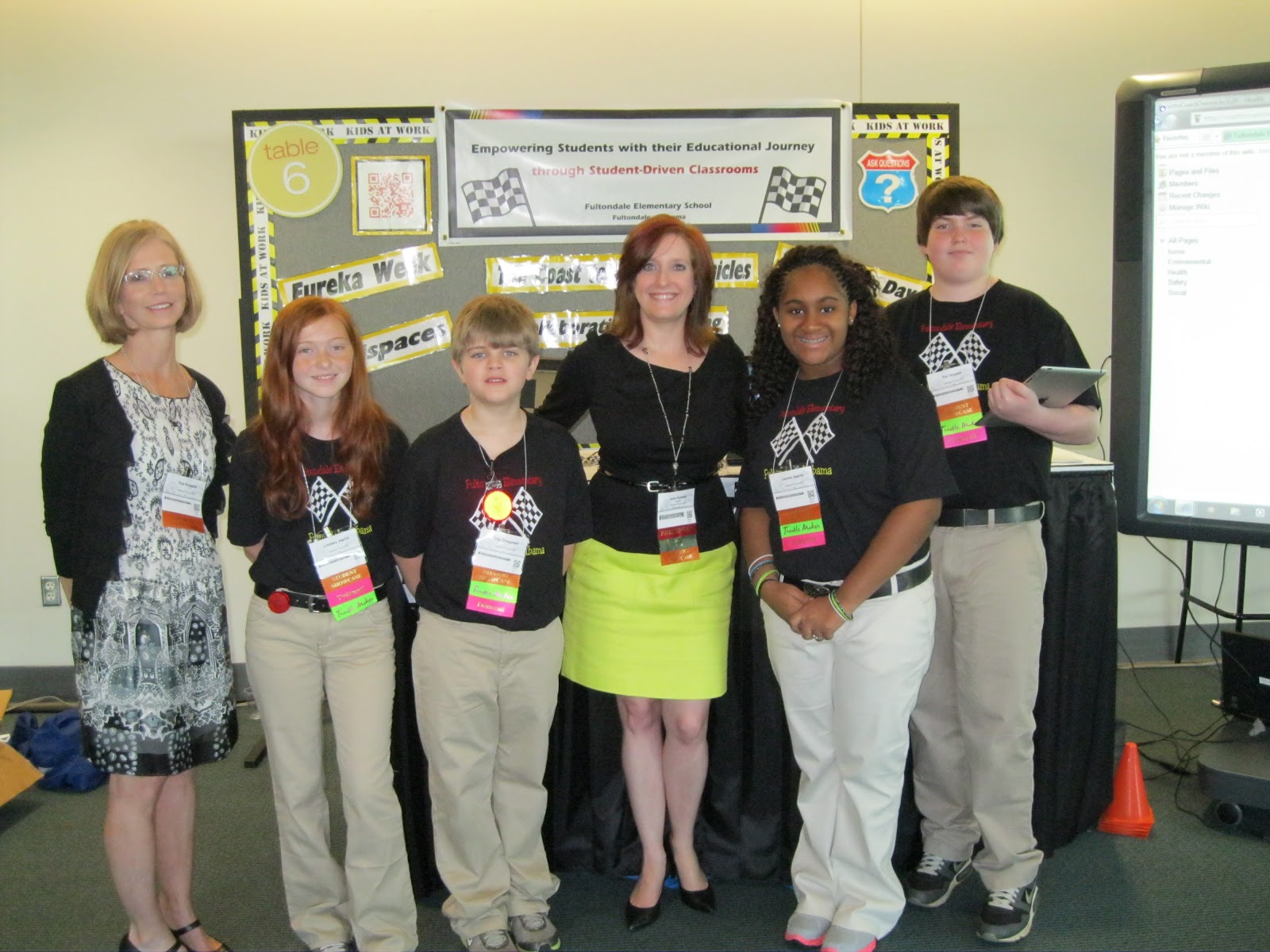
I've just returned home from my eleventh ISTE. My experience at ISTE is probably much different than most of the other 20,000+ people who attend because, for the last ten years, I have attended with my ten and eleven year old students. They have been invited to present a Student Showcase. I get the rare opportunity to see the wonderful, hectic, sometimes chaotic learning machine that is ISTE through the eyes of my students. I get to see what their perceptions are of other educators' opinion on what should be going on in today's classroom. Surprisingly enough, they are extremely tuned into what is worthwhile and what is pure "fluff." Each year, my students choose to spend less and less time in the exhibit hall and hotel pool and more and more time in formal sessions and speaking to people informally between sessions, on the conference bus, and impromptu networking sessions. They speak passionately about their learning and the technology that supports it.If you are willing to listen and converse with them (you'd probably be shocked by how many attendees don't and are downright rude to them) you will see that they have very powerful voices...each distinct one from the other.

As I'm reflecting on this year's experience, I have one even that keeping circling back to the front of my mind. I want to share that story with you here.

If you attended my students' presentation, you know that it is 100% their work. They prepare what they are going to say to attendees, they've designed the take-home souvenir (instead of a hand-out), and they've designed the display. Of course, everything that they are sharing is also 100% created and published by them as well. We usually get a very good crowd that visits us and the kids don't get to come up for air for over two hours.

This year, I had one student with me that we'll call Trent. Trent is a quiet guy with a great sense of humor. Through our student-directed classroom, he has become an extremely strong leader often setting aside his work momentarily to help a peer in need. He encourages others when they feel like success is out of their grasp. He is an amazing individual who doesn't pull any punches when you want the truth.

Each of my students simultaneously run their own little presentation with groups of educators throughout our allotted time. We really need one computer per student, but we weren't able to travel with that many computers this year. Trent asked if he could use our iPad,"I know it won't show many of the awesome projects that we did, but I know I can explain it well enough that they will get a good idea of what I'm talking about.That way everyone else can keep using the laptops." Pretty selfless for an eleven year old, huh?

As my students present I stand back, field any questions they feel they can't answer fully and provide any support that they need. They've told me that if I stand too close it makes them nervous...so I keep a small distance. I could overhear Trent speaking with a small group and doing a beautiful job. They had so many questions that he was able to field effortlessly. That small group dwindled down to one teacher. She continued to pepper him with questions and take notes furiously. Trent took his time to explain all the tools, helped her write down steps, and even helped her spell out the tool's name if she asked.

She thanked him after about thirty minutes and went on her way smiling. Trent looked up at me with a huge grin, "Mrs. Ramsay, I just changed that woman's life forever. She'll never teach the same again. And isn't that what all of this is all about anyway?" Before I could answer, he turned and started his next presentation with another group who had just walked up.

WOW! Trent understands the importance of going to a conference; he knows it's not just about getting, but about giving back; it's about sharing a piece of yourself. It really is about changing lives forever.

As educators it is so important that we take the time to let our students have these experiences. They need to share what they are learning with others of all ages and geographic locations. They need to know that what they are doing can positively impact more than just themselves. They need the opportunity to share their perspective in the field of education and beyond. As I've said many times, they are the reason we are constantly learning and growing. Let's not underestimate our learners, but give them the opportunities to change people's lives forever.


Friday, June 8, 2012

Professional Development: One Size Does Not Fit All

For many of us, one of the busiest times of the year is upon us.Yes, it's summer, but for most educators that means a summer filled with a myriad of opportunities to learn and connect with others. I have colleagues who think I'm crazy to spend my summer travelling to speak at a host of conferences. I had one teacher say to me, "I'm professionally developed enough. I've been teaching for 22 years. I think I know what I'm doing." I didn't quite know how to respond to her comment in that moment, but as I've had time to reflect, I think she embodies the perception that many teachers have. They have been forced to go through some workshop or training regardless of whether they need it or not. They view it as something they have to suffer through so that they can get back to what they want to do with their students in the classrooms.

Perhaps the problem isn't these mandatory training sessions, but the fact that many have lost sight that each teacher is an individual with a different background of experiences, different interests, and different talents. These need to be taken into consideration when pursuing professional growth. Aren't these the qualities that we seek out in our students so that we can best meet their needs?

People seem surprised by how many sessions I attend at the conferences where I present. I'm often asked how I choose which sessions to attend when there are so many from which to choose. Here are some of the factors that I take into consideration when selecting professional development for myself.

In what area do I need to grow professionally? My natural inclination is to gravitate towards presentations that include technology, differentiated instruction, or literacy. However, those are the areas that I present on myself. Is that what I really need? Although I do attend some of these sessions, lately, I've been seeking out opportunities to learn about teacher leadership, math (because I've just started teaching it), innovation, and strategies for (further) promoting student-directed learning. Like our students, we all know the areas in which we don't feel as strong as educators. This is an opportunity to strengthen those areas and make connections with other educators.

Who is the presenter? How many of us have gotten into a session and been "sold" a program or tool for the hour long session? It's rotten because often we know our school doesn't have the money to purchase the program. One of the first things that I consider is whether this person is in the classroom like me. I don't want to hear theory about how something could work in a  classroom. I want to see how it's used. I want real examples from real students. I want a practitioner, not a theorist. Do they actually practice what they preach or are they just good a research? Once you start looking, I think you'll be amazed at how this narrows down which opportunities you pursue.

Is this worth my time? Not every session is for every person. Just because someone is a renowned speaker that everyone wants to attend, it doesn't mean that it's what you need. Sometimes in spite of narrowing down the choices of sessions for ourselves, we might still find ourselves in a session where the speaker isn't offering any content that we need. If you get into a session and the presentation isn't what was portrayed in the program, it's okay to move on to another session. If a presenter rolls out a "death by PowerPoint" and reads every word on all slides, it tells me that they didn't value my time enough to be prepared for their presentation. Here's a novel idea: Get up and leave. Your time is valuable. Find something else from which you can glean something.

Although most of my examples involve attending a large conference, the same principles hold true for other professional development whether you are building a PLN through Twitter, Facebook, blogging, Second Life or you are attending virtual discussions and webinars. Your learning is personal. You are in charge of your own growth. Take a few minutes to consider if this is the learning that YOU need because ultimately, your students will be the ones to reap the benefits.

Monday, June 4, 2012

Education is NOT Broken

It's all around us: the negativity about what's wrong with education, what must be repaired. I've written several blogs explaining some of the practices that my students and I have put into place because there are things that need to be re-evaluated. However, in the last month I've had the great fortune to hear stories from some of the most amazing educators in Alabama. Many of them working in difficult, high-need schools across the state. The resiliency and creativity of educators and their students abound in spite of the challenges that many of us face day to day. I know these educators and students are all over the world, often fighting to overcome what may seem insurmountable obstacles to find success. They are the unsung heroes that we should be hearing about regularly. I'd like to share a few of the stories here to remind all of us what is right in classrooms and schools everywhere.

Until a few weeks ago, I had never heard about Green Ribbon Schools. Green Ribbon Schools (GRS) is an award program that recognizes schools participating in activities that promote and encourage a healthy and environmentally friendly learning environment. It's a program where students can learn to better use their resources and addresses the issue of childhood obesity by promoting health and fitness. Munford Elementary School in Talledega County partnered with the park rangers in the Talledega National Forest to create environmentally sustainable learning spaces, to protect health and foster wellness for Alabama students while saving energy and reducing costs. They also integrated forestry, conservation, and environmental education themes throughout the curriculum through "theme immersion." For their hard work and dedication, Munford Elementary School was a National Winner for the United States  Department of Education Green Ribbon School Award.

One of the must heart touching stories that I heard was from Kim Beaty who teaches at Hope Academy in the Eufaula City School System. Hope Academy is not your average public school. It's an alternative school for students who have personally (or through their families) experienced truly horrific things. No student should ever have to live through the violence, abuse, or, or crimes that they have endured. Most people would write these kids off as a "lost cause." But not Kim and her fellow teachers.  These teachers dedicate their time to helping these students become a powerful voice for change instead of just letting them coast until they drop out of  school. These teachers see the potential in every student and, in spite of obstacles, many of these students do successful earn their diplomas and enter the work force as successful members of society. 

Often we hear that students today are not interested in the world around them. This story proves that statement unequivocally incorrect. Here's the story of a teacher, Brian Copes, at Calera High School who challenged his students to build a basic utility vehicle that could be used in developing countries. Their challenge was to create these out of donated parts that could easily be found in these countries. The students not only created a vehicle that survive the remotest terrain, but they also built variations: a school bus, an ambulance, a drill for wells, and a plow. Additionally, after hearing from an area specialist that there are many people in these countries who are amputees, but cannot afford the $2000+ prosthetic, he let the students experiment and investigate with the prosthetic. Then they build replicas that could do the same job for under $100. These amazing students and their teacher are travelling to the Honduran Cloud Forest this summer to deliver one vehicle, help them construct a second vehicle, and fit amputees with their prosthetic.(Watch their amazing story here.) And did I mention, these are kids who haven't even graduated high school yet? They are confident, knowledgeable, and have a clear understanding of how math, science, and engineering directly impact the lives of people. (Yes, they've won multiple awards against university students, but that's not what drives these students.)

I hope that these stories encourage all of you to take a few minutes to see the trees in the giant forest of education. There are some real stories of triumph and student empowerment all around us. Yes, there is no doubt that there needs to be some change in education, but these are stories that must not be overlooked. If you've got a story of an unsung hero, I'd love for you to share it here. We would all benefit from celebrating these successes.

photo credit: Stuck in Customs via photo pin cc

Wednesday, May 30, 2012

What Great Teachers Do Differently

While I was at ASCD, I had the opportunity to hear Todd Whitaker speak. Some of the thoughts that he expressed have really been rolling around in my brain lately. His advice is plain old common sense, but like one of students said, "You know, common sense isn't so common." Sometimes, we may need reminding of these things to give us some persepective....especially as the school year is winding down and we are making plans for the next year.

We have a choice of what comes into our room whether it's positive or negative. As the teacher, we set the tone. We are the filter as to what gets through to our students and impacts our days, positively or negatively. We must treat every student with respect every day for the entire school year. We all know that learners who are treated with respect will, in turn, treat others with respect. This creates a positive culture where students feel open to exploring new ideas and trying new things.

Parents send us their best kids. I laughed when he said this, but as I pondered it, I realized that it is absolutely true. Those kids are the best the parents have. It is our job to nurture, educate, and give them the best that we've got. Making excuses does not help anyone. It's a waste of energy.We know that students don't have a choice in where they live, their socioeconomic level, or their family situation. Our job is not to judge them, but work with each of them, nuturing their talents, finding their challenges, and empowering them with the ability to be successful people who can make a difference in this world.

Great teachers are intentionalists. In a great teacher's classroom nothing happens randomly. Great teachers plan and guide students into correct behaviors instead of fighting those discipline fires that will continue to pop up throughout the year. They understand that they have the ability to respond to something or not to respond, remembering what is best for each of the students within our classrooms. In a great teacher's classroom, the students don't know how to push their teacher's buttons because they've never seen their teacher's buttons. It's easy for us to pulled into the "reality show" mentality where using sarcasm, insults, and outrageous behavior is acceptable. However, it is our job to make sure students know that being a teacher is an honorable career. We are professionals who carefully and intentionally make educated decisions for ourselves and for them.

Here's the good news: what teachers do matters. The bad news: what teachers do matters EVERY day. We never know what will stick with our students, good or bad. Sometimes a flippant response to one of them can stick in their minds for the rest of their lives (some time I'll have to write about why I became a teacher). We all have those days where we are exhausted, stressed, sick, or feeling blue. However, we need to remember that everything we say and do in the classroom has an audience. What we do matters. One comment or action can really impact our students positively or negatively. We are the professionals. We need to remember it's not about us...it's about them.

I know at this time of year, in spite of being exhausted, all of us are planning for our next group of students. I hope that these bits of wisdom help you (as they've helped me) to focus on what's most important...our students.

photo credit: mkrigsman via photo pin cc

Thursday, March 29, 2012

Serious Fun at ASCD

Yes, I used the "F" word in my title...fun. Fun is a word that has been banned from many individual's vocabulary when speaking about education. People tend to feel that the word "fun" means that there is a free-for-all playground going on in the classroom with little to no learning occurring. That is unfortunate because fun, humor, cartoons, synectics, word play, analogies and true passion are all fun and foster creativity. This is one of my big take-aways from ASCD12 (more blogs to follow). There needs to be more fun in the learning process.

Now, let me be clear, if you asked one if my students if they had fun learning or being a member of our class, they would say "yes" without hesitation. However, there are aspects of this fun, creative thinking that I have overlooked in my classroom. By starting the day by putting up a cartoon or analogy for the students to reflect upon and respond to, they get another mode in which to become familiar. It reaches a different type of learner, sparks a different part of the brain. It helps them to really analyze (and perhaps get a good laugh) about a topic that they may not have taken the time to analyze.

With Rick Wormeli
By giving my students the opportunity to use synectics, where students compare two things that would not seem to have a relationship promotes creative thinking skills. If learners use these relationships, building metaphors, it takes learning that they are doing and puts it into their long term memory. It fosters learners who think outside the box and critical thinking skills that prepares them for their future. As Rick Wormeli said, "Novices think in pieces. Experts make connections." And don't we want our students to become those experts?

Reed Timmer
A true expert is someone who has a passion for their expertise and is so excited about their topic that they can't wait to share it with others. Anyone who was in the general session with Storm Chaser Reed Timmer knows what I'm talking about. He is so excited about storm chasing and the practical use of STEM in a real world application that it makes anyone listening tune in closely and care about what he's discussing. Passion is contagious. If we are passionate about learning and teaching, our students will be too. They will listen closely, become actively engaged, and strive harder to become those experts. We need to keep this in mind every day when we stand in front of our learners.

So I'd like to thank Rick Wormeli, Reed Timmer, Carolyn Hirst-Loucks and Kim P. Loucks for reminding me of the importance of fun in the classroom. Because (as I'm often reminded by my husband) if you're not having fun, you're doing something wrong.


Thursday, February 23, 2012

In Defense of Student-Directed Learning

Recently, I was in a training session where we observed a lesson. Once it was over, we were led into a group discussion about what we had observed. Immediately negative comments were made placing the blame solely on the students. As the negativity escalated, I knew I needed to speak up. I also knew how they would react, but I jumped into those shark infested waters anyway.

Even though many of our children have no support system at home, we can give them the skills to learn at school. If they become invested in what they are learning and they see the relevance, they will WANT to learn and practice what we do in the classroom...even when they aren't in the classroom.Students need to be given the opportunity to explore how each standard we teach relates to their lives. They need to have the guidance from us to find how learning this content will make their lives better. Then, we need to give them the opportunity to explore, design and create something new with what they have learned. If we give them this, they will be self-motivated to learn...not because of some grade or a test, but because they LOVE it.

I know there is plenty of research out there that supports student-directed learning. However, I don't need research to know that this is a valid way of facilitating learning.  I see it every day in my class. I have had students that are exceptional education students, who are so low or such behavior problems, I was told they wouldn't even be able to function within the classroom. My administrator admits to putting the more challenging students in my classroom because "they always make such great gains and reach a level of success that they've never had before." (See Let's Celebrate or When Things Click or  Becoming Techknowledgeable) I'm not saying this to pat myself on the back, but to give examples of how successful this is with students...academically high or low; wealthy or homeless; Asian, Latino, African American, or Caucasian. When you have 10 year olds who don't want to go home at the end of the day or they want to spend their Friday afternoon doing research to prepare for a lesson they are going to teach older students via Skype, you know that it works. (See Students as Teachers). It works because we are giving students the power and responsibility to drive their own learning.

The reason I spoke up was because the students of those teachers were being sold short. Their potential wasn't being explored. That love of learning hadn't been ignited. I hurt for those kids.

Isn't it our responsibility to do whatever we can to meet the needs of our students? We can't afford to waste any time giving them the tools to success. Because when you ultimately think about it, we are only hurting our future selves. These are the kids who will be running the world in a few years. We can't afford to sit on the sidelines and point fingers at the students. Students know how they learn best if they are given the opportunity. They are the SOLUTION.


Monday, January 30, 2012

Reflecting on MITCHELL20

This weekend the Alabama NBCT Network had their annual conference. A perk to the conference was that MITCHELL20 was screened. If you are not familiar with this film here is the trailer:


The Mitchell 20 Trailer from Mitchell 20 on Vimeo.

When I first saw the trailer at the National Boards Conference last summer, it really struck a chord with me. Although I am in a different geographic location in the country, I felt like I could identify with many of the challenges that they were facing. (I've heard that from many other educators who have seen the trailer and the film.) As Kathy Wiebke, executive producer for MITCHELL20 and one of our keynote speakers said, this is a true story, not the story they set out to make, but one that needed to be told. If you go into it thinking this is another movie like Mr. Holland's Opus, you will be disappointed... because after all, for those of us in the classroom today, many days are a struggle to do what we feel is best for our students.

When the film ended I had no words, but so many emotions. I think one reason it is so emotional is because to some degree, we can identify with their challenges. We've been there. We've felt their tears and their frustrations. Now I'm going to attempt to put some of these thoughts into words.

One of the major things that I took away from the film is the impact that one teacher can make. One teacher led the charge to make a difference in her school. She started encouraging fellow teachers to change the quality of their teaching. Twenty teachers agreed and they began their two year journey that was documented in the film. These teachers met together to discuss the changes they had made in their instruction and the impact it was having on their students, and ultimately on their community.  Several times throughout the film the different teachers talked about how it changed their relationships with one another. Before they were colleagues who only knew one another by speaking in between their teaching; now they had become a family as they all worked towards the same goal.

I've heard several times that teaching is a solitary profession. To an outsider, that may seem strange as we are in a school filled with people. I know at times we feel like we are alone in the fight to not only improve our teaching practice, but also continue to provide the best quality teaching for our students.Like the teachers at the Mitchell School, we may struggle against policy and practice mandated by those outside the classroom, but it's a struggle we are all facing. By banding together, we can work together to find solutions. When you see the results that the students reaped from their journey (one many of us have seen in our teaching as well) you know that all of the hard work was worth it.

Their journey wasn't an easy one. Once they started speaking out and not accepting the status quo, things became even more difficult for them. What was different? They had one another. We know that when you start speaking out, sometimes there is push back. Truth is it isn't fair. Who ultimately suffers? Our students. It is our responsibility to speak up for them to give them the best opportunities that we can. One quote from the movie that stuck with me was that "We need to let our students know they can be anything that they want to be. Nothing can stop them if they have that conviction." And what better way can we teach them that than through our example? We can speak up; we can make their world a better place through our teaching; we can be the change that our students need.

To read more about MITCHELL20, here is a blog post written by Kathy Wiebke on Talk Priority Schools. To schedule a screening see mitchell20.org.MITCHELL20 will be released on DVD in March. I highly recommend you schedule a viewing for the teachers and  educational leaders in your area .  

Tuesday, December 27, 2011

One Year and Counting...

Today marks the one year anniversary of my blog, Eduflections. When I started this a year ago, I had just turned in the final manuscript for Can We Skip Lunch and Keep Writing? I missed having that avenue of writing and reflecting about my journey with my students. Dr. Frank Buck suggested that writing a blog would be a good way to continue reflecting on my teaching practice and sharing my journey with others. My initial goal was to write or reflect at least once a week. I came a few blogs shy of that by only blogging 47 times, but by going back and reading what I've written, I realize how much I've grown as an educator, and ultimately a person, over the last year.


Here are some of the things that I've learned this year:

  1. Be bold. Do not be afraid to speak up for your students. If we don't speak up for what is best for our students, no one else will.
  2. Share your students' successes. The community at large has a misconception of what accomplished teaching looks like in the 21st Century. Build a contact list of community leaders, legislators, board members, and parents and send them photos, stories, and projects so that they can see what is possible in today's classroom.
  3. Let your students design the learning environment. I had already given control over so many different aspects of our classroom to my students; I don't know why I didn't think of this. They have arranged the room, the classroom library, and requested that we add a large area rug. They are the ones who need to feel comfortable in the learning environment, so let them take the lead in this area as well.
  4. Blogging is a powerful tool...for students as well as teachers. I tried blogging immediately after I began blogging, but the students didn't enjoy it. This year I tried a new approach starting on the first day of school. I let them design the expectations. As a result, I've gotten to know my students much better and much faster which enabled me to better customize lessons. Their writing improvement has also grown exponentially. They are voracious writers who take ownership for what they are learning each day
  5. Join in the conversation. Although I had been somewhat active on Twitter, I had not started building relationships with other educators. That was the key to really connecting with other educators and not just consuming from the community, but giving back to the community.Those relationships were further solidified as I got to meet them at various conferences, EdCamps, and Tweet Ups. Now my PLN is even stronger and the ones that truly benefit are my students.
  6. Counteract the affects of high-stakes testing on students. I've had students who HATE reading because they associate it standardized-testing and our prescriptive reading program. I've also had learners tell me that the one thing they look forward to is standardized testing. When they begin the year, they struggle with being creative and thinking outside the box. They have very little knowledge of history, science, or art because all of the focus has been on reading and math. These have been a bit of surprise to me, but kids are so adaptable, we've been able to meet those challenges and focus on a well-rounded, student-directed learning environment.
  7. Focus more on math. As I look back over my past blogs, they all seem to focus around the language arts and technology-supported learning. Yes, those areas are where my comfort level is and it stretches across Social Studies and Science. However, there aren't very many blogs about what we're doing in our math class. Perhaps, I need to stretch my wings a bit out of my comfort level and see what I can find to further improve my teaching practice in the field of mathematics.
  8. Get involved in the community.On April 27, 2011, tornado ripped through the community where I teach. I did something I had never envisioned; I took a list of my students' names and addresses and entered theses communities searching for them and delivering supplies. One thing that I learned was how valuable it is to be a part of the community in good times or in bad. It helps solidify a strong relationship between you and families with whom you work in a much deeper manner. The final outcome is a much better education for each of your learners.

Is this all that I've learned? Absolutely not! These are just the highlights. I'm sure once I press the publish button several more will come to mind. However, I would be remiss in not thanking all of you that have helped me along this journey this last year. All of your comments, emails, retweets, and mentions have given me the encouragement to continue writing and growing even when things become extremely challenging, as they often do in a public school classroom.

So if you are considering beginning a blog, or you have a blog that needs to have the digital dust brushed off of it, I highly recommend it. This has been one of the most power tools for my professional growth and I look forward to where my path will take me in the next year. Let's continue to learn together.

Monday, December 12, 2011

When Things Click

You know those days when you work and work with a certain students and there doesn't seem to be much progress and then ...BOOM, they blow your mind with what they've accomplished? Yep, we've all had those moments. I wanted to share with you the success of a student that we'll call Allison. Allison is a good-natured student who wants to do well in school, but she really struggles with reading and math. She not only is missing some key elements in her phonics understanding, vocabulary, and comprehension strategies, but she also doesn't know her basic math facts. 

When I do intervention or mini-lessons across content areas, Allison is there with me 95% of the time. I have to hand it to her, she never gives up. Then, the day before we take our reading test, she opens up her reading book and I notice all of these hot-pink sticky notes stuck all throughout the selection. Now this is a strategy that I've led her through many times (in reading and other content areas), but this time I hadn't done it with her. In fact, I hadn't even suggest that she do it. I asked her to share with the small group what she had done and as she explained it, she got out some blank sticky notes and started guiding them through her process.

photo by avrene
She showed them how to write notes on words she was unsure of as well as the vocabulary words. She picked out the setting, characters, problem, solution, author's purpose and examples of cause-effect and main ideas and supporting details on each page. She said she wasn't sure what to focus on so she had taken time each time she had read the selection at home to pick out each of the different strategies or skills. (as a side note, the students are not assigned the selection to read at home; all reading is done in class...she did this because she wanted to do it)

By the end of the our group time, she had led these struggling readers through a thorough evaluation and analysis of the selection. They were all focused on what she was saying. Allison doesn't usually volunteer to take a leadership role, but this time she did. She took ownership of her own learning and the skills and strategies that she had learned and she wanted to share them with others.

Of course, it probably goes without saying...she aced that test and so did the others in her group. She now is reminding the other struggling readers of what she taught them and giving them other advice. She asks me questions to make sure she's on the right path, but she has taken these skills and she is running with them. Don't you just love it when everything just clicks?

Friday, October 14, 2011

Students Seeking Validation Through Writing

Those of you have been reading my blog know that I recently had my book published. In fact, while I was in DC, I made a trip to the Library of Congress.  Not only is it a beautiful place, it is the home of books, learning, knowledge, and wisdom. Many people do not realize that it is solely a research library where books are not checked out. Also, many people do not realize that the Library of Congress only physically houses 10% of the books ever written. I was curious...would my book be one of the 10%? After asking several people to help me find the answers to my curiosity, I finally found a librarian who was willing to dive into their records. A few bated breaths later, she turned the screen to show me that my book was not only registered there (which I knew Stenhouse had done), but it was also one of the 10% housed there onsite as a physical book. She and I both did a little jumping and clapping to celebrate. I was waiting for another librarian to blow us over with her powerful, "Shhh!"


Afterwards, I have been thinking about the power of publishing your work for others to read...especially in regards to our students. Those of you who are familiar with my classroom know that my students use a wide variety of digital tools for publishing their work for a much wider audience. They love all of the different publishing tools that they use (and are constantly finding new ones), but one of their favorites is still using Lintor Make a Book to create their own hardcover book. It still surprises me that with all of the other digital tools that they use, my students thoroughly enjoy...and seek out new opportunities...to publish a hardcover, hardcopy version of one of their pieces of writing.

Lintor Publishing makes publishing a hardcover book extremely user-friendly. Their product makes it simple for students to create and publish their own hardcover books from start to finish. They have a variety of book publishing packages to fit most needs.

Just like me, (I wanted tangible evidence that my book was in the Library of Congress) sometimes our students enjoy having that tangible book in their hands as evidence of their hard work.They like taking it to share with others. My authors love taking their books to read to younger students.We keep a library of their books for them to be read by everyone in the class.They are shared with anyone who will take time to listen and look at their books. Their books always receive a lot of attention at our Young Authors' Conference because they look so professional and my students are so proud of and enthusiastic about what they've created. After all, they created it so that others would read it.

So next time your students begin to publish, remember that sometimes students want to have that tangible book in their hands to share with others. It's a way for them to receive validation for all of the hard work that they've done.

(As a side note: Many of you know that the community where I teach was hit by the April 27th tornado that came through Alabama. One of the first people to reach out to us was Janice Miller, owner of Lintor Publishing. She not only reached out as concerned  for our safety, but she suggested that the students have the opportunity to do some therapeutic writing about their experiences with those storms. She generously sent my class book covers so that they could publish their own books. Her generosity touched my students and they treasure those books that they wrote.) 

Sunday, August 28, 2011

Are you Sad?

We've just finished our second full week of school with our students. The teachers returned three days before the students and something that a teacher said to me is still floating around in my head. After asking me how I spent my summer and I told her the highlights, she frowned and said, "Aren't you sad that summer's over and you wasted your summer?"

I was a bit stunned. How could someone look at all of the things that I did over the summer and think that I would be sad? My summer was full of things from participating in a flash mob, having my book released, presenting at four different conferences, speaking with Alabama legislators, and meeting the most amazing educators from around the world...and those are just a few of the highlights.

Was I busy? Yes, but I was energized as an educator (and a person) by all of the connections and life experiences I had over the summer. As I thought of all of those things it brings to mind an assumption that many have about a student's perception about returning to school. They assume that they student is unhappy about returning to school. We know that if a student hears something numerous times, they will start to believe it. Should they be sad about returning to school?

As I mentioned last week, my students started blogging. As I've read some of their first blogs, I realized there are under currents of this mentality. However, they have told me, through their writing, that they don't dread school, they look forward to it. Here is an example:

While I was out of school for the summer people always asked me,”Are you ready to go back to school?” I always said , “No, not at all.”   I said this because I thought that fifth grade would be horrible. I hadn’t seen my teacher once before the first day of school and I didn’t know how she would act. I was a little surprised because I hadn’t met any teacher who did as much as she did in the class. We have so many opportunities this year. I was also a little freaked out because throughout my whole life (well at least kindergarten to fifth )I always had the nicest most creative teachers. It’s hard to say that is a coincidence. Now I can barely sleep because I wish that school could start again as soon as dinner is over.
I could share several other quotes, but I think this one makes my point. Learners should look forward to school. It should be a place with "many opportunities" to learn and engage with one another and explore new concepts and how they fit into their lives.  It should not be a place where students are sad. I'm definitely not sad about my summer or the fact that I get to go to school each day and do what I love...and I hope that rubs off on my students every day.

Sunday, August 21, 2011

Did I Make the Grade?

I've just finished my first week of school with my new class of fifth graders. This week, we started out building a strong foundation for the rest of the year. We did many of the same activities that I discussed in Chapter One of Can We Skip Lunch and Keep Writing?, but we also stretched and adapted those strategies as they best met the needs of my students. Much of what we do springs from conversations from reading Frindle by Andrew Clements. It serves as a great example of writing as he expertly weaves together the different modes of writing and the use of figurative language, with an entertaining story for middle aged readers. As we read it, I encourage my students to not only enjoy and discuss the humorous story, but also to begin looking at it through a writer's eyes.

As we are reading, my students begin to create a list of "Characteristics of Great Writing." My new students begin a bit hesitantly to add to the list as I've requested that they explain and justify their answers. I ask a lot of questions to guide them in this kind of thinking. They've been so trained to think that there is only one possible answer or conclusion to a question that when I told them that most questions have a multitude of possible answers, you could see a burden being lifted off of their shoulders. They were so eager to grasp this new kind of thinking. This discussion led students to making conclusions not only about the craft of writing, but also they purpose of composing using correct grammar and mechanics.

All of these fabulous conversations lead us into our blogging conversation. None of my students have ever blogged before and most of them were unclear about what a blog was. I used a variation on McTeach's blogging lesson, but the students naturally linked the importance of good writing from our Frindle discussions to our blogs. We also read and discussed parts of Net Cetera (I ordered copies for each family) to ensure that the students understood digital citizenship, Internet safety, and cyberbullying.

One strategy that I love is that I let my learners create their own criteria/rubrics for each of our activities. It puts the power of expectations into their own hands. After all, this is their blog, they should have a say over what should be included. (Note: I realize that many feel that blogs should not be evaluated. However, those that read my blog regularly know that this is not a luxury that I have in my classroom. See: Homework and Reading Logs)

Since this was the first criteria they were going to create, I led them through it as a class. Here is the list that they created of their Blogging Expectations:


  1. Use proper capitalization, organization, punctuation, and spelling. (As they explained, "If you don't edit, it doesn't matter what you've written; no one will understand you.")
  2. Be safe with all of your choices.
  3. Create posts that show what we've learned.
  4. Always use appropriate and kind words.
  5. Think about the audience.
  6. Explain and give great details in your posts. ( As one student said, "Who wants to read something that's boring?")
  7. Compose three or more blog posts a week. (They really wanted to have more in this number, but several students do not have access to a computer outside of school hours.This was a heated debate...pretty cool that most of the kids were fighting for MORE work instead of less, huh?)
  8. At least one of your blog posts will be about what you are reading. (The class actually cheered when they figured out this was going to replace the dreaded reading logs.)
  9. Create comments that are thoughtful, relevant, and continue the conversation.(One learner actually pointed out that by creating comments like this, they were also giving evidence that they were reading...score another point for getting rid of reading logs, but still meeting that independent reading standard on the report card. Yep, he got a high five...wish I had though of that.)
  10. Practice using characteristics of great writing in every post.
Is this the of expectations that I would have made for them? Absolutely not! It is infinitely better. This list demonstrated to me how well they had grasped all of the activities and discussions that we had done all week. They tied it all together and saw the relevance of how all of the pieces of the puzzle fit together better than I did. What I didn't realize (until we were done) was that they were grading me on how well I had done this week. Did I make the grade? Did I grow as a teacher this week? I think so. This group of learners are going to keep me on my toes. The sky's the limit now. Who knows what tomorrow is going to bring?

Sunday, July 31, 2011

My Own Educational Reform

I’ve just concluded a week in Washington D. C. This week I had the opportunity to participate in Hill Day where I got to speak with 8 of Alabama’s nine legislators (or their staff). At the National Boards Professional Teaching Standards, I co-presented two poster sessions promoting the Alabama NBCT Network and the Second Life Network. I also had the opportunity to meet several Stenhouse authors and have my first official book signing. And I presented a session called “Empowering Students with Web 2.0” in person and virtually.

I knew that I was going to be busier than any other conference that I attended. I knew was I was going to get to connect with people that I’ve been connecting with for several years virtually. I knew that I was going to hear dynamic speakers like Daniel Pink, Diane Ravitch, Sarah Wessling, Arne Duncan, and Pedro Noguera. And let’s not forget about the amazing Save Our Schools March.


With all of these events, speakers, and activities, my mind has been struggling to find a single thought and lesson that I can take away from all of this outstanding professional development….I am on overload. However, as the conference was winding down last night a thought came to me. I need to do a better job of having my voice heard. That may seem strange considering all of the speaking, blogging, social media and PD in which I engage on a regular basis. But, as I was sitting in the final activity, I realized that I need to be better at practicing what I preach.

In my classroom, I am always encouraging my students to share their voice through their writing, their work, their projects, their collaborations. I listen to their voices grow stronger through the school year. I let them voice their opinions and guide their choices in the classroom. Shouldn’t I be putting my money where my mouth is, so to speak?

I think as educators, many of us have been threatened with our jobs if students’ standardized test scores don’t rise or if we don’t teach scripted programs to fidelity. Fear has been used to try to make educators compliant and time and again it has been proven ineffective. It’s ineffective because good educators are not doing the job for pay or incentives. We do it because we are passionate about giving our students the best education that we can… in spite of the challenges, lack of support and difficulties.

So although I do speak up on occasion, I plan on making a much more concerted effort to stand up for what is right for our students. I am going to show them through my example what it means to have your voice heard because they are the ones who are ultimately being affected. My legislators (and administrators) are going to know me by name and they are going to see the work my students do. There are many more educators than there are elected officials. It is up to us to be the voice of change. Things will not change by just talking about it amongst ourselves. We must speak up. Our students can’t wait. Who’s with me?

Friday, July 29, 2011

SMOKE Detectors to the Rescue

Scripted reading programs, grade level meetings, data meetings, CIP boxes, mandatory standardized test practice, required no-choice professional development...OH MY! As teachers, we know that this list could go on and on of the things we have to do that has very little to do with our day to day teaching. Unfortunately these things also have little to do with improving our learners. Now some of these things do have a place...collecting data (as long as it reliable and relevant) is what helps us find individual weaknesses in our students and chart their growth.

However, as teachers it is very tempting to give our students something to do at their seats so that we can complete the mountain of tasks and paperwork that comes with our teaching responsibilities. We must NOT give in to this temptation.It is our responsibility to fight against SMOKE...

Stuff 
Muffling 
Our 
Kids' 
Education


We need to become SMOKE Detectors. We all have those things that tend to creep into our classroom time. We have last minute deadlines we have to meet. We have yet another form that we have to fill out. We have practices enforced that squeeze creativity out of the classroom. These things are different for all of us. What we have in common is that we can protect the integrity of the learning time for our students. We can see that something has the potential to eat up their time to work together, your time to meet in small groups, or time when all of us need collaborative learning.

As the teacher it is our responsibility to detect it, stand in that gap, fight back the SMOKE, and give our students the best possible education possible within the confines of a (sometimes) restrictive system. So who will join me in becoming SMOKE Detectors? Our kids are depending on us!

(Anyone else feel like donning a superhero cape? Superheroes created on HeroMachine)

Wednesday, July 20, 2011

The Real 3D...No Glasses Required

This summer has been a hectic one for me....exciting, but hectic. I have been busy travelling to conferences and participating in activities to promote my new book, "Can We Skip Lunch and Keep Writing?" As I'm preparing to travel to D.C. for the National Boards for Professional Teaching Standards Conference, I am looking forward to many things: getting to speak with our congressmen about the importance of National Board Certification and education in Alabama, networking sessions to make new connections, learning new things to add to my educational knowledge, my presentation on Empowering Students, and a book signing. However, what I am most looking forward to would be getting to meet the people that I've been working with for over three years now.

People not involved in technology like twitter, blogs, Skype, or Second Life, think it's a bit strange that you have friends that you've never met. One person tweeted at the beginning of the ISTE conference whether they thought that face to face conferences would eventually become a thing of the past. That really got me to thinking. Would it? As I continued to ponder that thought, I had the opportunity to meet, for the first time, face to face, with five of the other seven teachers involved in the collaborative project where our students collaboratively publish The Coast to Coast Chronicles.

We made the time in our busy ISTE schedules to meet and chat over lunch. As we talked and brainstormed ideas for the next year, I kept thinking, "What an amazing group of women. They're smart, and funny, and compassionate." I loved just listening and watching their mannerisms and inflections. Of course, I already knew much of this from our planning times via Skype, TodaysMeet, and emails, but after meeting them those previous meetings seemed so two-dimensional. What was missing was that depth that you only get from face-to-face interactions.

Now don't get me wrong...technology opens up all kinds of worlds, connections, and collaborations, but sometimes I think we get so caught up on the possibilities, we lose sight of how important it is to make those personal face-to face connections. We need to keep that in mind when we are offering opportunities to our students. Technology does open up an infinite amount of opportunities for them and us, but nothing can replace actually touching a snake, receiving a pat on the back, or getting a high five when success is achieved.

So as we beginning planning for next year and we include all of our great collaborations made possible with technology, let's remember that our students also need a that three-dimensional, hands-on experiences that only we can provide for them.

Wednesday, July 13, 2011

A Shocking Answer from a Future Student

Yesterday, we had our registration for the upcoming school year. It is the first opportunity where I get to meet some of my students for the next year. I look forward to this opportunity to get to know some of my future students and get a feel for their expectations for the upcoming year. One of the questions that I ask is, "What are you looking forward to the most about 5th grade?" I usually get a wide variety of answers, but yesterday I got an answer that shocked me. One of my future students told me  (without hesitation) that she is most looking forward to standardized testing in the Spring.

WHAT?!? Really?!? What does this say about the state of education that a student would look forward to testing as the most exciting thing in the upcoming year? I know that we are constantly bombarded (sometimes assaulted) with the constant pressure to have students perform on these tests. For some of us, we hear about it at every faculty meeting, grade level meeting, data meeting,  and via email correspondence. We have mandatory PD about the new strategies we are required to employ with our students in the name of meeting AYP. As a teacher it can really wear you down, stress you out, and kill all of your creativity.

However, as teachers, should we be passing this pressure of standardized testing off onto our students? Are we giving them a false sense of the priorities in their educational journey? Just because we are assaulted with the pressures, that doesn't mean that our learners need to be. We still need to protect the integrity of our learners' education. It is our job to stand in the gap. I know first hand that it isn't easy. I'm envious of the teachers who get to teach and promote literacy and not be hampered by a scripted reading program. I long for time to actually have a writers workshop. Unfortunately, that is not the case.

But, that doesn't mean that our students can't still thrive in our classrooms. They can be creative; they can connect; they can make choices in what and how they learn. It just takes a little bit of effort on our part to find a way to give them that freedom. I tell my students at the beginning of the year that we are not in fifth grade to prepare for a test. We are here to prepare for life. The looks of relief that I see are remarkable. It's a small shift that makes a big difference. Are we still mastering the standards? Yes. Actually, my students usually far exceed the standards. They become thinkers. They love what we do in class so much that they beg to come to school early, stay late, or even skip lunch.

Does that mean that they don't hear about testing? No, that's being unrealistic. We hear about it everywhere. In spite of this, we can make a difference so that none of our students leave us at the end of the year and only having testing to look forward to for the next year. I'm looking forward to this year and changing this student's expectation for the year. Once we get started, testing will be the furthest thing from her mind.

Monday, July 11, 2011

A Sincere Thanks

This weekend I had the good fortune to have several friends and family members host a small book release party for me to celebrate the release of my book "Can We Skip Lunch and Keep Writing?" Collaborating in Class and Online. I don't know what I was expecting, but I came away from this experience extremely humbled.Some people came from quite a distance to celebrate with me. Many gave up or changed their Saturday plans to attend. I was even able to reconnect with a dear friend with whom I shared my (our) first year of teaching. I had friends who I have shared much of my lifetime with and friends and colleagues I have only known a short time.


The kind words of praise, encouragement, and support really moved me. It dawned on me that often as educators we don't get that kind of recognition. We fight for our students and bend over backwards to look out and provide the best for them. Sometimes I think we forget that there are other educators fighting the good fight right next to us. We have no idea what challenges they may be facing in their classrooms that day. As teachers we rarely seem to get much positive reinforcement for our hard work. It can feel lonely and isolating. A kind word, a bit of encouragement, or some praise can make a huge difference in their day. We are all in this together.

So I wanted to thank all of you out there who have helped shape me into the educator I have become today. And although you may not realize it, the positive, uplifting words, even in passing, have really helped in lightening the load that I (like all of us) carry in my mission to give each of my students the very best. Even though I may not have said it as often as I should have, I appreciate all of the hard work and dedication that each of you puts in every day for all of our students. From the bottom of my heart, I thank you!

Thursday, July 7, 2011

When is Enough...Enough?

I recently reflected on some of my ISTE2011 experiences, but I still have something rattling around that I feel I need to further explore. One of the things that I often hear from newbies to ISTE is the overwhelming volume of opportunities to learn and connect. One of the things that I love about ISTE is that there are so many ways to learn with and from so many other passionate educators from around the world.

As we connected and shared with one another, this year I noticed that a majority of what we were sharing were the tools and how they supported learning. I was thrilled that much more of the conversation was about the learning as this is what I passionately believe in.

However, this is often not reflected in the Exhibit Hall. Amanda Dykes did a great blog post about the misguided selling seen in so many of the vendors in this year's Exhibit Hall: It's easy and cool. Now, I realize that the exhibitors are the ones that sponsor the conference, but don't they need to hear from those of us who are in the classroom? My students would walk away from a booth and say, "That was fun, but I don't see how it's going to help me learn better." Now if 11 year olds get it, shouldn't exhibitors get it?

It's easy to get caught up in the newest, hardware or software. It's new and shiny and the salespeople are good at convincing you that your classroom is incomplete without their newest tool. We all enjoy new toys. But it's our job to really look at the tool and see if it really will improve the way our students learn or if it is just  a fun new tool to amass in our classrooms.

If you look at the ISTE NETS, you will see that technology plays a supporting role. It supports collaboration, innovation, creativity, and critical thinking. Technology doesn't do it for them. The focus is on the learner and how they use technology to support their learning across content areas and grade levels. We don't always need more "stuff." So many of the tools we use in the classroom that supports real, rigorous learning are free tools that are available online.

So the next conference that you go to, really listen to what someone is saying. Are they sharing something that will really positively impact your students' learning or are they trying to sell you on a new toy? Sometimes you already have enough in your classroom. Enough can really be enough.