Showing posts with label authentic writing. Show all posts

Monday, December 12, 2016

Makerspaces in a Content Area Classroom

In my last post, Let's Make a Mess, I shared how we began the process of turning our 6th grade ELA classroom into a  makerspace that we dubbed the Makery. As an ELA teacher, my administrators expect to see ELA instruction and learning taking place every minute of every day. The question that I get most frequently from other content area teachers is how one can blend best teaching practices, subject area content and a makerspace into finite teaching time. To be completely transparent, that was why it took me two years to take this step. I researched, went to formal and informal presentations, participated in digital conversations, and spoke with many educators. What I typically got was a list of tools and gadgets to stock without any connection to the learning. Yes, it promotes creativity, design, perseverance, communication, problem solving and critical thinking. However, I still needed to be able to justify my instructional choices as an ELA teacher...and I needed to be able to produce sound evidence as to why this was a worthwhile use of our ELA class time.

Here are some of the best practices that simultaneously occurred while students were using our Makery. I hope this answers some of the questions that you may be having as you look at bringing a makerspace into your classroom.

Content Standards: When Caylyn Harden and I stopped and looked at our state's College and Career Ready Standards, we identified twelve standards that directly correlated to our makerspace-informational writing project. There were six additional standards that could also be tied into this project. Looking at where our students were on the learning continuum and what they had mastered previously, we narrowed our focus down to four standards.

As is our usual practice, Caylyn guided the students into breaking down the standards into measurable components that allowed students the freedom to be creative and pursue their passions. These rubrics gave students a destination for showing mastery in each of these four content area standards.

Reading Literature:  Knowing our students, we knew that there needed to be a (slightly) different mindset. Although our classroom was already designed to promote a growth mindset where we try new things, fail, learn from those failures, and move forward with new ideas and experience, many learners were still struggling with perseverance. Many were afraid to try new things for fear of failure. We knew that we wanted to change that. Before beginning our foray into our makerspace, we read Mistakes that Worked by Charlotte Foltz Jones so students could see how many of the things we use, eat, wear or play with were mistakes that the inventor turned into something other than its original intention. Then each day, we would start our class with a read loud of a picture book that demonstrated through characters' actions important life lessons on perseverance, problem solving, failure, courage, individuality, collaboration and creativity. These opened the door to many insightful conversations about the work in which students were involved with our Makery. Furthermore, it provided students the opportunity to look inward, make evaluations and set goals in order to find success.

Reading Informational Text: Because students were going to be writing in a new genre, informational how-to, they needed mentor texts. The students were guided through a Blendspace of a wide variety of mentor texts to analyze in order to identify the nuances in this type of writing. Through this lesson, students who needed support in reading informational text, received small group instruction as many student would be reading information text in their process of making, documenting, writing and publishing.

Writing Workshop: Although each learner would be making something different, they were all documenting their progress in order to publish a how-to guide for a group of 3rd grade students. Having an authentic audience for their writing, encouraged the students to stay focused throughout the designing and making as well as the writing and publishing. All the writing, editing and revising took place in Google Drive. Caylyn and I (as well as their peers) left students feedback every 2-3 days. Students met with one of us for one-on-one writing conferencesAdditionally, students were included in small group lessons when a weakness was identified in their writing. 

During the 2.5 week project, their 3rd grade buddies came for a visit to see what we were creating. Their questions gave our students an authentic reason to look at the impact that audience has upon what and how one writes. We observed a sharp increase in the quality of students' writing.

So while all the wonderful mess was happening in our classroom, there was an enormous amount of authentically applied content area learning taking place as well. Students were being given the tools necessary to propel their learning forward while being engaged in learning that each individual designed. They became (more) brave, creative, courageous and confident when speaking about their learning...and isn't that something that our world really needs?


Saturday, December 3, 2016

Let's Make a Mess

Learning is messy. Very messy....at least when it's done right. As classroom teachers we are faced with the immense challenge of diagnosing each of our students: What are their strengths? What are their goals?  Where to they need to grow? How can I help them get there? What ignites a passion within each one?

We work at it daily knowing that simply teaching content area standards is not enough. Our students must have ownership over their learning, see a relevance to what they are doing and employ strategies that work for them. Our learners crave the opportunity to apply what they are doing in a way that makes sense to them. They want to be creative, they want to communicate, they want timely feedback, they want the challenge of critically analyzing and problem solving.

As teachers, how can we provide meaningful experiences for students that are personalized? I wrestle with this question daily. In my ongoing quest to find answers, I began digging into research on the Maker Movement. I wanted to provide my students with the opportunity to prove mastery of content standards, while giving them the freedom to explore, design, create and make. The challenge was that it was my responsibility to facilitate the mastery of ELA standards with my 6th grade students. As an ELA teacher, my administrators expect to see ELA instruction and learning taking place every minute of every day. How could these two things live in harmony? The answer to that question came from a student...one who I had not yet connected with until I saw his laser focus and passion while building and coding a  Lego Mindstorm kit on our Innovation Day (Students Learning the True Value of Literacy). He saw what I had been missing...

We were going to turn our ELA classroom into a Makerspace. Students were going to design, make, or create anything that interested them in order to teach it to a group of 3rd grade students through informational "how-to" writing.  As my intern, Caylyn Harden, and I began planning out the specifics of how to provide students with ELA content instruction and how to manage a Makerspace within our small classroom, she asked if she could take on this challenge for her 10 day unit. 

Students were given an interest survey to determine what types of projects and topics interested them. Caylyn created a basic supply list with a parent letter explaining the what and why of what we would be doing and included a Sign-up Genius request some of the basic supplies that we would need (cardboard, pipe cleaners, masking tape, poly-fill, fabric, thread, yarn, etc.). The focus was never on the materials, but on the learning that would occur when students dove into making. We were creating a host of learning opportunities where students were safe to explore, investigate, fail, persevere, and have fun while harnessing their literacy learning to propel their individual growth.

Learners were exposed to new ideas and methods before they embarked because how can they know what they want to make if they've never experienced something? Caylyn created a collection of about 70 different open-ended challenges providing students an opportunity to find their own path to the destination.We had all kinds of materials (mostly donated) for students to use in meeting these challenges, including four sewing machines (which turned out to be extremely popular). Due to student interest, learners also had the opportunity to build and make with coding, Makey Makey, Google cardboard, Snap Circuits and a variety of other digital tools.

After 2 days of hands-on fun, our learners began making a plan for their creating and their writing. Each student conferred with us one-on-one explaining their plans. Every single one of them was excited about the opportunity to make a mess, document it and share it with an authentic audience. Every single one of them chose something different. For us, that meant we had 90 different projects being made...being made in our extremely tiny classroom and the hallway and the storage closet and the outside courtyard and in any space that they could find to spread out.

Was it messy? Absolutely. It was the biggest, most wonderful mess. Students were 100% focused on their project, on their writing. They could wait to get started and they didn't want to stop at the end of class time. And as their teacher, how could I ask any more than that?

But, I couldn't help but wonder, how can we do this on a regular basis....


Wednesday, April 9, 2014

Writing to the World

Several months ago, the editors of Educational Leadership asked me to submit a piece on collaborative writing for their April edition. After months of writing, re-writing, and waiting, it's finally here, Writing to the World. I'm so thankful for the opportunity to give an audience a peek into our classroom to see the amazing things that are possible when you empower students with the ability to drive their own learning and share their voices with the world.


Saturday, February 1, 2014

From Hashtag to Home: Where Everyone Matters

This week Central Alabama was hit by a debilitating winter storm. Over 11,000 students with their teachers, administrators, and support staff were trapped at schools. Some who do not live in close proximity to school (like myself) were in safe, warm places but home felt a million miles away.... then the community outreach began. When I realized that I wasn't going to make it home, I had countless offers for me to come stay in different homes from colleagues and my students' parents. Throughout the two and a half days that I couldn't get home, I had so many people reach out to me to make sure that I was taken care of. How did this happen? Through digital mediums. The kindness of others reached me through Twitter, Facebook, and email. I felt such an overwhelming sense of gratitude as this community reached out to me, a newcomer.

As I began to reflect upon the strong sense of community, it brought to mind all that I'd read about how this digital age has deteriorated the sense of community. While contemplating this contradiction, I received an alert that I was being mentioned in a Twitter conversation. I hopped onto my HootSuite to discover that three of my stellar colleagues, Jamie Thomas, Laren Hammonds, and Liz Hancock, were discussing ways we could connect our entire community through a digital, community-wide project. Within a matter of a few minutes, we finalized an idea where students would compose six word stories (memoirs) about their snowy adventures away from school. They would take a photo and post them on Instagram and/or Twitter using the hashtag #RQMSJags. Our ever-supportive administrator, Andrew Maxey, joined the conversation. Between the five us, we began reaching out to our other colleagues asking each one to pass the word through any of the outlets they had to contact their students. They used class Twitter accounts, Edmodo, class websites, Remind 101, blogs, and Facebook (just to name a few) to reach out to the community.

While staying put due to the weather, it was riveting to watch photos* coming through the feed and see what the students were engaged in while we were all physically apart from one another. Without the digital medium, none of us would have known that everyone was safe and having fun adventures in the snow.

Laren then pulled the tweets and posts all together in a Storify making one collaborative community story that everyone could enjoy. It validated experiences, hopes, fears, excitement, and victories by telling the story of our entire community by uniting the voices of individuals.

Snow in Alabama is one of those moments that sticks in the minds of kids. By providing them (and teachers, parents) this outlet, they had the opportunity to share a piece of their story, connect with one another, and further strengthen that community bond. It brought all of us closer together...something that would not have happened had we not provided this outlet.

Could this have been done ten years ago? No. It was only because of the digital age that we had the ability to ensure the safety of all of its members while also bringing everyone together in a meaningful way. So while people may argue the detriment that digital tools have upon our communities, I whole-heartedly disagree. Not because I'm hearing about it on Twitter or at a conference, but because I lived it. Personally, I am closer to my colleagues, my students, and their parents because of this experience. Upon returning to school, my learners shared that our snow stories made them feel like they belonged, they mattered, and they each were valued. Isn't that what we want for our students? Isn't that what we want for their parents? Isn't that the kind of community we want for each of us as educators? I don't know how you will answer those questions, but for me, because of this experience, I no longer feel like an outsider looking in. I'm thrilled to be part of such a wonderful community; one that is focused on collaboration with a singular vision towards doing what is best for students.

Thanks to all of you who opened your hearts (and homes) to me this week.

*For students who had Instagram or Twitter private accounts, they emailed their photos, videos, and stories to me to post through our class account.

Monday, January 20, 2014

When Walls Talk

This year, I was fortunate to get to turn one entire wall in my classroom into an idea wall using Idea Paint. Floor to ceiling, corner to corner became an empty canvas for my students to brainstorm, share, collaborate, problem-solve and create ideas using dry erase markers on this wall. This wall has become an integral part of our learning environment that the students are always eager to share with visitors to our classroom.

Since painting the wall in August, I have been eager to facilitate a Chalk Talk activity with my students. This is an activity where students are given a prompt in the form of a quote, piece of text, or open-ended question; they respond using only the comments that they write on the wall. There is complete silence....no verbal communication. Those of you who know me know that it is rare that our classroom is completely silent. My students are accustomed to commenting, discussing, and debating everything. It is a room filled with words. But for this activity, I wanted them to focus on the text and ideas written by their peers, free from the distraction of noise.

For our prompt, I wrote the poem "Night Comes..." by Beatrice Schenk de Regniers. We are in the midst of a grade-wide collaborative unit on space. I selected this poem because it is full of imagery, figurative language, and it lends itself to many different interpretations. I explained the procedure for a Chalk Talk to my students, and then we each took a dry erase marker. They understood that this was an activity that involved thinking critically, not superficially.

Initially, I predicted that this activity would have a duration of ten to fifteen minutes. In actuality, we passed the thirty minute mark and the students were still going strong. Their comments reflected how deeply they were contemplating the text. They connected this poem to a wide variety of other literature and pop culture. They internalized the lines of poetry then transposed them through the filter of their personal experiences. My learners not only identified the elements of imagery and figurative language, but also analyzed how her careful selection of words could translate into their own writing. My students not only commented upon one another's thoughts, but also asked questions to push one another's thinking. Through this silent conversation, they demonstrated a sense of respect and empathy for one another that had not been evident before this activity.

This learning activity was met with an overwhelming sense of pride and enthusiasm by my learners. They realized that sometimes we need time away from the distraction of the spoken words to truly reflect and deeply understand written text. In our go-go-go world, students have often never had the experience of stopping, being still, and just thinking. This activity taught them the value of quiet contemplation. Once we completed the Chalk Talk, they all sat back and pondered the ideas that had manifested themselves in a new way. Before leaving, they took out their devices to document their learning. As one looks at the finished product, you can see how the students created a map of the intersection of their lives and Beatrice Schenk de Regniers' words. It was a truly moving experience.

I encourage you to consider facilitating a Chalk Talk with your students whether you have a wall to write on or you need to cover it with paper. What you will realize is that your students have mind-boggling ideas trapped in their heads; ideas that may never be shared in a class discussion. As their teacher, we always need to find ways to unleash their voices. I'm confident that you will discover like I did, that learners are overflowing with ideas we never imagined. All we have to do is put the pen in their hand.

Saturday, January 11, 2014

Saying Yes: Making Their Ideas a Reality

In my last post, Student Motivation: It's No Mystery, I shared the five-week mystery unit that my students designed and implemented. The depth of their learning and the ownership that they took was astounding. In their impromptu planning session, one idea kept re-occurring: the students wanted a real mystery to actually solve. I pondered over how to make this idea become a reality that would also promote collaboration, communication, problem-solving, and critical thinking.  I turned to my PLN, both in school and online, and although they shared some great ideas, nothing felt right...until one of my learners, we'll call her Annabeth, approached me with an idea.

Annabeth had the idea to write a mystery for the class (that's right folks; a middle school student ASKED to write). She wanted to call it "The Case of the Missing Teacher." I would be the missing teacher. She wrote down some initial ideas which included reaching out to a fellow 6th grade teacher, both of our administrators, our school counselor, and our school librarian. With little prompting, she applied everything she had learned about the structure of a well-written, highly interesting mystery. She spoke with each of the individuals to plan their role in our mystery, making sure that supervision of students would not be an issue (I was hidden in a storage room which backs up to our classroom, giving me the ability to hear their conversation).

The first clue was in the form of a warm-up with grammatical errors; using each error, the students could put together the name of the first individual who held the key to their journey to find their missing teacher. With a smile, Annabeth told me that the dead giveaway that the warm up was not from me was the fact that it told them to do a packet of worksheets. For each of the subsequent clues, Annabeth composed a poem with a riddle for the class to solve. It was so interesting to listen to the students working together to find me. It took them an hour and twenty minutes. Once found, and rescued, they students stumbled over one another trying to tell me about their adventure. They bragged on their ability to apply their knowledge and rescue me from "my kidnapper." They explained how what we had been learning about analyzing text, listening, problem-solving, and sharing ideas was the key to solving the mystery. Then it was revealed that this experience was not orchestrated by me at all....it was their peer, Annabeth. Needless to say, they were impressed and begged to do this again.

So as a classroom teacher, what can we take away from this experience? The answer to this question could easily become a series of blog posts. Personally, it showed the importance of listening to our students. If I had not been open to Annabeth's ideas and willing to help guide her through the logistical aspect of this project, my students would have missed out on the opportunity to put their knowledge and abilities to the test in an authentic manner. They learned firsthand the important of working together, problem solving, investigating options, following a process, communicating clearly, and analyzing text. Annabeth had the joy of seeing the impact that her writing, planning, and implementing had upon the learning of all of us.

Sometimes as teachers we get in the mindset of "no." We see the obstacles, not the possibilities. We worry about "covering the standards" or marking everything off of a checklist.  I know I always feel like there isn't enough time to provide my students with all of the learning experiences that I want for them. However, look at the learning that would not have transpired if I had said "no." Annabeth and her creative ideas reminded me that I need to live in a Yes-World. I need to make sure that I am not so busy that I don't stop to listen to my students' ideas. After all, it is not about me at all. It is really all about them.

Thank you, Annabeth, for the reminder.

Sunday, March 24, 2013

Students Drive to Pass It On

Many of you who follow this blog know that my students are voracious writers. Much of their writing is through their KidBlogs (Did I Make the Grade?Whose Voice is Heard?). They set the expectations the first week of school. Rarely do I give them a prompt, however, I wanted to know how they felt that they had grown and changed a person from our time together this year. I wondered if they had seen the same growth that I had seen or if they had made discoveries about themselves that I had missed. I always find these posts particularly insightful. If you want to know what a student thinks, ask them. You will gain a wealth of information that can guide you in preparing learning activities that will meet their needs.

What I learned this time was a re-occurring theme. Their own words express it best...
What I want to accomplish by the end of Fifth Grade is I want to learn how to teach other individuals how to become better learners so that they can teach others. 
I have learned to teach myself and others too. So now others can learn the same way I did. In the fifth grade, I have learned how to become successful in life. 
I want to accomplish learning about what everyone is like what their opinions are because they all matter.  what I want to accomplish at the end of the year to here what others think and what they got to say. 
I need to help other people to under stand the subjects that they are having trouble with. 
Well, when I began 5th grade I usually did things on my own, but now I see why it is important to work as a team and not always do things alone. I guess that is one way I have changed as a person.
In a world where so many in society are complaining about apathetic youth and bemoaning our future, I discovered a class who was very "others" centered. Yes, they want to learn, communicate, and share their voices, but they understand why it is important to connect and collaborate with others. My brilliant learners had come up with this separately on their own. Yes, in our classroom, we live that idea everyday by sharing our background experiences, thoughts, ideas, and respectfully challenge one another's thinking. However, through their experiences they found the relevance of it and pursue that course daily within and without of the classroom walls. We cannot be a world that only looks for what we need and "take" from others without being willing to jump in and give back our knowledge, our expertise, and parts of ourselves. 

Saturday, November 3, 2012

A Wow Way to Support Student Learning

Those of you who follow me through other social media know that my students participated in the Global Read Aloud where 24,000 students worldwide read, discussed, analyzed, and published work based on one book. This year the book selected was The One and Only Ivan by Katherine Applegate. To say that my students enjoyed it was an understatement. Not only did they enjoy getting to know these well-written, deeply engaging characters, they also had an outstanding piece of literature to analyze through the lens of a writer.

This book was based on the real life of a gorilla named Ivan. One of the experiences that we (me and the other teachers in our school engaged in the GRA) wanted to provide for our students was being able to visit the Atlanta Zoo, the (eventual) home of Ivan. None of our students had been to the Atlanta Zoo (which is really worth a trip) and many had never been to Atlanta which is only 2 hours away from where we live in Alabama. We knew that this would be an amazing learning experience for our students.

Initially, we planned on taking several digital cameras for the students to take photos of our trip. However, one of my students suggested that we turn those photos into "movie to share with all of the other kids who can't go to see Ivan's home." Pretty brilliant, huh? They all agreed. That's where some real creativity took hold. With that in mind, students brought their own devices on the trip, took photos and shot video of their experiences.

Once we returned, I introduced them to TripWow, a free and very user-friendly tool by Trip Advisor that takes photos and turns them into a travel documentary. My students took all of the photos, debated about which photos best taught their audience, combined them together, added captions, and published it for all of the others students.

The discussions about what they had learned were so rich, they found they couldn't say everything that they wanted in the brief captions on TripWow. That's right, they felt the need to write more...to share their learning with others. So they turned to our class blog. Once they started collaboratively working on a class post to publish to accompany the TripWow,  they discovered that the learning that they wanted to share with their global peers was too long for a class post. There were also more photos and videos that they wanted to include. So they turned to their own blogs.

They have spent the majority of this week writing, editing, collaborating, and publishing because they felt the need to give back and share with their GRA learning community. As I reflect back on this week, it really does make me say, "Wow!" Look at how they took a simple experience and turned it into something amazing that could teach so many others. They truly understand the importance and power of harnessing digital tools and social media to empower not just their learning, but the learning of thousands of others.

Without further ado, here's their TripWow...

The Atlanta Zoo Slideshow: Mrs.’s trip to Atlanta was created with TripAdvisor TripWow!

Sunday, October 21, 2012

An App Stop on Their Learning Journey

As those of you who follow me on Twitter or Facebook know, my students have been actively engaged in participating in the Global Read Aloud. My students have been so engaged in diving into The One and Only Ivan, that they actively pursue finding time in our very rigid schedule to read and discuss it. You have to remember that my students have spent their entire education on a prescriptive curriculum and have not ever had the opportunity to explore an amazing piece of literature (before they come to me). What I love is how a story can really change and move who you are as a person. It makes you re-evaluate your place in the world. It can be transforming.

What makes this experience even more valuable to my learners is that we are connecting with other students worldwide through Skype, Twitter, and blogging in order to discuss and share this book. There is also a wiki where students can publish any work in which they engage that relates to the book; my students were anxious to contribute to this community of publishers.

We are working on analyzing characters in our reading and our writing. Thanks to Lara Deloza at the International Reading Association, I was introduced to a free app called Trading Cards.  This clever little app (also will be available on Android) allows the user to dig deeply in examining all aspects of a character. When my students began a debate about which character was the most important to the story, I felt like I needed to give them an opportunity to share their thoughts and ideas with a wider audience. Since one of my students had helped me test out the trading card app, she suggested that they create character trading cards.

My learners divided into small groups to write about their character. As I travelled around the classroom listening to their conversations, their depth and understanding was amazing. They were inferring characteristics based on how other characters reacted to their character. They were making connections with other books they had read, movies or television shows they had viewed, and their own lives. The idea that they were going to be publishing and sharing their ideas with other students gave my learners an authentic reason to really analyze their writing.

After they had written their summaries and created an illustration of their character based on the description in the book, we conferred. I had them explain and justify the choices that they had made in their writing before they set off to publish their trading card. One group of students even expressed that they felt like these characters had become their friends. (Isn't it amazing the depth of understanding and connections that students will make when they get to read and enjoy really engaging literature?)

Once they began publishing, they discovered that they had to really limit the number of words that would fit into each category. At first this lent itself to some frustration because they really wanted to include all of their writing. Then one of my clever students reminded them that they could always publish their trading cards and their entire characterizations on our class blog. The rest of my learners agreed that this was an excellent solution.

I love this time of year. After months of guiding them, everything has started to click with my students. They have the confidence to state their ideas, justify them, suggest ways to improve upon them and find solutions for one another's challenges. They have learned the power of being in a student-directed classroom. Not once during their discussion did they focus on the technology...they focused on the learning. Our week was filled with a new energy that had not been there until now. They now KNOW that they are the ones designing their learning. Watching them take that step into becoming independent learners has been the best experience...one I never grow tired of witnessing.  I know that there is no stopping them now...and that app was the vehicle that got them to this place on their learning journey. I can't wait to see where they take us next.

Tuesday, September 25, 2012

Looking to Connect Your Students? First Steps in Social Media

There is much debate about the use of social media in the classroom. Those of you who follow my Twitter/Facebook/blogging/speaking know that I am pro social media. Our job is to prepare our students for today's world. Our classroom is the opportunity to teach students the importance of making safe choices while they are engaged in social media...and let's face it, even our youngest students are already there. We can guide them in how to safely harness the power of social media in order to support their learning.

As I mentioned in my post, Our First Day(s) of School, we begin these discussions from the start of school. I want for them to develop these skills before we begin connecting with other students. Many may wonder how to take their first steps. When I started, I really had to search to find other classes with whom we could communicate, create, and collaborate. But the good news is there is a prefect project where you can make connections and have much support as you venture into this avenue. This project is the Global Read Aloud.

The Global Read Aloud is the brainchild of fifth grade Wisconsin teacher, Pernille Ripp, who had a vision of connecting students from all over the world through the reading of one book. Teachers are invited to participate, add their ideas and then a mutual, collaborative project is formed. This year the books selected are The One and Only Ivan by Katherine Applegate and Charlotte's Web by E. B. White.  You can select which book best meets the needs of your learners.

So what does social media in the classroom have to do with reading a book?  Simple, teachers register to connect with other teachers. You can connect through Skype, Twitter, Edmodo, Google Hangout, or KidBlog. If there is another way you would like to connect, simply put it on the form and see if anyone is interested in connecting in that way. The great thing about this project is that it is participant driven. The teachers who are here are here because they are passionate about connecting students through the reading of literature. If you have been wanting to try a new tool in your classroom, this is the perfect opportunity to do that because you have a very supportive network of teachers willing to help you. If you are unable or uncomfortable in participating using social media, there is also the Global Read Aloud wiki complete with the reading schedule, a map of participants, and a place for students to publish their writing and projects for other students to enjoy. This is a project that you can  mold into whatever the needs are for your students.

We know the power of reading; it takes the readers on new adventures, challenges their thinking, and inspires them to action. Thanks to Pernille and all of the teachers who’ve connected through the Global Read Aloud, we can bring the world into our classrooms, giving our students an authentic and exciting way to discuss literature and have their voices heard globally. 

If you haven't connected with the Global Read Aloud, you still have time. It begins October 1st. Won't you join us? Your students will become so passionate about reading, connecting, and collaborating, they will be begging to continue the learning long after the project ends.

Wednesday, September 19, 2012

Whose Voice is Heard?


At this time of year, we see many people sharing their beginning of the year activities and strategies. You see tweets, blogs, Pinterest pins, Facebook posts, articles, and Back to School Conferences. Many people asked me how we started our year, so I shared some of our activities in the post Our First Day(s) of School. In that post I also explained that I felt like it's not so much about what you do as it is about how you do the activities. Are you nurturing a learning community that communicates, collaborates, thinks deeply, and puts the learning into the hands of your students?

As I mentioned in that previous post, one of the activities that we begin the first week of school is blogging. My students set the criteria for themselves. They know what is expected of them when they blog because they set those standards.  Blogging is one of the most powerful ways for me to get to know my students, academically and personally. Through their writing, I get to know about their thoughts and expectations, their strengths and weaknesses, their hopes and dreams. They reflect on their own learning, discuss the things they wonder about, and generate meaningful conversations on a wide variety of topics. 

I have written several posts about the drastic decline in my students' interest to read. When conducting a survey in math about favorite school subjects, reading has fallen at the bottom of the list every year for the last three years. So when a student posted the following comment in a blog last week, I saw an opportunity to facilitate a blog conversation with the class. He wrote,


I asked him to clarify what he meant and share his thoughts on those statements. He obviously understood the relevance that reading has in everyone's life when he replied with...


This was like throwing a match on extremely dry tinder. It ignited a heated discussion among my students who expressed their frustration in our prescriptive reading program and all of the different aspects of it. No one had ever asked them how they felt about it. They shared how much they wanted to be able to just read books, articles, blogs, comic books, and graphic novels for fun. I found it interesting that they began to formulate ideas of how to work around all of the required practices to include what they found meaningful. They weren't complaining, they were problem-solving. All of this dialogue was generated by one student who stuggles in reading because English is his second language and not spoken in the home.

This just reaffirmed what I already knew. Students need a voice....every student. This is their education. Let them discuss it, try new things, and find their own solutions. The learn to communicate effectively and critically analyze. It empowers them and sets them on a path of being a highly-motivated lifelong learner in spite of obstacles they may face.

When people ask me which tech tool I find most valuable, I find it difficult to come up with one tool because we use so many to support the diverse needs of my diverse students. However, with blogging, my students have an avenue to share, discuss, reflect, dream, plan, and debate. It has greatly enhanced the way I teach my students and the way that they learn. If I could only use one tool, blogging would be my choice. Because with blogging, my students each have a voice.

Tuesday, February 14, 2012

How We Love to Learn

One thing that I've observed that makes a huge difference in student motivation is HOW the students learn the content. I've written other blog posts on this subject (see An Afternoon in Pleasantville and A Tale of Two Tools and Learning Inside the Box) but this past week, we've put a little different twist on it. We are working on the 10th Edition of the Coast to Coast Chronicles. The students wanted to learn more about the scientific method for this edition.

One of the collaborative projects we are doing is a Voice Thread of poetry on different science topics.This is a way for the students to connect, broaden their horizons in the field of science, and sharpen their poetry writing skills. We are working directly with a 3rd grade class in our building along with the students across the country. For this activity my students and the 3rd graders were put into heterogeneous groups across the grade levels. The first day, they brainstormed different topics that interested them in science. Because my students had just had Innovation Day, they were really thinking outside of the box. My learners did an amazing job of guiding the 3rd graders into topics in which they were unfamiliar.  The conversations were amazing. When the groups had a time to add their ideas to a words splash, because of the way that my students had encouraged and nurtured their ideas, all of the students participated in sharing their thoughts and why that topic was of interest to them as a group.

The second time we met, the learners began building context and meaning with different types of poetry. Because SimplyBox has closed their site, we moved to LiveBinders. Some of my previous students (who are now in 6th grade) and I created a Poetry LiveBinder of examples of different types of poetry. As with all genres of writing, I want my students to read real examples (mentor texts) to building their understanding of the characteristics of that type of writing. As one student said, "If I want to write great poetry, I need to read great poetry."  With the LiveBinders, you can create a collection of URLs, files, images, video or text on a particular topic. It is a great collaborative tool because you can invite collaborators to add to the binder.  It also allows the user to embed it into another site, which made it easy for my students to access.

As the writers were reading and discussing the different genres of poetry, the 3rd grade teacher and I were moving around the room, joining groups, listening to their conversations and asking guiding questions. They were already selecting a genre that they wanted to compose. What was validating to hear was that they weren't just choosing a particular genre randomly, they were thinking about how that genre would support their science topic.  All 50+ of these students were engaged in deep and meaningful conversations. With their previous experience, my students already knew where this was headed and guided their younger partners who stepped up to the challenge and joined right in the conversations.

Before they began composing, the learners set the criteria for their writing. This is where the real evidence of the learning manifested itself; not just my students but also the 3rd graders had a clear understanding of not only their genre of poetry, but also what things needed to be included with their topic, the audience and the purpose. As they began creating their poetry, they divided up the work. In most groups, you had a researcher to check facts, a recorder to write the ideas, and editor/time keeper, and an illustrator. With this lesson, everyone, no matter their exceptionalities, were able to successfully participate.

Of course the enthusiasm was intoxicating...all of the learners enjoyed themselves and they gained a much deeper understanding of poetry and their science topic. When kids complain about having to pack up to go home because they want to keep reading and writing, you know you've found a winning idea.


Thursday, January 12, 2012

Weebly to the Rescue

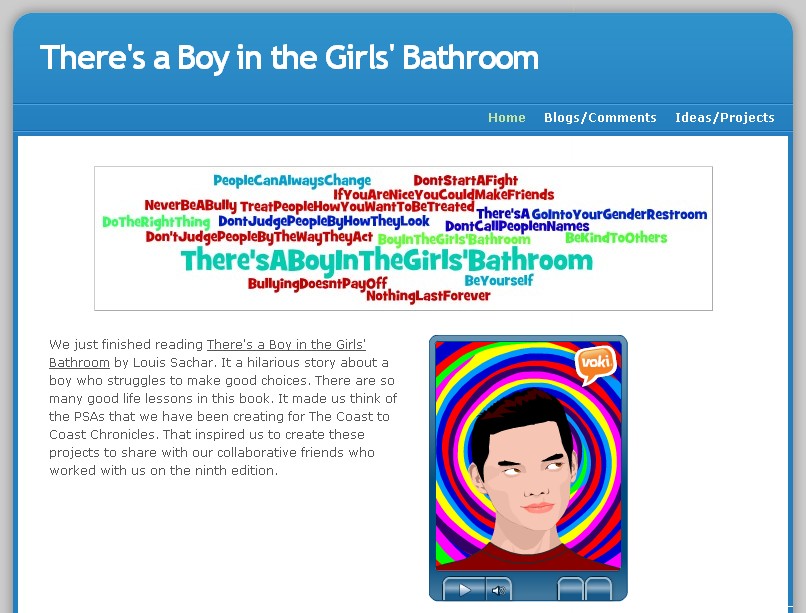
As my students were putting the finishing touches on their collaborative PSAs that they were creating with students from across the country, we were reading There's a Boy in the Girls' Bathroom by Louis Sachar. One of my goals this year is to bring more literature into our day in spite of our rigid schedule and prescriptive reading program. (See blog A Book in a Day) I select books that have high interest for the students in my class, that spur great conversations, and that reinforce the standards that we're studying. This book has many of the themes that that go along with the Coast to Coast Chronicles Edition 9's theme. The 200+ students wanted to create and collaborate on the theme of "Making a Difference." These PSAs were for The Coast to Coast Chronicles.

As we finished up our book, my learners asked if they could create different projects to go with the book that would also connect to their collaborative work on the Coast to Coast Chronicles. That's right...they asked to do these projects. They brainstormed all kinds of ideas about what they wanted to create. As with everything else, we only had a small amount of time that they could work on this project from start to finish. They wanted to publish "a digital poster that would hold their different projects." My first thought was that we would use Glogster. But after a few minutes, we discovered that it was blocked at school. One student said, "I wish we could just create a website or something." Great idea. That's when Weebly came to the rescue.

http://theresaboyinthegirlsbathroom.weebly.com/
Weebly is a free site (there is an upgraded paid version) that allows one to create websites. It has a very easy drag and drop interface that my students navigated very quickly. There are preset themes and templates to get you started. While two of my students started setting up the page for the class, the other students broke into pairs and began planning and writing their projects.

I conferred with each pair several times throughout this project. They knew that they were responsible for explaining what they were creating and why it supported the themes of the book and the Coast to Coast Chronicles. Several of them wanted to tell about the story and the themes through a certain character's point of view. After writing, and conferring with me, they decided that Voki would be a great way to publish this. (See blog on Voki). Another team wanted to use the camera and act out what they had learned from the book about bullying. They decided to publish is as a Voice Thread. Others wanted to write poetry. They wanted to create songs with their poetry. We pulled up Songify on my smart phone, they selected the music that they wanted to use, read their poetry into the phone and published their song.

http://theresaboyinthegirlsbathroom.weebly.com/
My learners were so excited about what they were creating because they felt like it was going to be a surprise to all of their collaborative Coast to Coast partners....a little something extra for this edition. Of all the tools used, the one that's holding it all together is Weebly. It may not be as flashy as a VoiceThread, Voki, or song, but without it my students' planning would have probably stopped short. It housed all of their creativity and supported so much learning. So although it probably won't be discussed much when the other students see our Weebly, my students know that it's the tool that made it all this student-directed learning possible.


Monday, November 28, 2011

Question Everything!

Almost four years ago I came to the realization that, although I was a good teacher, my students weren't making the growth that I expected. I knew that there had to be a better way to reach my learners, but I wasn't sure how I would do that. So together, we set out on a journey to discover a better way to organize our class. The biggest shift was from a teacher-centered classroom to a student-directed learning environment. How did we discover a better way? We questioned everything. And even now, that is something that as proven to be the most power agent of change....questioning and reflecting on everything that we do.

So I want to challenge each of you (and myself) to question everything that you do with your learners. Here are a few questions to get you started thinking...


  1. Why is your learning environment set up the way that it is? Most of us will recognize that the classroom learning environment makes a drastic change after the primary grades. Why is that? Isn't good teaching, well, good teaching? This year, I let my students design our learning environment. They organized our classroom library in a way that was meaningful to them. They created the anchor charts and displays that are hanging in the classroom (they love the poster maker). Their self-portraits are the first thing you notice when you walk into the room which reflects whose learning environment this is. Our classroom was already set up for small groups, but they also wanted different learning spaces within the classroom. Somehow, even with 27 large desks, they have created different spaces for paired and small group collaboration. But, I think that their favorite area is the large rug. They love to stretch out and work with their peers. They also love to sit around our and have group discussions. Believe it or not, they LOVE to be read to while sitting around our big rug. So regardless of your grade level or content area, question why you have your room set up the way that it is. Ask your students what they think. Is "this is how it's always been" a good enough answer? Does your current learning environment meet the needs of your learners? Does it reflect them?
  2. Do your classroom norms and procedures meet the needs of your current students? Whose classroom is it? Is it yours or your students? We all remember at the beginning of the school year sitting in a new teacher's classroom and having them dictate a list of rules or procedures to us. Did that nurture and environment where you take ownership of what went on in the classroom? Of course it didn't. So often I hear that students are not interest in what's going on in the classroom. Could this be a contributing factor? We have class conversations for days about what type of learning environment we collectively want. Students come up with ideas that we may never think of including. As a teacher, we already know the basics that need to be included. It is important for us to guide students towards those topics, but allow them to set the procedures and classroom norms for the themselves. They take ownership of their own behavior and they hold one another to the standards that they set. My students know that the norms that are hanging on our classroom wall (thank you, poster maker) are a work in progress. They can change as our needs change. Have you asked your students to share their ideas about how the classroom runs? You'd be amazed at the difference it makes to them to feel like their voice is heard.
  3. Do all learners have to learn the same thing at the same time in the same way? Are any two of our students in the same place in their learning journey? No. Then why do we expect them all to sit through the same learning activities and do the same activities? I realize that we all have pacing guides to follow. However, if a student has already mastered a standard, should they have to sit through the same lesson and same activities as students who have not mastered the standard? No. That's why only having whole group instruction in a classroom has proven unsuccessful at meeting the needs of all learners. By giving a pretest on a standard, you'll find out who needs some instruction, who needs a lot of instruction, and who needs no instruction. That gives you the opportunity to provide students with activities that will challenge them. Also, within an umbrella of a standard, it gives you the opportunity to allow your students to explore what interests them. Let them write about a topic that peaks their interest and publish it with tools that strengthens their voice. No two students are alike so there is no way that one way to teach, one strategy, or one tool will meet the needs of your unique learners. This empowers students to guide the path of their own learning. 
  4. Why do you give the assignments that you do? Why do you give the homework that you give? What are these assignments really measuring? I recently had a fellow teacher tell me that the parents of her students told her she was a good teacher because she gave a lot of homework.Is that why we give homework... because of others' expectations? I hope not. It is important that we take the time to really evaluate what we are giving our students to do and whether or not that is relevant and reliable. Here are my thoughts on Homework and on the Reading Log Part 1 and Part 2.
  5. How do you assess your students? I realize that most of us have no say over many of the tests that we are required to give. However, is that the only way to assess our students? Of course not. Here's something to think about: How many of us have come up with a project for our students, created a rubric, taken it to our class, explained it to them and then they proceeded to pay little heed to the rubric? Why might that be? Could it be because this was all about what we wanted and they had little say in the project? Were they invested in this project? No. What do you do to make that shift? Let them design the rubric or standards for each of the projects in which they are engaged. Of course, you are the content specialist. You know what needs to be evaluated. But, it needs to come from the students. Guide them, through your questions, into designing the rubric for their own projects. Let them evaluate themselves and one another. What you will discover is that the students hold themselves to much higher standards because they designed the project and the expectations. It's theirs. So think about how you  assess your students. Is it effective? Is it reliable? Does it meet the needs of today's students?
This is a short list, but I think I've made my point. Just because we have done something in the past and it's worked or just because that's the way that something has been for years doesn't necessarily mean that it is what is best for our students. We are in the classroom for THEM. Our job is to provide them with the best educational experience possible and to help them along their personal learning journey. Our job is to provide them with the tools that they need to be successful outside of the classroom walls. That is why we need to rethink everything that we are doing to make sure that what we are doing is what is best for THEM.

Monday, October 31, 2011

The Transformative Power of Writing

Today, I want to tell you what I learned from a student that we'll call Thomas. At the beginning of the week, we read an article by National Geographic Kids entitled, "Jane Goodall's 10 Way to Help Save Wildlife." This interview with Jane Goodall tied in beautifully to the pieces that my students are writing with their collaborative partners in another state about how they can make a difference in the world.

This led to a great discussion about other ways we could make a difference in the environment. One student suggested picking up trash when they were at one of our local parks. She explained how it would improve not only the park for each of us, but also for the wildlife in the area. The rest of the class were chiming in their agreement when Thomas spoke up and said, "I don't roll like that. It can just stay there 'cause it doesn't bother me and I'm not touching someone else's mess." Many of his peers tried to persuade him otherwise, but he just crossed his arms and shook his head. We returned to our discussion.

A couple of days later, Thomas was sitting with me as we were conferring on his research and ideas for the piece he is preparing for our collaborative journal with the theme "Making a Difference." Each writer chose a topic that interested them. As we spoke about what he had discovered on his topic (for privacy reasons his topic will remain anonymous), I had a lot of difficulty getting him to focus. He set a plan of action and returned to work on his writing. While I conferred with my other students, I was constantly having to redirect him back on task, reminding him of the plan he had laid out for his project.

The next day, while we were working on our writing, he came running over to me with a shocking fact. Not only was he upset by it, but he had come up with several solutions. His focus changed; his pace accelerated. When it was time for lunch and I'm trying to get my students out of the door, he kept stepping in front of me to show me what he had written. Telling him that I would look at it after lunch or even during lunch wasn't good enough. He wanted me to read what he had put together right then.

I was amazed at his dedication and enthusiasm when the day before he was busy doing anything but this project. He was outraged with the injustice of his topic and he wanted to change something right then; he felt strongly that he needed to share it with me without delay. I agreed to confer with him while walking down the hall (we are one of the last classes served lunch...we cannot be late without some unpleasant consequences). As we walked and conferred, I marveled at how expertly and passionately he discussed his topic. When I asked him why this topic meant so much to him, he referred back to that shocking fact he had shared with me earlier. He explained how it made him think of something that had happened in his family. This experience made him re-evaluate some of his thinking. As he wrote, he examined ways that he could affect some change to make the world a better place.

After lunch, we had a guest come and lead my writers in an activity. She had them write letters to a community member who was away at basic training and missing his friends, family, and community. My students were very excited and wrote heartfelt letters. So what about Thomas? Was his new found determination to help make the world a better place a one time experience? After they had been writing for several minutes, Thomas spoke up, "I really like this. I think this is good for us to do because it's really going to make him happy. I fell good about it too." Hmm, I guess Thomas does "roll like that" after all. And what made the difference? Giving him the opportunity to learn and write about a topic that interested him. Writing has the power to help you explore, grow and change your thinking. Writing can transform who you are as a person as it did for Thomas.  I wonder what else he will roll with this year. There is no telling, but I can't wait to find out.

Thursday, October 20, 2011

What's In Your Writing Tool Belt?

With today being the National Day on Writing, my students and I have spent some time discussing "why I write." They have actually created tweets to add to the hashtag #whyIwrite throughout the day today. When I think about the what has made the biggest difference in my students' perception of creating and writing, it has to be that they now write and publish for an authentic audience...not just for me or some mystery scorer. Their writing has an audience and a purpose.

So on this National Day on Writing, I would like to share our top ten favorite tools that support writing. These tools empower my writers by strengthening their voice.


  1. KidBlog- Those of you who have been following my blog know that my learners have latched onto blogging like a fish to water. They have become voracious writers sharing what they are learning, reading, exploring, or contemplating. Rarely is there a time when at least one of my students isn't blogging. They have found the power of personal reflection and love the aspect that what they write has an audience who will continue their conversations and challenge one another's thinking.
  2. Voice Thread- This is a truly collaborative tool that allows participants to make comments and continue conversations. Usually my writers create a piece of writing, upload it, record it and then their peers will comment upon one another's writing. Comments can be done with text, voice, video, or doodling. 
  3. Wikispaces- Wikis are a fast and simple way for students to collaboratively publish their writing projects. It gives you the ability to not only insert text, but also insert Word documents, audio files, URLs, PowerPoints, video files, spreadsheets, and photos. And if that wasn't enough, you can also embed projects like VoiceThread, ToonDoos, Vokis, Xtranormal, Wallwishers, and Livebinders directly into a wiki.
  4. ToonDoo- ToonDoo is a tool that lets the writer create a comic strip. They provide a huge gallery of clip art and speech bubbles, my my creative students love drawing their own illustrations, scanning them and uploading them into their ToonDoos. You can also upload photos. If your students want to create more of a comic book page than a comic strip (like my students), you can try using ComicLife.
  5. PhotoStory-My learners love taking their writing and turning it into a digital story. When they finish publishing,  we often have a viewing party.  The tool that we turn to most often is PhotoStory.It is very intuitive to use as it walks the user through every step of the publishing process.
  6. Audacity- If you are looking for a tool for your learners to create an audio file or podcast, Audacity is user friendly. There are the basic functions of recording a piece of writing as well as a lot of bells and whistles which can really tap into a student's creativity.
  7. Lintor Publishing- I described Lintor Make-a-Book in this blog post.  Because sometimes writers still want a tool that allows then to hold, carry, and physically share their books with others, my writers love using Lintor's products. They provide a variety of templates as well as book sizes so that students have the opportunity to create their own hard copy, hardcover book from start to finish.
  8. Twitter-In class, we have a Twitter account. Many of you may be wondering about this as a publishing tool as a user only has 140 characters. However, with Twitter, my learners have to learn about being succinct and powerful in their words choices. It has really helped them to focus on their message and the best way to get that message across to their followers. They all agree that standard English is what we use when we tweet from school...no "text speak" so that all of our audience understands what they are saying.
  9. StoryJumper-In this post, I wrote about a project that my writers created using StoryJumper. StoryJumper allows students to create digital storybooks which can also be purchased should someone want a copy. StoryJumper has huge selection of clipart and backgrounds, but writers also have the ability to upload their own artwork and photographs, which my learners love.
  10. Voki- I wrote about Vokis in this blog post.Voki allows the user to create a personalized talking avatar that can be easily embedded into wikis, blogs, profiles, and email.Voki has the option for the creator to type the text they want spoken or record their voices with their avatar. 
So there's our list...for now. Ask us again what our favorite publishing tools are in an hour and you would probably get a different list. The one constant is the role that these tools play in our stduents' writing....they support the writing; they are not the driving force. We would love to hear about any publishing tool that your students enjoy. Have a happy National Day on Writing today.

Friday, October 14, 2011

Students Seeking Validation Through Writing

Those of you have been reading my blog know that I recently had my book published. In fact, while I was in DC, I made a trip to the Library of Congress.  Not only is it a beautiful place, it is the home of books, learning, knowledge, and wisdom. Many people do not realize that it is solely a research library where books are not checked out. Also, many people do not realize that the Library of Congress only physically houses 10% of the books ever written. I was curious...would my book be one of the 10%? After asking several people to help me find the answers to my curiosity, I finally found a librarian who was willing to dive into their records. A few bated breaths later, she turned the screen to show me that my book was not only registered there (which I knew Stenhouse had done), but it was also one of the 10% housed there onsite as a physical book. She and I both did a little jumping and clapping to celebrate. I was waiting for another librarian to blow us over with her powerful, "Shhh!"


Afterwards, I have been thinking about the power of publishing your work for others to read...especially in regards to our students. Those of you who are familiar with my classroom know that my students use a wide variety of digital tools for publishing their work for a much wider audience. They love all of the different publishing tools that they use (and are constantly finding new ones), but one of their favorites is still using Lintor Make a Book to create their own hardcover book. It still surprises me that with all of the other digital tools that they use, my students thoroughly enjoy...and seek out new opportunities...to publish a hardcover, hardcopy version of one of their pieces of writing.

Lintor Publishing makes publishing a hardcover book extremely user-friendly. Their product makes it simple for students to create and publish their own hardcover books from start to finish. They have a variety of book publishing packages to fit most needs.

Just like me, (I wanted tangible evidence that my book was in the Library of Congress) sometimes our students enjoy having that tangible book in their hands as evidence of their hard work.They like taking it to share with others. My authors love taking their books to read to younger students.We keep a library of their books for them to be read by everyone in the class.They are shared with anyone who will take time to listen and look at their books. Their books always receive a lot of attention at our Young Authors' Conference because they look so professional and my students are so proud of and enthusiastic about what they've created. After all, they created it so that others would read it.

So next time your students begin to publish, remember that sometimes students want to have that tangible book in their hands to share with others. It's a way for them to receive validation for all of the hard work that they've done.

(As a side note: Many of you know that the community where I teach was hit by the April 27th tornado that came through Alabama. One of the first people to reach out to us was Janice Miller, owner of Lintor Publishing. She not only reached out as concerned  for our safety, but she suggested that the students have the opportunity to do some therapeutic writing about their experiences with those storms. She generously sent my class book covers so that they could publish their own books. Her generosity touched my students and they treasure those books that they wrote.) 

Wednesday, October 5, 2011

An Afternoon in "Pleasantville"

Today, we had the most pleasant afternoon. My students spent this afternoon blogging, answering questions and making comments to their collaborative partners on Moodle, and working on a Global Read Aloud Project. They were all sitting in different small groups all over the room, occasionally chatting about what they were thinking about, writing, or creating. There was just a nice, low hum of happy kids discussing what they were learning with one another. I loved it!

Moments like this just make me want to do a little dance. They are so highly engaged and independent from depending on me to tell them what to do. Of course, this afternoon didn't just happen. It's taken weeks of modeling, discussing and practicing how and why we use these tools and what behaviors they deem appropriate. They've set their own expectations and they are holding one another to those expectations.

The great thing about this afternoon (besides listening to their happy, thought-provoking and somewhat humorous comments) was that this gave me the opportunity to work with some students one-on-one. While they were all actively engaged in meaningful work, I was reading through their pending blog posts. By looking at their writing, I was able to determine if they had a misunderstanding with their grasp of not only content area but also with grammar and mechanics.

It was a great opportunity to visit with my students and have them explain what they saw in their writing that could improve it for the reader. Almost all of them would take a minute to look at what they had written and determine what should be corrected. Others needed a bit more prompting, but by leading them to making those discoveries meant much more to them. They found the error; they determined what needed to be corrected; they determined why it needed to be corrected. (By the way, those of you itching to write a comment about how blogging shouldn't be evaluated, need to read these previous posts: Did I Make the Grade? The Reading Log Conundrum and What is Homework? It's not a luxury that I have where I teach right now.)

This method of conferring, letting the students make the edits and corrections with your guidance, is much more powerful for the students. We use this in my classroom for all of our writing assignments regardless of genre, content area, or method of publishing. It allows them to make these discoveries for themselves. It's no longer a teacher telling them what to do and how to do it. It's them making these choices because it strengthens their voice in whatever they are writing.

So, I look forward to many more days like this where my writers are all engaged in meaningful, (and let's face it) fun and yet rigorous work. Now back to reading those blogs....they have passed 400 blogs since school has started. What do you think? Do my kids like to write, or what?

Tuesday, September 6, 2011

An Update to the Reading Log Conundrum

A while back, I wrote about our school's nonnegotiable practice of requiring every student to complete a reading log and how I felt like it was counterproductive to a student developing a real love of reading. Here's the original post. Since then, I've had quite a few people question me about that blog and request an update.

As I wrote earlier, my students started off the year blogging. One of the expectations that my students designed was that their individual blogging would replace the dreaded reading log, among other things. In fact, most of them have taken to it like a fish to water. A few others have needed to have a bit of encouragement that their voices were important enough to be heard.

Now, I realize that I have a totally different set of students with totally different needs than my previous class. However, this is one of he most diverse classes that I've been fortunate enough to work with. With that in mind, I want to share with you what I've observed.

When my students complete an activity, project, or assignment, they are much more likely to pick up a book and read. Shortly after they've read a few minutes, they ask to use the computers so that they can blog. (As an aside, the students don't have to ask me to use the computers. It's a hang over from previous years.) When I finally asked one of my students about their willingness to read as often as he was, he said, "Well, in my last blog post, I told about what was happening in my book and made a prediction. Three people commented on my post and asked me questions. I had to find the answers so that I could answer their comments."

My students have discovered what has escaped so many, well-meaning educators: Having an interactive conversation about a book, even through writing, provides students a reason to read and write. It's so simple really. How many of want to share something great we've read with others? Isn't that what we see so much of on Twitter? How about all of the book clubs that people have? All of those speak to the fact that we like to talk about what we've read. We want to share our discoveries with others. It's real, it's relevant, and it's fun!

...and as a side note, I'm finding a ton of new books to read, all reviewed by my 5th graders!

So is it working? Absolutely! However, if at any time it doesn't work, my learners know that we will stop, have a discussion, find a solution, update our blogging expectations, and move forward. I love that my students have taken such ownership of their reading, writing, and blogging. It's exciting to see every day.

Sunday, August 21, 2011

Did I Make the Grade?

I've just finished my first week of school with my new class of fifth graders. This week, we started out building a strong foundation for the rest of the year. We did many of the same activities that I discussed in Chapter One of Can We Skip Lunch and Keep Writing?, but we also stretched and adapted those strategies as they best met the needs of my students. Much of what we do springs from conversations from reading Frindle by Andrew Clements. It serves as a great example of writing as he expertly weaves together the different modes of writing and the use of figurative language, with an entertaining story for middle aged readers. As we read it, I encourage my students to not only enjoy and discuss the humorous story, but also to begin looking at it through a writer's eyes.

As we are reading, my students begin to create a list of "Characteristics of Great Writing." My new students begin a bit hesitantly to add to the list as I've requested that they explain and justify their answers. I ask a lot of questions to guide them in this kind of thinking. They've been so trained to think that there is only one possible answer or conclusion to a question that when I told them that most questions have a multitude of possible answers, you could see a burden being lifted off of their shoulders. They were so eager to grasp this new kind of thinking. This discussion led students to making conclusions not only about the craft of writing, but also they purpose of composing using correct grammar and mechanics.

All of these fabulous conversations lead us into our blogging conversation. None of my students have ever blogged before and most of them were unclear about what a blog was. I used a variation on McTeach's blogging lesson, but the students naturally linked the importance of good writing from our Frindle discussions to our blogs. We also read and discussed parts of Net Cetera (I ordered copies for each family) to ensure that the students understood digital citizenship, Internet safety, and cyberbullying.

One strategy that I love is that I let my learners create their own criteria/rubrics for each of our activities. It puts the power of expectations into their own hands. After all, this is their blog, they should have a say over what should be included. (Note: I realize that many feel that blogs should not be evaluated. However, those that read my blog regularly know that this is not a luxury that I have in my classroom. See: Homework and Reading Logs)

Since this was the first criteria they were going to create, I led them through it as a class. Here is the list that they created of their Blogging Expectations:


  1. Use proper capitalization, organization, punctuation, and spelling. (As they explained, "If you don't edit, it doesn't matter what you've written; no one will understand you.")
  2. Be safe with all of your choices.
  3. Create posts that show what we've learned.
  4. Always use appropriate and kind words.
  5. Think about the audience.
  6. Explain and give great details in your posts. ( As one student said, "Who wants to read something that's boring?")
  7. Compose three or more blog posts a week. (They really wanted to have more in this number, but several students do not have access to a computer outside of school hours.This was a heated debate...pretty cool that most of the kids were fighting for MORE work instead of less, huh?)
  8. At least one of your blog posts will be about what you are reading. (The class actually cheered when they figured out this was going to replace the dreaded reading logs.)
  9. Create comments that are thoughtful, relevant, and continue the conversation.(One learner actually pointed out that by creating comments like this, they were also giving evidence that they were reading...score another point for getting rid of reading logs, but still meeting that independent reading standard on the report card. Yep, he got a high five...wish I had though of that.)
  10. Practice using characteristics of great writing in every post.
Is this the of expectations that I would have made for them? Absolutely not! It is infinitely better. This list demonstrated to me how well they had grasped all of the activities and discussions that we had done all week. They tied it all together and saw the relevance of how all of the pieces of the puzzle fit together better than I did. What I didn't realize (until we were done) was that they were grading me on how well I had done this week. Did I make the grade? Did I grow as a teacher this week? I think so. This group of learners are going to keep me on my toes. The sky's the limit now. Who knows what tomorrow is going to bring?