Showing posts with label collaboration. Show all posts

Sunday, October 11, 2015

Setting the Stage for Successful Student Collaboration

In today’s digital world, our roles as educators have shifted. We are no longer the sole proprietor and expert in the classroom. Truth is that if Google can replace us, we are no longer doing our job. Our role in the classroom is to teach our students how to apply content knowledge to solve problems. We promote skills like critical thinking, creativity, communication, and collaboration. However, those are not skills that come naturally to our students. 

We live in a time where boundaries of learning are being pushed. With the myriad of digital tools at their fingertips, our students have the ability to connect and collaborate with peers both locally and globally. Students have access to experts in any field. Because of the lives they lead, they crave feedback. Yet, their efforts at collaboration often lead anywhere from shutdowns to meltdowns.

We hear our colleagues extolling the virtues of connecting students for collaborative learning and it may cause us to wonder what is going wrong in our classroom. The truth is that everyone, no matter how well intentioned, enters with certain expectations and perceptions. Many of our students expect to walk into a group situation where everyone is working on the same goal doing the exact same thing as their fellow group members. That is simply cooperation or compliance. Often cooperation does not push students into authentic tasks that require higher level thinking and reasoning. True collaboration comes when each member in a collaborative group brings his/her strengths, ideas, experiences, and knowledge to share with the group. Everyone contributes towards the common goal using their unique talents for the good of the entire group.

As teachers, I’m confident that a great majority of us have probably experienced the same frustration as our students when trying to collaborate with our colleagues. I thought I would take an opportunity to share with you some of the practices that my students have learned through our years collaborating with peers both locally and globally.  By preparing them of these mindsets in advance, their likelihood of success is greatly improved.

Communicate expectations up front. The first step that my students do when forming a new collaboration partnership is to outline a list of the norms and expectations that they have for their upcoming project. They discuss timeline, deadlines, behaviors, work ethic, and accountability to the group. Through these conversations, they have the opportunity to share their goals and their concerns about their impending work together. This dialogue lets every member know before they begin the first step exactly where they are headed. It not only helps them create a relationship with one another where they feel safe to be transparent in their thinking, but also connect with one another as individuals on a deeper level. Although this may seem time consuming in an already jammed packed learning day, the group will make up the time in the long run as their project will not suffer from constant derailing due to miscommunications.

Remain flexible.  Things happen. People get sick. Schedules get rearranged. Parents set appointments.  As adults, we understand this is part of life, but sometimes students get frustrated when a deadline isn’t met by a teammate, one member seems to fail in following through with their part of a project, or they miss a time for real time communication. By guiding our students into becoming adept at adjusting plans, they are learning valuable life skills. Often when a student comes to me aggravated because something has disrupted their project, we can lean on the strong foundation that they set in the beginning. Once they open that dialogue, the learners discover a solution together that stronger than their initial plan. They learn to listen to one another, have patience, and pull their resources to reach towards their common goal.

Keep an open-mind. As adults we understand that not everyone is like us. However, many of our students in spite of being globally connected, often live under the false premise that everyone is like them. I’ve discovered over the last several years that this is often the most challenging part of collaboration for students. Students may feel that they are the expert, the smartest, the most organized, the most creative, or the most talented individual in the group. Those beliefs are why I believe that collaboration is an integral part of the learning process. Students need to have experience with students who in many ways may not be like them. No single person is who they are with the talents they have without the guidance and input of others. We become the best version of ourselves by working and learning with others.


By preparing our students in advance for the shifts they will need to make in order to successfully collaborate with the peers, both in the classroom and through digital means, we give them the tools to open a world of learning possibilities. Through collaboration, students find commonalities with a diverse community of learners and apply content knowledge and higher order thinking skills for an authentic audience while becoming the strongest version of themselves. Collaboration, although challenging at times, is well worth the investment for us, our students, and the future.


photo credit: Empty Stage via photopin (license)

Wednesday, March 4, 2015

Once Upon a Time: Student-Run Book Groups

Upon returning to middle school last year, after some time in a self-contained fifth grade classroom, there was one challenge that I observed. In middle school, students are placed in honors (pre-AP) classes or in on-grade level classes. What I truly missed was the ability for students on different places in their learning journey to learn from one another. My on-level group was not being afforded the opportunity to participate in literary discussions where there was deep analysis coupled with life applications. They didn't have student models in the classroom who were extremely adept in writing, editing, and communicating ideas using a broad vocabulary. Conversely, the students in my honors classes were being denied the opportunity to break down and articulate their learning so that another person could learn from their expertise...this "why" is a vital part of the learning process. Yes, my students were connected via digital means such as their blog, but that one-on-one, synchronous conversation was lacking. Then a light bulb went off. The other full time 6th grade ELA teacher, Lindsay Kilgore, had a reverse schedule. When I had an honors class, she had an on-level class and vice versa. After a little celebration that scheduling worked in our favor, we began looking at our students' interest and needs.

We noticed that our students this year were really interested in fantasy books and narrative writing. Also our students really enjoyed our A Christmas Carol unit, their first foray into classic literature. Couple that with a local production company doing a performance of Alice in Wonderland, our fairy tale unit was born. Now, to be truthfully honest, I never thought I would be doing a fairy tale unit with my middle schoolers. This time last year, we were doing a huge mystery unit designed by my students. [Student Motivation: It's No Mystery and Saying Yes: Making Their Ideas Reality]. However, I've come to expect that no two years will be the same because no two groups of students are the same.

For this fairy tale unit, we decided that we wanted to provide students with plenty of voice and choice. Since we had a much more diverse population by joining our two classes, we knew we would need to provide some chapter books for them to select from with an option to make another choice on their own. I reached out to my PLN for suggestions on middle level reader fairy tale books (or books write fairy tale elements). After a lot of marathon reading, the books that we settled upon were Cinder by Marissa Meyers, Harry Potter and the Sorcerer's Stone/Harry Potter and the Chamber of Secrets by J.K. Rowling, A Wrinkle in Time by Madeleine L'Engle, A Tale Dark and Grimm/Through a Glass Grimmly by Adam Gidwitz, Far Far Away by Tom McNeal, Alice's Adventures in Wonderland by Lewis Carroll and The Graveyard Book by Neil Gaiman. When reading, we looked for challenging and exciting text that would interest a wide range of students. We wanted to break the Disney stereotype of fairy tales and really provide our students with texts that brought in strong themes, multiple cultures, history, and strong protagonists. 

When we presented these to students, we themed this entire unit as travel packages, complete with their travel consultant "Faire E. Wiing." Students made choices and then Lindsay and I set about creating diverse, heterogeneous groups a.k.a. travel companions for their adventure. Before students met in their groups, each one of us took a reading survey to gain insight about our specific reading strengths, challenges, likes, and dislikes. Lindsay and I modeled with one another how to be transparent in a conversation with others. Then our students met together and shared with their groups their reading identity with their new book group. As Lindsay and I travelled around listening to their conversations, we realize how transparent they were being with one another. We realized that this was a crucial part of laying the foundation for the success of the next five weeks.

Once our students got to know one another, they were given the task of setting their group norms. They outlined exactly what they expected of one another on their adventure. What will our discussions look like? How will we treat one another? How will be address any challenges? This opened students up to transparently sharing their apprehensions about working with students with whom they were unfamiliar. They had crucial conversations and addressed all of these while putting it in writing as a reminder throughout the five week journey.

Then students received a calendar. Using their books, they set goals and identified when they would hold a weekly synchronous conversation. It was up to each group how much they read each time they met. The only requirements that we gave them were the date of completion for their reading and that they had to discuss their book at least once a week. With these foundations in place, the student groups set off with their plan and an exciting adventure in hand.

Students were given a little over three hours a week to work together. Lindsay and I would rotate through the groups to observe and listen to their discussion. However, what we quickly learned was that they had taken ownership over their reading groups. They wouldn't stop and expect us to take over the discussion. Our readers would ask us questions to draw us into their discussions. It was thrilling to see them work through challenges, grow as readers and communicators, and totally drive their learning. Students who struggled to get through a couple of pages in a book, tore through three-hundred page books and wanted to keep going. (We intentionally chose books that were a part of a series or from a author who had a lot of other books.)

In total, these book groups impacted about one-hundred sixty students. In five weeks, we only had to step in with two students. After an honest conversation with each of these individuals, we guided them into finding a way to address their concerns and rejoining the group as a productive member.

As a classroom teacher, it's exciting to see the success that students reach when they are empowered to make choices about their learning. The ultimate compliment that we received was when students asked when we could do this again. They built new friendships, grew as learners, and they were hungry for more. For me and Lindsay, that endorsement was our "happily ever after" and like the kids...we can't wait for our next adventure. 

Saturday, March 29, 2014

Conflict: Maintaining Professionalism, Integrity, and Relationships

Conflict is all around us as educators. Conflict among students, their parents, and our colleagues. I've recently completed a Masters in Teacher Leadership where we spent much of our time in the program diving into strengthening communication skills and dealing with interpersonal conflict among our colleagues. The most active discussion among my classmates always arose around the topic of conflict: avoiding it, rectifying it, and restoring peace. My class had students from all over the world which showed me this is a topic not limited to one specific school, district, state, or country. It's universal for us because, as educators, we deal with people. So how can we deal with conflict when working with our colleagues? It is impossible to avoid if you do not know one another very well.

This year, I have been very fortunate to work with an extremely talented and confident team of experienced and passionate teachers. Each member has an area of speciality that they bring to the group as we move towards providing our students the best learning possible. However, in any group there is always the possibility that our viewpoints and perspective will not always align with one another's.

During the first semester, our team leader, Lindsay Kilgore (@lindsaykilgore on Twitter), suggested that we create a unified goal as a group of 6th grade teachers. Through this discussion, we were able to share our own vision for our students and the grade level, giving all of us an insight into each other's perceptions. Being a new member of the team this year, our creating of the goal gave me the opportunity to understand my team members and feel like an integral part of the team. All of us agreed that student learning needed to be our driving force. I believe that the process of writing this goal is what solidified us as a true team and laid a foundation for further discussions.

I admired how much research that Lindsay did on communication, conflict resolution, and professional goal setting. Another team member suggested that it would be helpful for us to take a personality test so that we could understand one another on a deeper level when working closely with one another. Lindsay sent us the article Personality Types: Using Personality Assessments to Identify Your Strengths (and Understand Your Co-Workers). In that article is a link to the Myers Briggs Type Indicator that we each took and sent the results to her to compile. During the time that we took the personality test, many of us were surprised at not only how accurate the explanation of our type actually was for ourselves, but also at how different some of our colleagues were in reality than we had perceived them. In spite of regular conversations, team meetings, and collaborative projects, it became apparent that there were some crucial personality characteristics that we each needed to take into consideration.

Lindsay compiled all of our information and distributed at our team meeting. She included tips for how
Photo bPeggy2012CREATIVELENZ
each personality type should interact with the other personality types. Through our discussion, it led us to the conclusion that not only understanding ourselves, but each other and how to communicate effectively would be of great benefit in knowing our students. We discussed how we could begin the school year with a personality test in order to truly gain insight into our learners and begin the year teaching them the way that they learn and communicate. (Lindsay used 16 Personalities: Get to Know Yourself and Relationship Between Personality Types and Truity and Personality and Relationships to compile and explain our results.)

Another conversation that we had as a team was discussing conflict: what sets us off, how we deal with conflict, and how we want to resolve the disagreement. It became very apparent that not understanding these elements could potentially cause a problem. For example, if one individual deals with conflict considerably different than another in the team, that could exponentially escalate the conflict. This kind of issue could hinder the true point of conflict, which is resolution. Knowing this about one another helps each of us to understand what to expect of each individual and proceed in the manner that fits their personality.

Out of the conflict dialogue grew a discussion on where we wanted to be as a team professionally...our professional goals as a team. This conversation showed that some team members wanted to focus all their efforts in their classroom while others wanted to pursue National Board Certification, writing for professional education organizations, building a model school for lab experiences, coaching fellow teachers, or presenting at conferences. This opens the door to ongoing conversation as we continue to teach together. Knowing an individual's goal helps you to understand actions you might have misunderstood (A lesson that easily applies to our students.).

Conflict is difficult. Conflict among great and passionate teachers can take a great place to teach and make it unbearable. Opening up the dialogue, being honest and kind can lay a strong foundation before conflict arises. It builds strong relationships based on trust and mutual respect. And, when you really think about it, the true beneficiaries of handling conflict with professionalism and integrity are our students...the ones that it's all really about.

PS- Next week, at our team meeting, we will be creating norms for our group. Stay tuned!

Saturday, January 11, 2014

Saying Yes: Making Their Ideas a Reality

In my last post, Student Motivation: It's No Mystery, I shared the five-week mystery unit that my students designed and implemented. The depth of their learning and the ownership that they took was astounding. In their impromptu planning session, one idea kept re-occurring: the students wanted a real mystery to actually solve. I pondered over how to make this idea become a reality that would also promote collaboration, communication, problem-solving, and critical thinking.  I turned to my PLN, both in school and online, and although they shared some great ideas, nothing felt right...until one of my learners, we'll call her Annabeth, approached me with an idea.

Annabeth had the idea to write a mystery for the class (that's right folks; a middle school student ASKED to write). She wanted to call it "The Case of the Missing Teacher." I would be the missing teacher. She wrote down some initial ideas which included reaching out to a fellow 6th grade teacher, both of our administrators, our school counselor, and our school librarian. With little prompting, she applied everything she had learned about the structure of a well-written, highly interesting mystery. She spoke with each of the individuals to plan their role in our mystery, making sure that supervision of students would not be an issue (I was hidden in a storage room which backs up to our classroom, giving me the ability to hear their conversation).

The first clue was in the form of a warm-up with grammatical errors; using each error, the students could put together the name of the first individual who held the key to their journey to find their missing teacher. With a smile, Annabeth told me that the dead giveaway that the warm up was not from me was the fact that it told them to do a packet of worksheets. For each of the subsequent clues, Annabeth composed a poem with a riddle for the class to solve. It was so interesting to listen to the students working together to find me. It took them an hour and twenty minutes. Once found, and rescued, they students stumbled over one another trying to tell me about their adventure. They bragged on their ability to apply their knowledge and rescue me from "my kidnapper." They explained how what we had been learning about analyzing text, listening, problem-solving, and sharing ideas was the key to solving the mystery. Then it was revealed that this experience was not orchestrated by me at all....it was their peer, Annabeth. Needless to say, they were impressed and begged to do this again.

So as a classroom teacher, what can we take away from this experience? The answer to this question could easily become a series of blog posts. Personally, it showed the importance of listening to our students. If I had not been open to Annabeth's ideas and willing to help guide her through the logistical aspect of this project, my students would have missed out on the opportunity to put their knowledge and abilities to the test in an authentic manner. They learned firsthand the important of working together, problem solving, investigating options, following a process, communicating clearly, and analyzing text. Annabeth had the joy of seeing the impact that her writing, planning, and implementing had upon the learning of all of us.

Sometimes as teachers we get in the mindset of "no." We see the obstacles, not the possibilities. We worry about "covering the standards" or marking everything off of a checklist.  I know I always feel like there isn't enough time to provide my students with all of the learning experiences that I want for them. However, look at the learning that would not have transpired if I had said "no." Annabeth and her creative ideas reminded me that I need to live in a Yes-World. I need to make sure that I am not so busy that I don't stop to listen to my students' ideas. After all, it is not about me at all. It is really all about them.

Thank you, Annabeth, for the reminder.

Friday, January 3, 2014

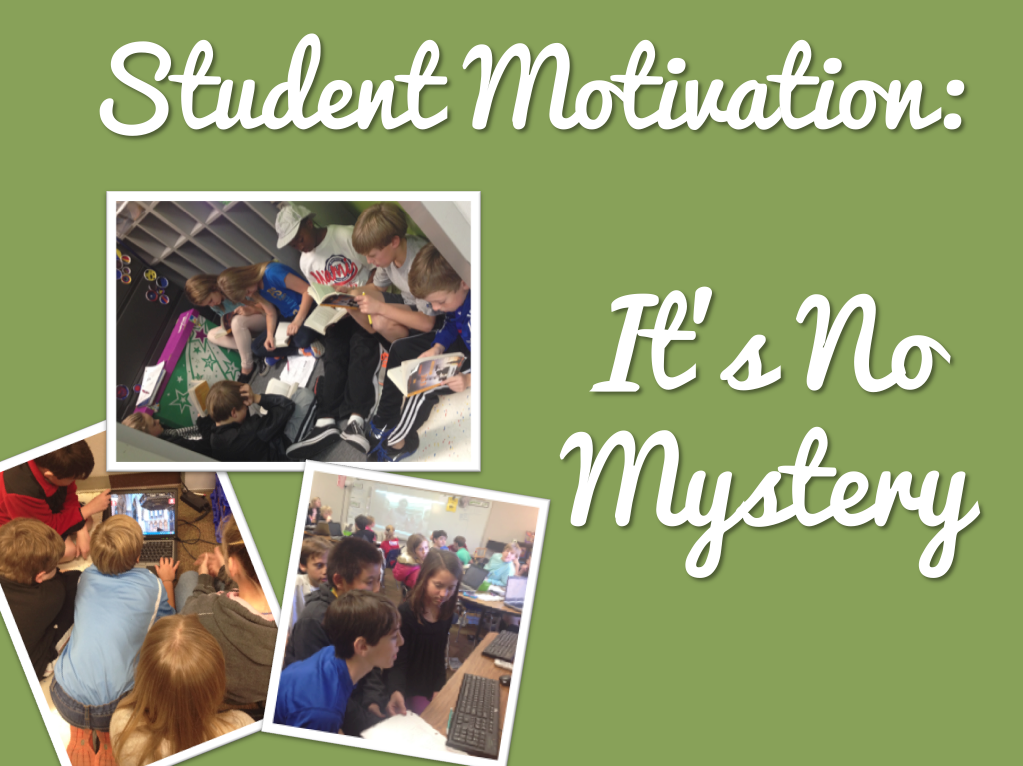
Student Motivation: It's No Mystery

This semester has been a whirlwind of excitement for me and my 6th grade students. So much has transpired that I am bursting to reflect upon and share with others. Moving to a middle school this year, I wondered about student motivation. Traditionally, middle level students are notorious for their apathy and pursuit of identity. Yes, I have spent more of my career in a middle school than an elementary school, but I couldn't help but wonder if what I had been practicing (and preaching loudly) regarding student motivation would translate to my new sixth graders.

Of course, my learners provided me with plenty of food for thought. This year as we were ensconced in the Global Read Aloud, one of my students asked me if we were going to be studying any mysteries this year. Since I am in a new school and I let my students lead my instructional plans, I responded to her that I wasn't sure. I asked, "What do you have in mind?" As she began speaking, slowly other students joined the conversation. What I found interesting was that in their excitement they not only made suggestions about learning activities but also tied in learning standards. Within ten minutes, eighteen of my students had joined the conversation and collaboratively planned a five week mystery unit. I had the pleasure of watching it take shape as they took notes, referred to resources on their devices, and discussed whether something promoted "real learning" or not.

Let's see what happens when students are given the ability to design their learning and how that impacts their motivation to learn. Fasten your seatbelt, here is a (brief) synopsis of their mystery unit.

With the guidance of our school librarian, we selected the book The London Eye Mystery, by Siobhan Dowd, as our main text, and used The Westing Game by Ellen Raskin, as a parallel text through their independent reading. Using both books opened many opportunities for students to deeply compare and contrast plot, character, setting, theme, audience, purpose, and the craft of writing.  Since many of my students had little background knowledge of British culture or history, that opened up opportunities to explore nonfiction texts to enhance their understanding of the novel, the framework where the story played out. This led to them exploring London through virtual field trips and publishing Travel Guides using Skitch.

Many British terms, phrases, and colloquialisms were included in the The London Eye Mystery; so, my students had the opportunity to put their skills at using context clues to work to determine the meaning of the text. They documented this learning on one of our Idea Walls to form a working vocabulary bank they called "Flibbertigibbets and Whatnots." This made them think about perspective, point of view, word choice, and an audience's background knowledge when composing a piece of writing.

As they analyzed the structure of a mystery, my learners also stretched their problem solving and critical analysis through image prompts and whodunit mystery puzzles. Students honed their debating/communication skills as they had to justify and support their claims in the solutions to these mysteries. They used the ability to dig deeply into the text of The London Eye Mystery to make inferences to create their "mystery motherboard" on our large Idea Wall. This wall grew and changed as we moved through the novel and students began to follow the clues in solving the mystery.

 In addition to participating in several Mystery Skypes, my students put to test their ability to analyze text in their pursuit of truth in investigating urban legends using a wide variety of digital and graphic sources. They took a topic of choice, became experts on that topic, synthesized that information, and drew conclusions on whether they were fact or fiction. Then, they took their learning and published "tabloids" on Smore providing resources to support their conclusions.

My students designed their exam and rubric, a complex, interactive Internet mystery, which put the reader to the task of using problem-solving and deductive skills in order to solve the puzzling question. And as a final culminating activity, the student each designed a complex Clue character. Their character had to have a background story, a sense of what motivates them to take action, family/friends/colleagues, and events that shaped who they are. Then the students came in character and we played Clue Queue (a Clue tournament).

Motivation? Is there any doubt that the students were excited each day to learn? My learners would come into class with additional ideas to enhance their learning and the learning of their peers. They took the learning beyond the classroom walls, often writing, blogging, researching, and creating something new to share with their fellow detectives the next day. In fact, as the unit came to an end, the students all commented that the time was too short. They wanted more time. More time? Were the students just "playing at school?" Absolutely not! These students dug deeply into their text. They found a meaningful way to connect the standards to their interests and needs. Did they have fun? There is no doubt about that. But that fun was enveloped in deep and meaningful learning that they not only shared with one another, but also with our digital tools to their global peers.

Is student motivation a mystery? No. Students know exactly what they enjoy and what will make learning in the classroom relevant for them inside and outside the classroom walls. All we have to do is ask and listen.


Tuesday, June 11, 2013

Mythbusters: Technology in the Classroom

I recently had the good fortune to hear Rick Riordan speak (he's the author of the Percy Jackson series...plus many, many more amazing books for middle level readers). Of course, when you mention Rick, one can't help but think about myths as those are the foundation of all of his books. His keynote was about the "Myths of Reading." This got me to thinking about the myths that many educators believe regarding technology in classroom. This is 2013 and I think that sometimes we get caught up in the minutia of our teaching and non-teaching responsibilities and forget that the world around us is changing. If we want to remain relevant for our students, then we too must adapt.

Here are the five most common myths regarding technology in the classroom that I hear from teachers. Let's bust these myths.

Myth 1: I don't know enough about technology to use it with my students.
Many of us grew up and were educated during the time where the teacher was the disseminator of information. The teacher was considered the content expert within the classroom. Once we begin to teach, it is easy to fall into the mindset that we must know everything and be able to answer all of our students' questions.
Yes, we are the content specialists and strategists in our classrooms, but students no longer need us to just deliver content. They have access to content 24/7 in the palms of their hands. They need us to guide them in how to use and apply this knowledge to create, collaborate, and critically solve authentic problems.
How do we overcome the fear of not being the classroom expert in technology? We change our mindset. Yes, we need to have some basic understanding of how a tool is used. However, the most important aspect is not how a tool works, but how a tool supports the learning needs of our students. My students learn how to use tech tools much faster and more efficiently than I do. Nevertheless, they understand that a tool is just that, a tool to support their learning. I am honest with my students and let them know that we are all learners looking for new ways to strengthen and grow as individuals. This takes the focus off of me (the teacher) and places it on the students and their learning.
Myth 2: Technology is an "extra" in the school day.
Believe it or not, I hear this one quite frequently. Often technology is treated as a separate entity where students go to a computer lab or the classroom computer/iPad to play games as a reward. Is that really the role of technology? Absolutely not! Technology is fully embedded in their daily lives. We need to embed technology seamlessly into our lessons and into their learning activities in a meaningful way. It's a tool, just like a pencil, a book, a globe, or a microscope. We only pull those tools out when they are relevant and meaningful for the learner. Technology is no different, but is a part of their lives; it cannot be ignored. As their teachers, we need to provide them with the opportunities for harnessing these tools to safely support their learning.
Myth 3: It is time consuming to teach students tech tools.
I agree that if I did a mini-lesson on all of the tools that my students use throughout the school year, it would take an enormous amount of time. That is why I spend very little time focusing on the tech tool. When we begin a project, we focus totally on the content standards and learning goals. We do not ever mention their mode of publishing (the tool) until they at the point of publishing. Then students select the tool that they feel will strengthen their voice in this project.
Many teachers ask how they know what their options are. There are several ways that I expose my learners to the different options for publishing their projects. First, at the beginning of school, we have an online scavenger hunt where the students search through our different school websites, wikis, and blogs. Through the scavenger hunt, students will see many different projects that past students have published. They may not remember the name of all of the projects, but they do remember what the final product looked like. 
Secondly, my students are connected with their global peers through projects like the Global Read Aloud. On these projects, they collaboratively work with other students and learn from them different tools and manners of publishing their work. Because they want to find something new to share, often my learners go searching for new tools and apps on their own and bring it to me to share how it will support their learning. When I find a new tool, I'll share it with a couple of students and have them explore it and review whether or not it would fit into the projects on which they are working.
These methods take very little class-time, but they put technology where it belongs in the learning environment...it is there to support, not be the driving force in the learning.
Myth 4: My students don't have keyboarding skills.
Quite frankly this one surprises me. However, many teachers equate technology with typing. Let's face it, today's students usually have an email account, but they rarely use it. They spend a majority of their time using a smart phone, tablet, or iPod Touch. Although these have keyboards, they are not traditional keyboards. They are very adept at using their thumbs/fingers to type on these devices. Should their ability use technology to support their learning be hindered by the fact that they are not using the traditional typing methods on a desktop or laptop? My 5th grade students have never been taught formal keyboarding skills. Would it be helpful for them to learn? Probably, but when given the choice of taking valuable school time to teach them keyboarding or giving them time to collaborate and create with their peers, I will always choose the latter. I think what we really need to focus upon is how these devices are helping them grow as learners rather than whether they fingers are on the correct keys when they are typing. 
Myth 5: Technology will motivate students.
When a teacher says this, I always wonder how long they expect the motivation to last. Students are exposed to so many technology gadgets at such a young age, if this is the sole source of motivation, you run the danger of desensitization.  I call this "Christmas Morning Syndrome." All kids are thrilled on Christmas morning by all their new toys. All they want to do is spend time playing with them. But, where are those toys in July? Usually sitting on a shelf or in a closet. Toys and gadgets only give a brief moment of motivation; the more students are exposed to these tools, the quicker they lose interest.
How do we avoid this in the classroom? We must evaluate what truly motivates students for the long term. When students are given the opportunity to make decisions and take ownership of their learning, levels of enthusiasm skyrocket. Today's learners want to connect and collaborate with others applying their knowledge in meaningful and authentic ways. They want to know how what they are doing in class affects their lives today...not some vague, undisclosed time in the distant future. Our learners have high expectations for what they want out of their education. Is technology present? Yes! Technology is the medium we can use to provide all of these aspects for their education, but technology is not what will motivate students for the long haul....student-directed learning is.
I know that this is not an exhaustive list of educational technology myths, but these are the ones I hear most frequently. What myths do you hear? I'd love for you to share some ways for busting common myths for technology in the classroom.

photo credit: marksmotos via photopin cc

Sunday, March 24, 2013

Students Drive to Pass It On

Many of you who follow this blog know that my students are voracious writers. Much of their writing is through their KidBlogs (Did I Make the Grade?Whose Voice is Heard?). They set the expectations the first week of school. Rarely do I give them a prompt, however, I wanted to know how they felt that they had grown and changed a person from our time together this year. I wondered if they had seen the same growth that I had seen or if they had made discoveries about themselves that I had missed. I always find these posts particularly insightful. If you want to know what a student thinks, ask them. You will gain a wealth of information that can guide you in preparing learning activities that will meet their needs.

What I learned this time was a re-occurring theme. Their own words express it best...
What I want to accomplish by the end of Fifth Grade is I want to learn how to teach other individuals how to become better learners so that they can teach others. 
I have learned to teach myself and others too. So now others can learn the same way I did. In the fifth grade, I have learned how to become successful in life. 
I want to accomplish learning about what everyone is like what their opinions are because they all matter.  what I want to accomplish at the end of the year to here what others think and what they got to say. 
I need to help other people to under stand the subjects that they are having trouble with. 
Well, when I began 5th grade I usually did things on my own, but now I see why it is important to work as a team and not always do things alone. I guess that is one way I have changed as a person.
In a world where so many in society are complaining about apathetic youth and bemoaning our future, I discovered a class who was very "others" centered. Yes, they want to learn, communicate, and share their voices, but they understand why it is important to connect and collaborate with others. My brilliant learners had come up with this separately on their own. Yes, in our classroom, we live that idea everyday by sharing our background experiences, thoughts, ideas, and respectfully challenge one another's thinking. However, through their experiences they found the relevance of it and pursue that course daily within and without of the classroom walls. We cannot be a world that only looks for what we need and "take" from others without being willing to jump in and give back our knowledge, our expertise, and parts of ourselves. 

Saturday, November 3, 2012

A Wow Way to Support Student Learning

Those of you who follow me through other social media know that my students participated in the Global Read Aloud where 24,000 students worldwide read, discussed, analyzed, and published work based on one book. This year the book selected was The One and Only Ivan by Katherine Applegate. To say that my students enjoyed it was an understatement. Not only did they enjoy getting to know these well-written, deeply engaging characters, they also had an outstanding piece of literature to analyze through the lens of a writer.

This book was based on the real life of a gorilla named Ivan. One of the experiences that we (me and the other teachers in our school engaged in the GRA) wanted to provide for our students was being able to visit the Atlanta Zoo, the (eventual) home of Ivan. None of our students had been to the Atlanta Zoo (which is really worth a trip) and many had never been to Atlanta which is only 2 hours away from where we live in Alabama. We knew that this would be an amazing learning experience for our students.

Initially, we planned on taking several digital cameras for the students to take photos of our trip. However, one of my students suggested that we turn those photos into "movie to share with all of the other kids who can't go to see Ivan's home." Pretty brilliant, huh? They all agreed. That's where some real creativity took hold. With that in mind, students brought their own devices on the trip, took photos and shot video of their experiences.

Once we returned, I introduced them to TripWow, a free and very user-friendly tool by Trip Advisor that takes photos and turns them into a travel documentary. My students took all of the photos, debated about which photos best taught their audience, combined them together, added captions, and published it for all of the others students.

The discussions about what they had learned were so rich, they found they couldn't say everything that they wanted in the brief captions on TripWow. That's right, they felt the need to write more...to share their learning with others. So they turned to our class blog. Once they started collaboratively working on a class post to publish to accompany the TripWow,  they discovered that the learning that they wanted to share with their global peers was too long for a class post. There were also more photos and videos that they wanted to include. So they turned to their own blogs.

They have spent the majority of this week writing, editing, collaborating, and publishing because they felt the need to give back and share with their GRA learning community. As I reflect back on this week, it really does make me say, "Wow!" Look at how they took a simple experience and turned it into something amazing that could teach so many others. They truly understand the importance and power of harnessing digital tools and social media to empower not just their learning, but the learning of thousands of others.

Without further ado, here's their TripWow...

The Atlanta Zoo Slideshow: Mrs.’s trip to Atlanta was created with TripAdvisor TripWow!

Wednesday, October 10, 2012

Professional Learning: Is it Pulling Teeth or a Sundae with a Cherry on Top?

I have written several posts in the last couple of years regarding our growth as professional educators (see the links at the bottom of this post). Recently, I have been doing much reading and contemplating about the forms that professional learning can take in today's world. Several years ago the term Professional Learning Communities (PLC) started popping up in blog posts, research, articles, and conference sessions. Those of us who have been in education know that there seems to be an ebb and flow of new ideas and initiatives which, in their essence, are a really good idea, but somehow get turned into something far from the initial vision. Unfortunately, those who are not fully aware of these new ideas, take these seemingly positive movements/programs/ideas and can quickly turn them into something negative.

I think that the whole idea of a PLC is one of these ideas. I have heard several stories similar to this one. A faculty was presented with a book that they were required to read as part of a Continuing School Improvement Plan. As they did the required reading and engaged in the required activities, there was an undercurrent of negativity. Teachers may even say, "I've taught for fifteen years. I think I know what I'm doing. I'm professionally developed enough." Then the faculty goes on to have mandated PLC meetings as grade levels, content areas, teachers with ELLs, and teachers with ExEd inclusion classes. They were always reminded that these meetings were mandatory. All of the paperwork that they had to complete as evidence was mandatory. Do you see a reoccurring theme here? Required. Mandatory.

I believe that most educators really do want to do whatever they can to help meet the needs of each of their learners. That is what PLCs do. Teachers with a wide range of experience meet to discuss challenges and look for possible solutions together. There is a dialogue. Sometimes there is a healthy debate. However, there is always an overlying mission of focusing on helping students become successful. It's a positive experience. The conversations are energizing. The collaborations help teachers to find that passion that led them to teaching in the first place because it is all focused on the students.

What's the difference between the two? One is forced; the other one is inspiring. That is such a small shift, but it makes such a huge perception in how educators engage with one another.

We are fortunate to live in a time where we can find the PLC that we need, even if there is not one where we teach. To me, that is where Personal Learning Networks come into play. If we don't have access to a PLC where we teach, through the use of social media and digital tools, we have access to educators from around the world with whom we can connect. As most educators are, these connected educators are willing to discuss the challenges that we might having and provide insight on how to meet those challenges. These are the people who are in the classroom trenches every day just like you. They know what works because they are living it.

Several years ago, I found myself craving some professional growth that was not available to me locally. I began to connect with other educators through Second Life, Twitter, blogs, nings, and Facebook. They helped me address the challenges that I was facing. They celebrated my successes. They asked my opinion in helping them to meet their challenges. It became an online relationship where we all contributed. I found myself renewed each day after connecting with these educators. As I awoke each day to go to school, I couldn't wait to try out something new I had learned.

I was so excited about my PLN that I realized that I wanted to provide this type of collaborative learning to my fifth grade students. That is when there was a real shift in our classroom. My learners began forming their own PLN. First they built it within our classroom, and then online through social media as we connected with students from all over the world. My learners look to their peers for assistance now instead of to me. They problem solve together collaboratively. Each day they enter the classroom excited by the possibilities without fear of the unknown. They are fearless because they know that they have a strong network to support them on their learning path.

Isn't that the purpose of building PLC and PLN, to empower our students with the tools to become self-motivated students with an unquenchable thirst to learn? So next time, when one of those required meetings comes up, remember what your mission should be, helping your students. And if you find yourself in a quandary as to what to do in a particular situation, keep in mind that there is a world of possibilities available at your finger tips online. All you've got to do is grab a spoon and dive in.

So is professional learning like pulling teeth or is it the sundae with a cherry on top? I'd love to hear your thoughts.

Some of my other posts about professional learning:


 Sundae: photo credit: stevendepolo via photopin cc 

Tuesday, September 25, 2012

Looking to Connect Your Students? First Steps in Social Media

There is much debate about the use of social media in the classroom. Those of you who follow my Twitter/Facebook/blogging/speaking know that I am pro social media. Our job is to prepare our students for today's world. Our classroom is the opportunity to teach students the importance of making safe choices while they are engaged in social media...and let's face it, even our youngest students are already there. We can guide them in how to safely harness the power of social media in order to support their learning.

As I mentioned in my post, Our First Day(s) of School, we begin these discussions from the start of school. I want for them to develop these skills before we begin connecting with other students. Many may wonder how to take their first steps. When I started, I really had to search to find other classes with whom we could communicate, create, and collaborate. But the good news is there is a prefect project where you can make connections and have much support as you venture into this avenue. This project is the Global Read Aloud.

The Global Read Aloud is the brainchild of fifth grade Wisconsin teacher, Pernille Ripp, who had a vision of connecting students from all over the world through the reading of one book. Teachers are invited to participate, add their ideas and then a mutual, collaborative project is formed. This year the books selected are The One and Only Ivan by Katherine Applegate and Charlotte's Web by E. B. White.  You can select which book best meets the needs of your learners.

So what does social media in the classroom have to do with reading a book?  Simple, teachers register to connect with other teachers. You can connect through Skype, Twitter, Edmodo, Google Hangout, or KidBlog. If there is another way you would like to connect, simply put it on the form and see if anyone is interested in connecting in that way. The great thing about this project is that it is participant driven. The teachers who are here are here because they are passionate about connecting students through the reading of literature. If you have been wanting to try a new tool in your classroom, this is the perfect opportunity to do that because you have a very supportive network of teachers willing to help you. If you are unable or uncomfortable in participating using social media, there is also the Global Read Aloud wiki complete with the reading schedule, a map of participants, and a place for students to publish their writing and projects for other students to enjoy. This is a project that you can  mold into whatever the needs are for your students.

We know the power of reading; it takes the readers on new adventures, challenges their thinking, and inspires them to action. Thanks to Pernille and all of the teachers who’ve connected through the Global Read Aloud, we can bring the world into our classrooms, giving our students an authentic and exciting way to discuss literature and have their voices heard globally. 

If you haven't connected with the Global Read Aloud, you still have time. It begins October 1st. Won't you join us? Your students will become so passionate about reading, connecting, and collaborating, they will be begging to continue the learning long after the project ends.

Thursday, January 12, 2012

Weebly to the Rescue

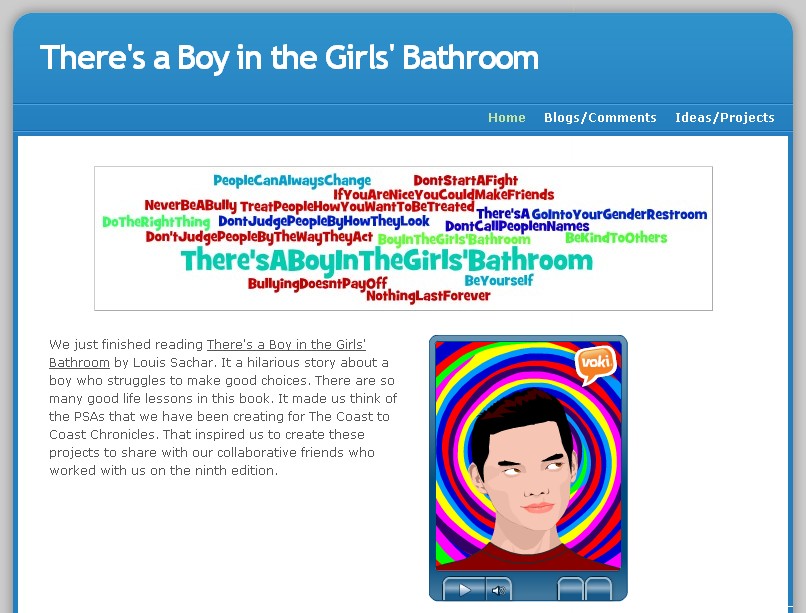
As my students were putting the finishing touches on their collaborative PSAs that they were creating with students from across the country, we were reading There's a Boy in the Girls' Bathroom by Louis Sachar. One of my goals this year is to bring more literature into our day in spite of our rigid schedule and prescriptive reading program. (See blog A Book in a Day) I select books that have high interest for the students in my class, that spur great conversations, and that reinforce the standards that we're studying. This book has many of the themes that that go along with the Coast to Coast Chronicles Edition 9's theme. The 200+ students wanted to create and collaborate on the theme of "Making a Difference." These PSAs were for The Coast to Coast Chronicles.

As we finished up our book, my learners asked if they could create different projects to go with the book that would also connect to their collaborative work on the Coast to Coast Chronicles. That's right...they asked to do these projects. They brainstormed all kinds of ideas about what they wanted to create. As with everything else, we only had a small amount of time that they could work on this project from start to finish. They wanted to publish "a digital poster that would hold their different projects." My first thought was that we would use Glogster. But after a few minutes, we discovered that it was blocked at school. One student said, "I wish we could just create a website or something." Great idea. That's when Weebly came to the rescue.

http://theresaboyinthegirlsbathroom.weebly.com/
Weebly is a free site (there is an upgraded paid version) that allows one to create websites. It has a very easy drag and drop interface that my students navigated very quickly. There are preset themes and templates to get you started. While two of my students started setting up the page for the class, the other students broke into pairs and began planning and writing their projects.

I conferred with each pair several times throughout this project. They knew that they were responsible for explaining what they were creating and why it supported the themes of the book and the Coast to Coast Chronicles. Several of them wanted to tell about the story and the themes through a certain character's point of view. After writing, and conferring with me, they decided that Voki would be a great way to publish this. (See blog on Voki). Another team wanted to use the camera and act out what they had learned from the book about bullying. They decided to publish is as a Voice Thread. Others wanted to write poetry. They wanted to create songs with their poetry. We pulled up Songify on my smart phone, they selected the music that they wanted to use, read their poetry into the phone and published their song.

http://theresaboyinthegirlsbathroom.weebly.com/
My learners were so excited about what they were creating because they felt like it was going to be a surprise to all of their collaborative Coast to Coast partners....a little something extra for this edition. Of all the tools used, the one that's holding it all together is Weebly. It may not be as flashy as a VoiceThread, Voki, or song, but without it my students' planning would have probably stopped short. It housed all of their creativity and supported so much learning. So although it probably won't be discussed much when the other students see our Weebly, my students know that it's the tool that made it all this student-directed learning possible.


Monday, October 31, 2011

The Transformative Power of Writing

Today, I want to tell you what I learned from a student that we'll call Thomas. At the beginning of the week, we read an article by National Geographic Kids entitled, "Jane Goodall's 10 Way to Help Save Wildlife." This interview with Jane Goodall tied in beautifully to the pieces that my students are writing with their collaborative partners in another state about how they can make a difference in the world.

This led to a great discussion about other ways we could make a difference in the environment. One student suggested picking up trash when they were at one of our local parks. She explained how it would improve not only the park for each of us, but also for the wildlife in the area. The rest of the class were chiming in their agreement when Thomas spoke up and said, "I don't roll like that. It can just stay there 'cause it doesn't bother me and I'm not touching someone else's mess." Many of his peers tried to persuade him otherwise, but he just crossed his arms and shook his head. We returned to our discussion.

A couple of days later, Thomas was sitting with me as we were conferring on his research and ideas for the piece he is preparing for our collaborative journal with the theme "Making a Difference." Each writer chose a topic that interested them. As we spoke about what he had discovered on his topic (for privacy reasons his topic will remain anonymous), I had a lot of difficulty getting him to focus. He set a plan of action and returned to work on his writing. While I conferred with my other students, I was constantly having to redirect him back on task, reminding him of the plan he had laid out for his project.

The next day, while we were working on our writing, he came running over to me with a shocking fact. Not only was he upset by it, but he had come up with several solutions. His focus changed; his pace accelerated. When it was time for lunch and I'm trying to get my students out of the door, he kept stepping in front of me to show me what he had written. Telling him that I would look at it after lunch or even during lunch wasn't good enough. He wanted me to read what he had put together right then.

I was amazed at his dedication and enthusiasm when the day before he was busy doing anything but this project. He was outraged with the injustice of his topic and he wanted to change something right then; he felt strongly that he needed to share it with me without delay. I agreed to confer with him while walking down the hall (we are one of the last classes served lunch...we cannot be late without some unpleasant consequences). As we walked and conferred, I marveled at how expertly and passionately he discussed his topic. When I asked him why this topic meant so much to him, he referred back to that shocking fact he had shared with me earlier. He explained how it made him think of something that had happened in his family. This experience made him re-evaluate some of his thinking. As he wrote, he examined ways that he could affect some change to make the world a better place.

After lunch, we had a guest come and lead my writers in an activity. She had them write letters to a community member who was away at basic training and missing his friends, family, and community. My students were very excited and wrote heartfelt letters. So what about Thomas? Was his new found determination to help make the world a better place a one time experience? After they had been writing for several minutes, Thomas spoke up, "I really like this. I think this is good for us to do because it's really going to make him happy. I fell good about it too." Hmm, I guess Thomas does "roll like that" after all. And what made the difference? Giving him the opportunity to learn and write about a topic that interested him. Writing has the power to help you explore, grow and change your thinking. Writing can transform who you are as a person as it did for Thomas.  I wonder what else he will roll with this year. There is no telling, but I can't wait to find out.

Sunday, September 25, 2011

A Tale of Two Tools

In a small school, not too far away, two tech tools hesitantly stepped into a classroom of excited fifth graders. The anxious fifth graders were sitting in pairs with net-books at their fingertips awaiting a new experience...one that could make them experts. The first tool, Lit2Go boldly stepped up first.


Lit2Go knew his power. He has hundreds of pieces of literature to share with the world. They are in print and MP3 and he can find what anyone needs whether by author, title, reading level, or subject matter. If those don't work, he also has the power to search by keyword. He's confident in his abilities to put quality literature into the hands of every student.

The students excitedly put Lit2Go to good use and found examples of 71 different fables to read, listen to and discuss with their partners.But where would these students put their new-found knowledge? That's when Lit2Go remembered his friend who had come into the classroom with him. He looked around and saw Lino-it waiting patiently for her turn.

Lit2Go called, "Hey, Lino-it! These kids need you. They have all of these new discoveries about writing in the fable genre, but they have nowhere to put all of this new knowledge. Can you help them?"

"You know, I'm the master of organizing important things. They can put post-it notes on me and I'll help them collaboratively build a wall that they can use day after day while they are writing," Lino-it confidently replied.

Together Lit2Go and Lino-it worked to help these fifth graders become experts at analyzing and creating fables of their own.The students loved that they had a plethora of fables to read and learn from. They were thrilled about how they could individualize the look and organization of their post-its on Lino-it, building their own tool to help them create fables for their collaborative fable anthology project.

At the end of class, Lit2Go and Lino-it gave each other a high-five, "Smack!" They knew that they had done their job and supported the learning and discovery of an amazing group of fifth grade students. These students were now fable-writing experts thanks to their support. They look forward to teaming up again whenever the need arises.They wave "good-bye" to the class as they set out in search of another class that may need their support.

The moral of this story is that powerful student learning is enhanced by quality tools like Lit2Go and Lino-it....so choose wisely.

(PS My students..who have discovered this blog...may point out that I missed a few of the characteristics that they discovered about fable writing in my little fable here. That's fine with me...they are the experts now.)

Tuesday, September 20, 2011

What is Writing?

I was recently sitting  in a grade level data meeting. As usual, I sit and listen, often keeping my comments to myself as my opinions and viewpoints are often counterproductive to the mission of the people driving these meetings. However, as the discussion turns to standardized testing, the comment was made that the students could not write as evidenced on the recent scores.   What they were calling writing is the portion where students answer an open-ended test question in reading or math. Yes, they physically have to use a pencil to compose an answer, but is that really writing?

I continued to sit and listen until I finally had to jump in.What they were describing is not writing unless you are calling the action of using a pencil to compose words on a page writing. Now don't get me wrong. My students do well on open-ended questions. I teach them a basic formula for answering this type of question that even my lowest of students can use with success.

When I expressed my opinion that what they were describing was not writing, I was met with confused faces. I honestly don't think they had ever thought about the true difference in the physical act and the craft. Unfortunately, the only "writing" that is given any credence is the writing that is done for standardized testing.

Not only was I irritated that they refused to listen, but I worried about the students who would never know the thrill of composing something that reaches others or helps them to explore who they are as people. What if students aren't given the opportunity to create something new and communicate it to others through their writing? Think about all of the ways that we write every day...mostly using a keyboard or touch screen. Students do it everyday through texting, messaging in games, blogging, Facebook, etc. Shouldn't they have the opportunity to learn how to amplify their voice through the written word at school?

This was still bothering me when my students and I returned to the classroom. So I asked them to explain through their blogs what writing is to them. It was not an assignment, just a request. I just wondered if my 10 year old students understood what teachers missed. Here are three examples of what I found:
I think we write so we can first of all learn. The only way we can learn certain things is by reading. Another reason we read and write is to express our feelings about different topics. Two more reasons that I think we write are to share our learned findings with other people and to explain how to do things. Everyone should write. ~LH
What is inspired writing?  Inspired writing is a good way to connect to your conscience. The hardest part of inspired writing is allowing the writing to happen instead of questioning what people will think about it. But how do I know my writing is true? It’s what speaks to me that’s true. When I write I think about what would interest my readers about this writing or what could make it better, but I also must be true to myself. I hope you begin writing with the intention to share your soul or the thoughts that amaze you.  ~KV 
When I write I like to express what I think about the question or the answers I write down.  Also, some grown ups don’t like to write anything even sometimes for work.  Writing is fun to me  because when you write you can express your feelings in it. That is why I like poetry. ~KA 
Do my students understand the importance writing? Is it more than the physical act of picking up a pencil or pen and putting it to paper? You can tell from these three examples (I could have put many more) that they each understand not only what writing is but also why we write.

I recently read that one of the biggest downfalls of students today is their inability to communicate. One of the biggest ways that we can communicate with one another is to write.. compose, create, explore. So no matter what age group or content area, please encourage your students to write. So even if you feel uncomfortable as a writing teacher, I hope that the quote below will give you something to think about.
We write because my teacher said so. We write to prepare for standardized testing. We write to explore who we are, to connect to those in the world around us, and to create something new.


Tuesday, September 6, 2011

An Update to the Reading Log Conundrum

A while back, I wrote about our school's nonnegotiable practice of requiring every student to complete a reading log and how I felt like it was counterproductive to a student developing a real love of reading. Here's the original post. Since then, I've had quite a few people question me about that blog and request an update.

As I wrote earlier, my students started off the year blogging. One of the expectations that my students designed was that their individual blogging would replace the dreaded reading log, among other things. In fact, most of them have taken to it like a fish to water. A few others have needed to have a bit of encouragement that their voices were important enough to be heard.

Now, I realize that I have a totally different set of students with totally different needs than my previous class. However, this is one of he most diverse classes that I've been fortunate enough to work with. With that in mind, I want to share with you what I've observed.

When my students complete an activity, project, or assignment, they are much more likely to pick up a book and read. Shortly after they've read a few minutes, they ask to use the computers so that they can blog. (As an aside, the students don't have to ask me to use the computers. It's a hang over from previous years.) When I finally asked one of my students about their willingness to read as often as he was, he said, "Well, in my last blog post, I told about what was happening in my book and made a prediction. Three people commented on my post and asked me questions. I had to find the answers so that I could answer their comments."

My students have discovered what has escaped so many, well-meaning educators: Having an interactive conversation about a book, even through writing, provides students a reason to read and write. It's so simple really. How many of want to share something great we've read with others? Isn't that what we see so much of on Twitter? How about all of the book clubs that people have? All of those speak to the fact that we like to talk about what we've read. We want to share our discoveries with others. It's real, it's relevant, and it's fun!

...and as a side note, I'm finding a ton of new books to read, all reviewed by my 5th graders!

So is it working? Absolutely! However, if at any time it doesn't work, my learners know that we will stop, have a discussion, find a solution, update our blogging expectations, and move forward. I love that my students have taken such ownership of their reading, writing, and blogging. It's exciting to see every day.

Wednesday, July 20, 2011

The Real 3D...No Glasses Required

This summer has been a hectic one for me....exciting, but hectic. I have been busy travelling to conferences and participating in activities to promote my new book, "Can We Skip Lunch and Keep Writing?" As I'm preparing to travel to D.C. for the National Boards for Professional Teaching Standards Conference, I am looking forward to many things: getting to speak with our congressmen about the importance of National Board Certification and education in Alabama, networking sessions to make new connections, learning new things to add to my educational knowledge, my presentation on Empowering Students, and a book signing. However, what I am most looking forward to would be getting to meet the people that I've been working with for over three years now.

People not involved in technology like twitter, blogs, Skype, or Second Life, think it's a bit strange that you have friends that you've never met. One person tweeted at the beginning of the ISTE conference whether they thought that face to face conferences would eventually become a thing of the past. That really got me to thinking. Would it? As I continued to ponder that thought, I had the opportunity to meet, for the first time, face to face, with five of the other seven teachers involved in the collaborative project where our students collaboratively publish The Coast to Coast Chronicles.

We made the time in our busy ISTE schedules to meet and chat over lunch. As we talked and brainstormed ideas for the next year, I kept thinking, "What an amazing group of women. They're smart, and funny, and compassionate." I loved just listening and watching their mannerisms and inflections. Of course, I already knew much of this from our planning times via Skype, TodaysMeet, and emails, but after meeting them those previous meetings seemed so two-dimensional. What was missing was that depth that you only get from face-to-face interactions.

Now don't get me wrong...technology opens up all kinds of worlds, connections, and collaborations, but sometimes I think we get so caught up on the possibilities, we lose sight of how important it is to make those personal face-to face connections. We need to keep that in mind when we are offering opportunities to our students. Technology does open up an infinite amount of opportunities for them and us, but nothing can replace actually touching a snake, receiving a pat on the back, or getting a high five when success is achieved.

So as we beginning planning for next year and we include all of our great collaborations made possible with technology, let's remember that our students also need a that three-dimensional, hands-on experiences that only we can provide for them.

Thursday, July 7, 2011

When is Enough...Enough?

I recently reflected on some of my ISTE2011 experiences, but I still have something rattling around that I feel I need to further explore. One of the things that I often hear from newbies to ISTE is the overwhelming volume of opportunities to learn and connect. One of the things that I love about ISTE is that there are so many ways to learn with and from so many other passionate educators from around the world.

As we connected and shared with one another, this year I noticed that a majority of what we were sharing were the tools and how they supported learning. I was thrilled that much more of the conversation was about the learning as this is what I passionately believe in.

However, this is often not reflected in the Exhibit Hall. Amanda Dykes did a great blog post about the misguided selling seen in so many of the vendors in this year's Exhibit Hall: It's easy and cool. Now, I realize that the exhibitors are the ones that sponsor the conference, but don't they need to hear from those of us who are in the classroom? My students would walk away from a booth and say, "That was fun, but I don't see how it's going to help me learn better." Now if 11 year olds get it, shouldn't exhibitors get it?

It's easy to get caught up in the newest, hardware or software. It's new and shiny and the salespeople are good at convincing you that your classroom is incomplete without their newest tool. We all enjoy new toys. But it's our job to really look at the tool and see if it really will improve the way our students learn or if it is just  a fun new tool to amass in our classrooms.

If you look at the ISTE NETS, you will see that technology plays a supporting role. It supports collaboration, innovation, creativity, and critical thinking. Technology doesn't do it for them. The focus is on the learner and how they use technology to support their learning across content areas and grade levels. We don't always need more "stuff." So many of the tools we use in the classroom that supports real, rigorous learning are free tools that are available online.

So the next conference that you go to, really listen to what someone is saying. Are they sharing something that will really positively impact your students' learning or are they trying to sell you on a new toy? Sometimes you already have enough in your classroom. Enough can really be enough.

Friday, July 1, 2011

ISTE Insights from Troublemakers

I've just arrived home from ISTE11 which was held in Philadelphia, PA this year. My experiences are probably much different than most of the other 20,000 educators in attendance as I travel with a group of my 5th grade students. For the last nine years, I've had the opportunity to bring a group of students to present their big technology project for the year. We count it as an honor to be invited to travel and share our experiences. However, even though we do attend the conference every day and attend sessions and workshops, having students with you changes your perspective on what you are seeing and learning. We always have great discussion and debates about how we can adapt and change our learning practices based on our new insights and learning. Yes, they are 11 year-olds and their insights are priceless.

The highlight of each ISTE for me is to see my students present their project (This year they shared our collaboratively produced, student-driven journal). Yes, THEY do all of the presenting. They begin working on their presentation and public speaking skills in February. They design and create the look of their display. Knowing that many of the students that attend each year are students who have overcome great obstacles to find personal and academic success is fulfilling. Hearing all of the comments from the 400+ visitors to their presentations is gratifying for me because they see the value in what my students have to say. My students exude confidence and enthusiasm for their topic because it is THEIR project...not mine. 

My students soak up all of the praise, the questions, the encouragement that visitors to their Student Showcase offer. At the end of their presentation day, after they've had time to reflect on their day, we all share how we've grown as people due to this experience. My students shared that they realize how important their presentation was to all of the students who had teachers attend their session. They said that because of them, other students from around the world may have the opportunity to do collaborative projects, create new projects to support their learning, and design their own learning path.

They were thinking about other students. They proudly wore the "Troublemaker" ribbons on their ISTE badges and explained to anyone who asked that they were troublemakers because they want education to change and they weren't afraid to fight for it. They know the importance of learning supported technology and the power of students making decisions about how and what they learn.

So I want to thank all of you who came by and lent your ear to their presentation. That day my students grew up. Through your words of encouragement, praise, and challenge, my students are more driven than ever to change the face of education. After all, it's their education. Don't all of our students need a voice in the direction that it goes?